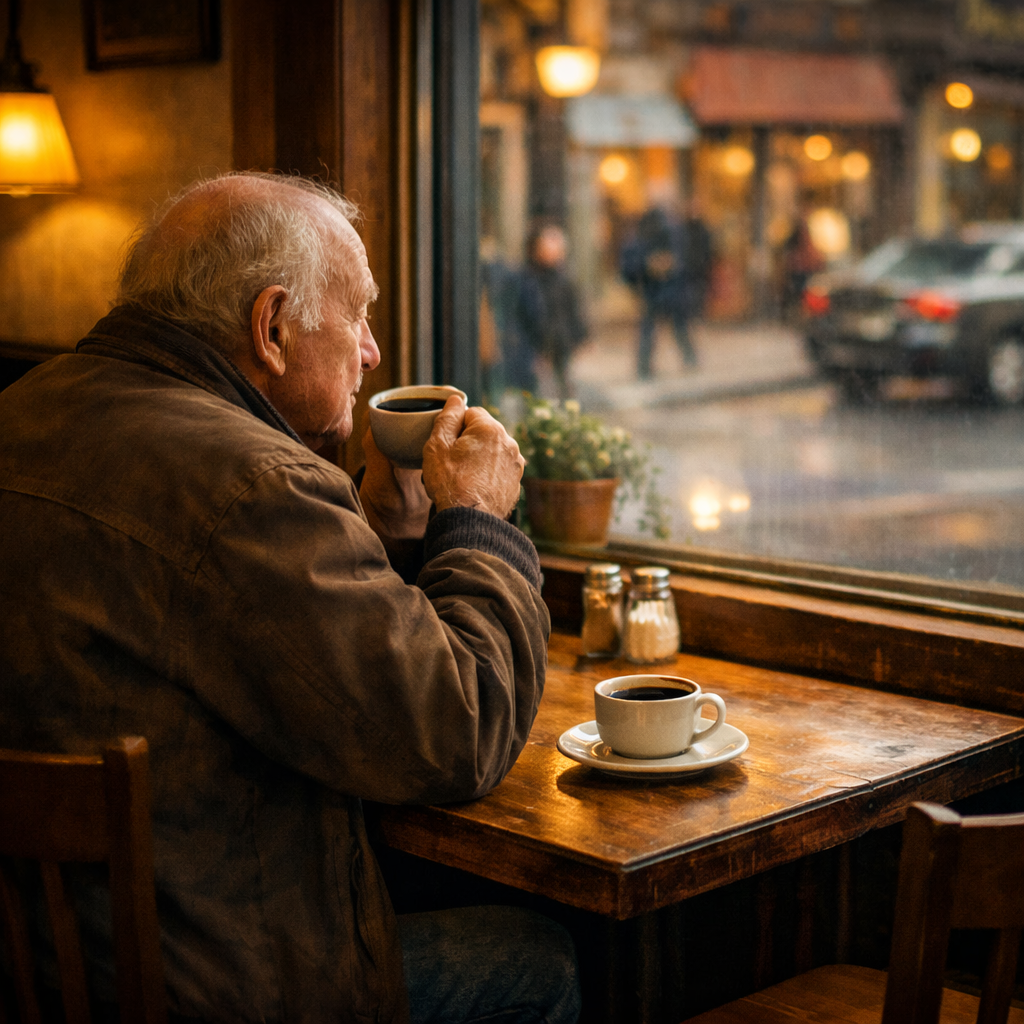
I run a small café on the corner of Maple and Third.
It’s not fancy. Just a few wooden tables, warm lighting, and the kind of place where regulars feel like family.
That’s why I noticed him the first day he walked in.
He was older — maybe late seventies. His coat was worn at the sleeves, his shoes scuffed. He walked slowly but with dignity.
He ordered the cheapest thing on the menu: a small black coffee.
Then he sat at the table near the window.

For three hours.
He didn’t scroll on a phone. Didn’t read a book. He just sat there, occasionally watching people pass by outside.
The second day, he came again.
Same coffee.
Same table.
Same three hours.
By the end of the week, some customers began whispering.
“He’s taking up space.”
“If he’s only buying coffee, he shouldn’t sit that long.”
“Is he homeless?”
But something about him didn’t feel intrusive.
He always said thank you. Always cleaned his table before leaving. Always left a few coins as a tip — even when I could tell that coffee was probably stretching his budget.
So I let him stay.
One afternoon, when I brought his coffee, I added an extra slice of bread.
He looked up at me.
“I didn’t order this,” he said gently.
“It’s on the house,” I replied.
He hesitated — then nodded. “Thank you.”
The next week, I added a small bowl of soup.
Then sometimes dessert.
He never asked for anything more than that coffee.
He never complained.
He just sat quietly, like the café was the only place he felt safe.
Over time, I learned his name was Walter.
His wife had passed two years earlier.
“I don’t like the house when it’s quiet,” he once told me. “Here, there’s life.”
That sentence stayed with me.
He wasn’t coming for food.
He was coming for noise. For warmth. For the feeling of not being alone.
Then one day, he didn’t show up.
I told myself maybe he was sick.
The next day, still nothing.
A week passed.
Then two.
I caught myself glancing at the door every afternoon at exactly 2:15 p.m. — the time he always walked in.
A month later, a woman about my age entered the café.
She looked around like she was searching for something.
“Are you the owner?” she asked.
I nodded.
“My father used to come here. Walter.”
My stomach dropped.
“He hasn’t been in for a while,” I said quietly.
She smiled sadly.
“He passed away last month.”
The words hit harder than I expected.
“I’m so sorry,” I said.
“He talked about this place constantly,” she continued. “He called it his ‘second living room.’”
She reached into her bag and pulled out an envelope.
“He left this for you.”
My hands trembled slightly as I opened it.
Inside was a handwritten letter.
It read:
To the kind café owner,
You may not realize this, but you gave me more than coffee. After my wife died, the days became very long. I didn’t want to burden my daughter. I didn’t want her to see how lonely I was.
Your café gave me something to wake up for. The extra bread, the soup — I knew it wasn’t random. You saw me. At my age, that matters more than anything.
Thank you for letting an old man take up space.
— Walter
There was also a small check.
Not a huge amount, but more than he had ever spent in my café.
“For the kindness fund,” his daughter said softly. “He wanted you to use it to help someone else who might need a place to sit.”
I had to turn away for a moment to steady myself.
After she left, I walked to the window table — his table.
The chair was empty.
But it didn’t feel empty.
The next week, I put up a small sign near that window:
“If you need a warm place to sit, you’re welcome here.”
No minimum purchase required.
Since then, a few people have taken that seat.
A college student studying between jobs.
A widow who brings knitting.
A man who just needed quiet.
And every time I bring them coffee — sometimes with a little extra bread — I think of Walter.
He came in every day and ordered the cheapest thing on the menu.
Some people thought he was taking up space.
But he taught me something simple and powerful:
Sometimes the most valuable thing you can give someone isn’t food.
It’s permission to not feel alone.
And sometimes, the quietest customers leave the loudest impact.
Part 2
The Table by the Window — What Happened After Walter
After Walter’s daughter left, I sat at his table for a long time.
The afternoon light was pouring through the window just like it had every day he came in. People walked past outside, cars rolled by, and the café hummed with quiet conversations.
For the first time, I realized something.
Walter hadn’t just been sitting there.
He had been watching life continue.
Maybe that’s what people do when they lose someone they love. They come somewhere where life is still moving — just to remind themselves they’re still part of it.
The next morning I placed a small jar on the counter.
I wrote three simple words on it:
“Walter’s Kindness Fund.”
At first, only a few dollars went in.
A regular dropped a five.
Another customer added some coins.
Then one afternoon, a young mother quietly slipped in a twenty and said, “For someone who needs it.”
Within weeks, the jar started to fill faster than I expected.
And something else began to happen.
People started talking to each other more.
The college student studying near the window began chatting with the widow who knitted scarves.
The quiet man who came in on rainy days started helping an elderly customer carry her tray.
The café felt… different.
Warmer.
Like Walter had left behind more than a memory.
One evening, just before closing, a teenage boy came in. His backpack looked heavy, and he seemed nervous.
He glanced at the sign near the window.
“If you need a warm place to sit, you’re welcome here.”
He sat down slowly.
I brought him a cup of hot chocolate and a sandwich.
He looked surprised.
“I didn’t order this,” he said.
I smiled.
“It’s from the kindness fund.”
He stared at the cup for a moment and then whispered, “Thank you.”
As I walked back behind the counter, I glanced at the window table.
For a split second, I could almost imagine Walter sitting there again — coat sleeves worn, hands wrapped around a cup of coffee, quietly watching the world go by.
He never asked for attention.
He never asked for help.
He only needed a place to exist without feeling invisible.
And somehow, that small daily act of sitting at a window table changed an entire café.
Sometimes people think kindness has to be big to matter.
But Walter proved something else.
A cup of coffee.
A quiet seat.
A little bread.
A simple “you’re welcome here.”
Those small things can echo far longer than we realize.
And even now, every afternoon around 2:15, I still look at the door.
Not because I expect Walter to walk in.
But because his presence never really left.
It lives in every person who sits by that window and realizes — even for a moment — that they’re not alone.