While stuck on my military base, I got word that my 82-year-old mother needed an emergency ride to the hospital. I immediately video-called my husband for help, only to see another woman wrapped in his arms. He looked me dead in the eye and said, “That’s not my problem. Figure it out.” I calmly replied, “Okay.” The very next day, he tried calling me 38 times.
Part 1: The Call He Refused
My husband looked straight into the camera while another woman rested against his chest, and for one terrible second, all I could hear was rain tapping the narrow window beside my desk. Behind them was my living room: the faded blue quilt my mother had sewn, my father’s brass reading lamp glowing in the corner, and the framed photo from my last promotion ceremony on the mantel.
The woman’s bare feet were tucked beneath her, her fingers resting casually against my husband’s shirt as if she belonged there.
“Evan,” I said, forcing my voice steady. “My mother collapsed. She has chest pain, and I’m trapped on base. I need you to drive her to the hospital.”
Evan Carter did not sit up. He did not ask whether she was conscious or how quickly he needed to leave. He glanced at the woman beside him, sighed, and looked back at me like I had interrupted his evening.
“That’s not my problem,” he said. “Figure it out.”
The woman lowered her eyes, but she did not move away from him.
Twenty-two years in the Army had taught me how to work through alarms, failed plans, storms, evacuations, and people panicking around me. Nothing had prepared me for the calm on my husband’s face while my eighty-two-year-old mother lay helpless on her kitchen floor.
“Okay,” I said.
Then I ended the call.
My name is Clara Carter. I was forty-five then, a logistics officer stationed at Fort Briar near the Kentucky–Tennessee border. I had been married to Evan for almost eighteen years, long enough to believe I knew every version of him.
I was wrong.
That Tuesday had started with burnt coffee and transport schedules. By late afternoon, a security incident placed the installation under temporary lockdown. No one could leave without direct authorization.
At 6:42 p.m., my mother’s neighbor, Mrs. Nolan, called, breathless with panic.
“Clara, your mother is on the kitchen floor. She keeps saying her chest feels tight.”
My mother, Margaret Lowe, had lived alone since my father died. She was stubborn, proud, and fiercely independent. At eighty-two, she still clipped her roses, carried groceries, and said paying someone to clean a good house was “how people forgot they had hands.”
“I’m coming,” I told Mrs. Nolan.
But I could not leave.
My commander tried to help, but the gates were locked until security cleared the incident. That was when I called Evan. Our house was less than thirty minutes from my mother’s. He knew her spare key, the hospital entrance, and how frightened she became in emergency rooms.
Yet he chose the woman on my couch.
After the call, I searched for anyone else. My cousin was traveling. My mother’s closest friend no longer drove after dark. Her pastor was leading service. Mrs. Nolan was nearly seventy-nine and too frail to lift her.
“She’s getting weaker,” Mrs. Nolan whispered when I called again. “She keeps saying not to make a fuss.”
Then I remembered Arthur Reed, a retired mail carrier who had delivered in my mother’s neighborhood for almost thirty years. He still visited her with tomatoes, peaches, or something he had repaired in his garage.
I found his number in Mom’s emergency file.
He answered on the second ring.
“Clara? Everything all right?”
“No,” I said, my voice breaking. “Mom collapsed. I can’t leave base.”
No hesitation.
“I’m on my way.”
Twenty-five minutes later, Mrs. Nolan called again.
“He’s here.”
Through the phone, I heard Arthur opening the front door.
“All right, Margaret,” he said calmly. “We’re going to the hospital.”
“I don’t want to bother anybody,” Mom protested weakly.
Arthur chuckled. “You’ve been bothering me since I had dark hair. One more evening won’t hurt.”
Forty-eight minutes later, a doctor from Mason Ridge Medical Center called.
My mother had suffered a mild heart attack.
“She’s stable,” the doctor said. “Mr. Reed brought her in at the right time. Another hour could have caused far more damage.”
Another hour.
When the call ended, I cried silently in the hallway beside a humming vending machine. A young sergeant passed, disappeared, then returned with fresh coffee and set it beside me without asking questions.
At 9:11 p.m., I checked my accounts to make sure I could cover Mom’s recovery costs.
A credit card charge sat near the top of the screen.
Riverton Chophouse. $218.63.
It had been processed at 7:18 p.m., while Arthur was helping my mother into his truck.
Dinner for two. Wine. Dessert.
Evan never called to ask whether she survived.
I turned off my phone, stared through the rain-streaked window toward the runway lights, and understood my marriage had not ended because of the woman beside him.
It ended because when someone I loved was fighting for her life, Evan showed me exactly who he was.
This time, I intended to believe him.

Part 2: Protected Assets
I woke before dawn to my phone vibrating against the metal nightstand.
For one frightened moment, I thought the hospital was calling.
Instead, I saw thirty-eight missed calls from Evan, twenty-one voicemails, and more texts than the notification bar could count.
The first message arrived shortly after midnight.
Clara, answer me.
Then came anger.
What did you do? This isn’t funny. Call me immediately.
By three in the morning, his tone changed.
Please call me. Something is wrong with the accounts. I don’t understand what is happening.
The final voicemail sounded like a stranger.
“Clara, please. Just answer once.”
I ignored him and called the cardiac unit. A nurse said Mom had slept, her blood pressure had stabilized, and she had complained twice about the oatmeal, which the nurse considered a good sign.
When Mom came on the phone, her voice was tired.
“They’re trying to kill me with breakfast.”
I laughed for the first time since the emergency began.
“You had a heart attack, and you’re criticizing oatmeal?”
“I can do both.”
Then she asked, “What happened with Evan?”
“I’ll tell you when I get there.”
“You don’t have to protect me from the truth.”
“I know.”
Twenty minutes later, Evan’s mother, Judith Carter, called.
“Clara, what exactly did you do?”
I stirred powdered creamer into my coffee. “What are you talking about?”
“Evan called before sunrise. His card was declined at a gas station. He says he can’t access several accounts.”
“I didn’t freeze everything.”
“What did you do?”
“I protected what belongs to me.”
“Is this because of an argument?”
“No.”
“Then what happened?”
“Ask your son where he was when my mother had a heart attack.”
Silence.
Judith knew my mother. She had eaten at her table, accepted Christmas gifts from her, and praised her pecan pie at Thanksgiving.
“What do you mean?” she asked.
“Ask him.”
Then I ended the call.
I had not spent the night inventing revenge. I had simply used protections that had existed for nearly a year.
After my father died, Mom and I spent months sorting insurance records, property documents, retirement accounts, and old tax files. During that process, my attorney, Dana Cole, convinced me to organize my own affairs.
With her help, I created a revocable trust. My father’s lake cabin went into it. So did investments I had built before marriage, my share of our residence, and the consulting company I planned to start after retirement.
Evan had been invited to every meeting.
He never attended.
“You’re better at paperwork,” he always said. “Just tell me where to sign.”
He signed forms without reading them, used cards linked to accounts where he was only an authorized user, and bragged about the lake cabin as though he had bought it.
I never lied.
Evan simply never asked questions unless the answers benefited him.
After ending the video call, I opened Dana’s secure portal. I revoked Evan’s authorized-user status on two accounts held solely in my name, redirected my military pay to an individual account, and authorized Dana to file the divorce petition we had prepared months earlier when I first suspected Evan was hiding something.
I had not been certain about the affair then. There had been late meetings, unexplained truck mileage, restaurant charges, and his new habit of placing his phone facedown whenever I entered.
Each clue had an explanation.
I wanted to believe him, so I accepted answers that never fit.
The woman on my couch ended the uncertainty.
During lunch, Dana called.
“The petition has been filed,” she said. “The trustee confirmed the access changes.”
“So Evan can’t use those cards?”
“Not the ones tied to your separate assets. The household checking account remains available, but your deposits are protected.”
“I don’t want anything that belongs to him,” I said. “I just don’t want him spending what my father left me while he takes another woman to dinner.”
Dana’s voice softened.
“Clara, you are not punishing him. You are stopping him from benefiting from your silence.”
By late afternoon, Evan’s messages grew desperate. The grocery card failed. His truck payment had not processed because the account he normally used no longer contained my salary. The lake cabin reservation he had promised someone was no longer available through the family calendar.
Then he left a message that tightened my stomach.
“You can’t do this to me, Clara. Half of everything you own is mine.”
He was wrong.
By the end of the week, he would discover how little he had bothered to learn about the life he claimed to control.
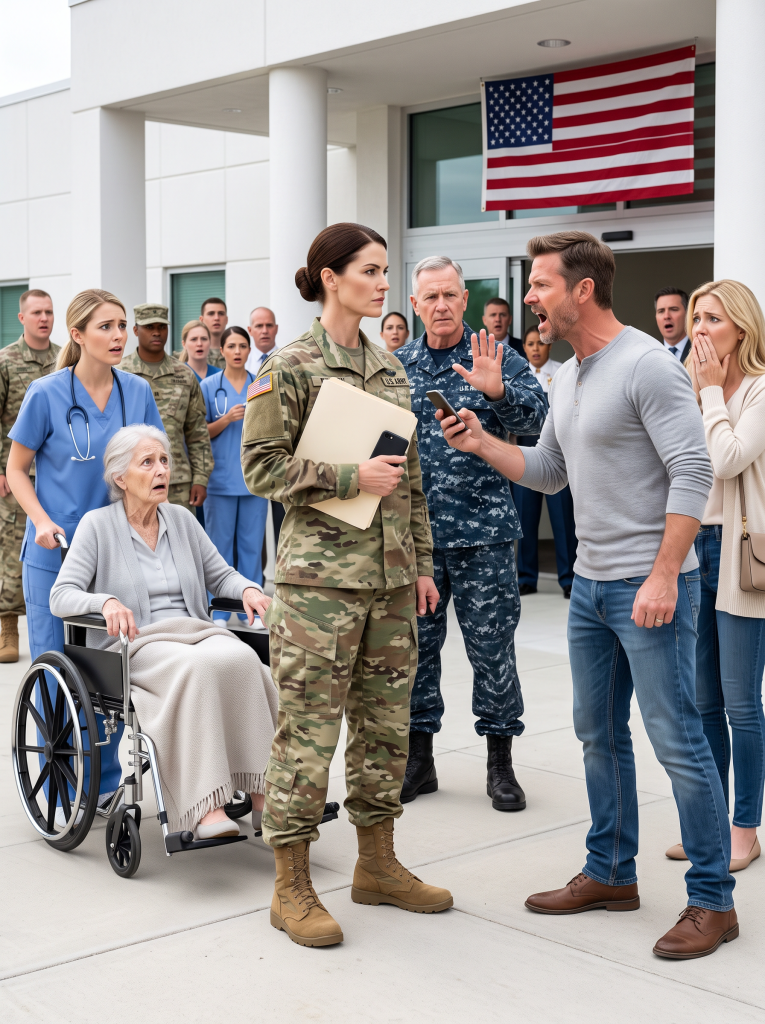
Part 3: The Story Collapses
For three days, I answered calls only from the hospital, Mom, Arthur, and Dana.
The silence felt unnatural.
For eighteen years, I had returned every call, paid every bill, remembered every birthday, and repaired every uncomfortable situation before anyone else had to feel responsible.
When Evan forgot his mother’s anniversary, I bought the flowers. When he spent too much before a truck payment, I moved money. When he insulted someone at dinner, I explained he was tired.
I had confused keeping peace with maintaining a marriage.
Now I stopped rescuing him, and his life began leaning sideways.
On Friday, Arthur called.
“Your mother is improving,” he said. “She argued with a nurse about how to fold a blanket.”
“That means she’s almost recovered.”
He hesitated. “I also saw Evan.”
My grip tightened. “Where?”
“At your mother’s house. He stood on the porch with flowers and knocked for five minutes.”
“Did Mom answer?”
Arthur laughed softly. “She looked through the curtain, saw him, and turned up the television.”
“She really did that?”
“She certainly did. He stayed almost twenty minutes. Those flowers looked expensive.”
Expensive apologies were one of Evan’s specialties. He believed discomfort could be purchased away: jewelry for a forgotten birthday, dinner for a cruel remark, a weekend trip for a broken promise.
The gifts were rarely about the person receiving them. They were tickets back into comfort.
“What happened to the flowers?”
“Your mother told me to put them beside the trash.”
That evening, Dana called.
“Evan hired an attorney. His attorney requested copies of the trust and property records.”
“What happens now?”
“We provide what the court requires.”
I heard amusement in her voice.
“What aren’t you telling me?”
“His attorney initially described the case as a division of substantial marital assets. After reviewing the preliminary documents, he requested a second meeting with Evan.”
The house we lived in had a marital portion, but I had provided the down payment from inheritance and retained a documented separate interest. The cabin belonged entirely to the trust. My retirement and investment accounts had clearly maintained premarital and marital portions. Evan had his salary, retirement account, and debts he had hidden from me.
Reality was introducing itself.
The next morning, Judith called again.
“Evan came to my house at six.”
“What did he want?”
“Money.”
“He has access to the household account.”
“Apparently, he spent most of it.”
“On what?”
“He wouldn’t tell me.”
Of course he would not.
Judith sighed.
“I asked him why you filed for divorce without confronting him first. He said the Army made you cold.”
“And did you believe him?”
“At first,” she said honestly. “Then I asked where he was when your mother got sick.”
“What did he say?”
“Nothing.”
Neither of us spoke for several seconds.
Judith’s voice lowered.
“I know my son. When he refuses to answer a direct question, it usually means the truth makes him look worse than the lie.”
It was the first time anyone in his family had admitted that possibility.
“I’m sorry about your mother,” she added. “I should have asked that first.”
On Monday, the lockdown ended, and I received five days of emergency leave. Halfway home, an unfamiliar number appeared on my phone.
I almost ignored it.
Instead, I answered.
“Is this Clara?”
“Yes.”
“My name is Serena Blake.”
The woman from my couch.
Her voice sounded younger than I expected, nervous and thin.
“I didn’t know Evan was still married,” she said.
“He told you we were separated.”
“Yes.”
“That the divorce was almost finished.”
“Yes.”
“And that he owned several properties.”
She went quiet.
“He promised we would spend the summer at the lake cabin.”
“That cabin belonged to my father.”
“I know that now.”
“Why are you calling?”
Serena swallowed. “Because my parents loaned Evan fifteen thousand dollars.”
“For what?”
“He said he needed temporary funds while an investment cleared. He showed them photos of the cabin and your house.”
“Did they give him the money?”
“My father did. Now he wants it back.”
There it was.
She was not calling because guilt had awakened. She was calling because Evan’s promised future collapsed.
Still, she surprised me.
“I packed my things this morning,” she said. “And I sent your attorney every message Evan ever sent me.”
My phone chimed while she spoke.
Dana had forwarded an email with screenshots: dates, photos, hotel confirmations, promises.
The affair had lasted nine months.
As I returned to the highway, one thought settled over me.
The video call had not destroyed my marriage.
It had only switched on the light.

Part 4: Mom Comes Home
My mother sat beside the hospital window when I arrived, wearing a pale blue robe and holding the morning newspaper. Sunlight fell across her silver hair, making her look smaller than I remembered, but when she saw me, her whole face changed.
“There you are.”
I crossed the room and held her.
She smelled of hospital soap, peppermint lotion, and the lavender powder she had used for as long as I could remember.
“You look tired,” she said.
“I’ve had a difficult week.”
“I wasn’t talking about your face. You forgot to color your gray hair.”
“Thank you, Mom.”
“I raised you. Keeping you humble is part of the job.”
Her cardiologist said the damage had been limited. She would need medication, regular checkups, lighter meals, and fewer arguments with people who suggested she slow down.
“I don’t argue,” Mom said.
The doctor smiled. “You argued with me twice this morning.”
“I was explaining.”
The next day, I drove her home. We stopped at a small diner where my father used to take us after church. Mom ordered grilled cheese and tomato soup, then said the hospital had lowered her food standards.
Outside her brick house, Arthur stood on a ladder replacing the porch light.
“I figured you two had enough to worry about,” he said.
“You’ve done too much already,” Mom told him.
“I haven’t collected payment.”
“What payment?”
“Two pecan pies before Thanksgiving.”
“One pie,” Mom said. “You damaged your negotiating position by asking for two.”
Inside, I unpacked groceries while Arthur checked the smoke detectors and Mom settled into her recliner. The house sounded like childhood: refrigerator humming, floorboards creaking, the old clock ticking too loudly.
Mom watched me place soup cans in the pantry.
“Tell me about the woman.”
“Her name is Serena. She says Evan told her we were separated.”
“And do you believe her?”
“I believe he lied to her.”
“That wasn’t my question.”
I closed the cabinet. “I think she believed what was convenient until it stopped being convenient.”
Mom nodded. “That sounds fair.”
“She sent evidence to my attorney.”
“Good.”
“She left him too.”
Mom raised an eyebrow. “How do you feel about that?”
“I don’t know.”
“That usually means you feel several things and don’t like any of them.”
I sat across from her.
“I’m angry she sat in my house. I pity her because Evan lied. I resent that part of me is relieved she exposed him. And I hate that I’m thinking about either of them when you nearly died.”
Mom took my hand.
“You are allowed to feel more than one thing.”
Then she asked, “Do you hate Evan?”
“No.”
“What do you feel?”
I thought about it.
“I don’t think I know him anymore.”
Her fingers tightened around mine.
“Then stop trying to understand the version of him that never existed.”
That afternoon felt almost peaceful. I watered the roses, changed sheets, and prepared meals Mom could reheat.
Then Dana called.
“Evan filed his response.”
“What is he claiming?”
“That your military career caused the breakdown of the marriage.”
I looked through the kitchen window at my uniform hanging inside the SUV.
“He’s blaming the Army?”
“He says you emotionally abandoned him through deployments, training, and career obligations.”
For years, Evan had praised every promotion. He introduced me at parties as “my wife, the major.” He posted ceremony photos and accepted compliments as if my service reflected on him.
Now the same career had become his defense.
“There’s more,” Dana said. “He hired a private investigator.”
“To investigate what?”
“You.”
Evan had already lied about my marriage, property, and devotion to family.
Now he intended to search my life for something he could turn into a weapon.
But he had forgotten a rule of logistics.
Before starting an operation, always know what the other side has documented.

Part 5: Evidence Is Quieter Than Lies
Evan’s investigator followed me for four days.
He was not very good.
On Tuesday, a gray sedan sat across from Mom’s house for three hours. On Wednesday, the same driver appeared outside the pharmacy pretending to read a newspaper upside down.
By Thursday, Arthur waved whenever he saw him.
“Should I invite him in for pie?” Arthur asked.
“No.”
“Coffee?”
“No.”
“A lesson in surveillance?”
I laughed despite myself.
Evan seemed convinced I was hiding something: another man, secret accounts, or a private scandal that would make his betrayal look reasonable.
Instead, the investigator documented the ordinary.
I drove Mom to cardiology. Bought low-sodium groceries. Picked up prescriptions. Sat on her porch with Arthur and Mrs. Nolan. Returned work calls. Organized medical papers at the kitchen table.
If Evan wanted proof of emotional abandonment, he had hired someone to record my devotion.
Meanwhile, he contacted relatives, telling them I had chosen the military over marriage, become controlling with money, and abandoned him without warning.
For a brief time, people believed him. Evan knew how to lower his voice, stare at the floor, and make failures sound like wounds caused by someone else.
I did not call anyone to defend myself.
Truth presented too early often sounds like competition. I let Evan talk until he grew careless.
On Saturday morning, Arthur arrived with tomatoes and gossip.
“I saw Evan outside the community bank,” he said. “He told three people Clara left because she cared more about soldiers than family.”
“What did you do?” I asked.
“I said, ‘That’s strange. When Margaret had a heart attack, Clara was trapped behind a locked military gate, and I drove her to the hospital while Evan was busy somewhere else.’”
“What did Evan say?”
“Nothing. He left.”
Mom laughed so hard she had to hold her chest.
By Sunday afternoon, casseroles began arriving. Neighbors brought cornbread, soup, and hugs. Small towns spread cruelty quickly, but they also remember patterns.
People remembered seeing me mow Mom’s lawn on leave, drive her to appointments, clean gutters, fix faucets, and sit beside her at church after Dad died. They remembered Arthur checking on her and Mrs. Nolan bringing in the newspaper.
When they searched their memories for Evan, many realized he rarely appeared unless a holiday meal was involved.
The next afternoon, the private investigator approached me in a grocery store parking lot.
“My name is Daniel Ross,” he said. “I was retained by your husband. I’m ending the assignment.”
“That’s between you and Evan.”
“There’s something you should know. He asked me to find evidence of an affair.”
“I’m not having one.”
“I’m aware.”
He looked embarrassed.
“He also asked whether there was a legal way to make your mother appear mentally incompetent so he could challenge decisions related to the trust.”
For the first time in days, anger burned cleanly through my exhaustion.
Evan had moved beyond protecting himself. He was willing to attack an eighty-two-year-old heart patient to reach property that had never belonged to him.
I thanked Daniel, loaded my groceries, and called Dana.
Until then, I had wanted a quiet divorce.
Evan had just ensured every conversation from that moment forward would happen through lawyers, records, and witnesses.
He had mistaken restraint for hesitation.
That mistake was about to become expensive.
Part 6: The Settlement Table
Our preliminary settlement conference took place on the second Thursday in November. The courthouse smelled of floor polish, old paper, and burnt coffee. The room had beige walls, fluorescent lights, and untouched water bottles.
Evan was already seated when Dana and I entered. He looked worn rather than remorseful. His expensive watch was gone, and his polished jacket had been replaced by a wrinkled shirt.
For nearly an hour, the attorneys discussed disclosures, property classifications, debts, and retirement calculations.
Then Evan’s attorney cleared his throat.
“My client maintains that Major Carter’s military obligations created prolonged emotional separation and contributed significantly to the collapse of the marriage.”
Dana opened a folder.
“We would like to address that claim through the documented timeline of October seventh.”
Evan shifted.
“At 6:42 p.m.,” Dana said, “Major Carter received a call that her eighty-two-year-old mother had collapsed with chest pain.”
She turned a page.
“At 6:51 p.m., Major Carter requested emergency release from Fort Briar, which could not be approved because of an active lockdown.”
Another page.
“At 6:58 p.m., she initiated a video call to Mr. Carter, who was approximately twenty-six minutes from Margaret Lowe’s home. At approximately 7:03 p.m., Mr. Carter refused to assist.”
Evan stared at the table.
“At 7:18 p.m., Mr. Carter used a card linked to Major Carter’s separate account to purchase dinner for two at Riverton Chophouse.”
The room went quiet.
“At 7:46 p.m., Arthur Reed transported Mrs. Lowe to Mason Ridge Medical Center. Medical records confirm the speed of arrival reduced the likelihood of more serious heart damage.”
Evan finally looked up.
“They’re twisting what happened.”
His attorney’s pen stopped.
Dana remained calm.
“Which portion is inaccurate?”
“I didn’t know it was a heart attack.”
“You were told she had collapsed with chest pain and needed immediate transportation.”
“I thought someone else would handle it.”
“Who?”
Evan opened his mouth, but no answer came.
Dana placed another document on the table.
“We also have a sworn statement from the private investigator Mr. Carter retained.”
Evan’s head snapped toward his attorney.
Dana summarized the report, including Evan’s request to find grounds for portraying Mom as mentally incompetent.
“That’s not what I said,” Evan protested.
The mediator raised a hand.
“You will have an opportunity to respond.”
“I was trying to understand the trust,” Evan said.
“By attacking my mother?” I asked.
It was the first time I had spoken directly to him.
For one second, I saw the man I remembered: the man who waited at an airport after deployment, danced with me in the kitchen, and promised my father he would protect our family.
Then he was gone.
“You shut me out of everything,” he said.
“No. You chose not to pay attention.”
“You planned this.”
“I prepared legal documents after my father died. You were invited to every meeting.”
“You knew this could happen.”
“I knew life could happen. I didn’t know you would be sitting with another woman while my mother fought for her life.”
The mediator called a break.
In the hallway, Judith stood near the courthouse windows with a folded tissue.
“Clara,” she said. “I read the timeline.”
I said nothing.
“When Evan told me you abandoned him, I believed him because he is my son.”
“I understand.”
“No,” she said, voice cracking. “You should not have to understand.”
She wiped her cheek.
“I raised him to know better. Margaret fed him at her table. She treated him like family.”
“She did.”
“I’m sorry.”
I squeezed her hand.
“This was not your decision.”
“No,” she said. “But I have to live knowing it was his.”
When the meeting resumed, Evan’s attorney requested a private conference. They returned twenty minutes later.
Evan looked frightened.
His attorney placed both hands on the table.
“My client is prepared to discuss settlement.”
Dana opened our proposal.
I would retain all separate assets and trust property. The marital portion of the home would be divided by documented contributions. Each person would keep individual retirement funds and remain responsible for personal debts.
I requested no spousal support.
Evan frowned. “That’s it?”
“That’s it,” Dana said.
“I thought she was trying to destroy me.”
I looked at him.
“I never wanted to destroy you. I wanted a husband I could trust.”
For once, Evan had no explanation.
Part 7: The Quiet Ending
Several weeks later, a judge approved the settlement. The hearing lasted less than twenty minutes.
No reporters. No speeches. No crowd outside.
Real endings are often quieter than the disasters that create them.
The judge reviewed the papers, asked several questions, and signed the order.
Eighteen years of marriage ended with the scratch of a pen.
On the courthouse steps, Dana shook my hand and told me I had handled everything with remarkable composure.
“I didn’t feel composed.”
“Most strong people don’t feel strong while surviving something.”
Arthur waited in the parking lot in his old white pickup.
“So?”
“It’s over.”
“Good. Get in. Your mother made pie.”
At Mom’s house, pecans, butter, and cinnamon filled the kitchen. Arthur carried vanilla ice cream, calling it the most important part of dessert.
Mom pointed a wooden spoon at him.
“I made the important part.”
For one evening, no one mentioned Evan. We talked about Thanksgiving, football, Arthur’s damaged mailbox, and Mom’s plan to garden before her doctor approved it.
“I survived a heart attack,” she announced. “I’m not going to be defeated by tomato plants.”
After Arthur left, Mom and I washed dishes.
“Your father used to say something,” she told me.
“What?”
“When people show you who they are, believe them the first time.”
“Dad was smart.”
“Irritatingly smart.”
Then she asked, “Do you forgive Evan?”
I thought carefully.
“No.”
Mom nodded.
“I don’t spend every day wishing him harm,” I said. “I hope he eventually understands what he did. But forgiveness would not restore trust, and I refuse to pretend the damage was smaller than it was.”
“That sounds honest.”
“He chose himself when you needed him. Then he lied, blamed my service, and tried to use your health against me. I can release the anger without reopening the door.”
Mom touched my arm.
“That is not bitterness. That is a boundary.”
In the months after the divorce, I heard occasional news about Evan. Serena’s father sued him for the fifteen thousand dollars. He sold his truck to cover part of the debt. He moved into a small apartment and took extra contract work.
Judith called once to say he had started counseling.
“I thought you might want to know.”
“I hope it helps him.”
“Would you ever speak to him?”
“No.”
The answer came easily.
By spring, Evan’s life no longer occupied much space in my thoughts.
I retired from the Army eight months after the divorce. The ceremony took place at Fort Briar on a cool morning under a white sky. Soldiers I had mentored stood in formation. Friends from earlier assignments came.
My commander presented my retirement flag.
“Major Carter, thank you for twenty-three years of service.”
I accepted it with both hands.
For years, my identity had been tied to schedules, missions, uniforms, and the certainty I could be sent elsewhere.
Now home meant permanence.
I moved into the lake cabin my father left me. It was not large. The porch leaned toward the water, the cabinets needed paint, and the dock complained on the third board.
But every morning, sunlight moved across the lake like silver glass.
Mom visited most weekends. Arthur came often enough that I gave him his own coffee mug. He repaired the dock, argued with Mom about fertilizer, and brought vegetables from his garden.
One afternoon on the porch, I asked him the question I had carried since the night of Mom’s heart attack.
“Why did you come so quickly?”
He looked confused.
“Because you called.”
“You didn’t ask how serious it was. You didn’t complain. You just came.”
Arthur set down his mug.
“Clara, your mother has spent her life showing up for people. So have you. Somebody ought to show up for you once in a while.”
I looked over the water to hide the tears in my eyes.
That simple sentence meant more than every apology Evan had ever attempted.
It also gave me an idea.
Part 8: The People Who Show Up
Six months after retirement, I began volunteering with a local transportation program for elderly residents and veterans.
The work was simple.
I picked people up, drove them to medical appointments, waited nearby, and brought them home.
My first passenger was a seventy-eight-year-old widower named Arthur Bell, who wore a faded cap and apologized every few minutes for taking up my morning.
“You’re not taking anything,” I told him. “This is where I’m supposed to be.”
At the clinic, he gripped the door handle before getting out.
“My daughter lives two states away,” he said. “She worries.”
“I understand.”
“You have children?”
“No.”
“Then how do you understand?”
I thought about the rainy night at Fort Briar, the woman on my couch, and Arthur Reed’s old truck pulling away from Mom’s house.
“Because sometimes loving someone means finding a way to show up, even when you can’t be the one driving.”
Over the next year, the program expanded. I organized volunteer schedules, emergency contacts, and route systems so no elderly passenger would be forgotten if one driver became unavailable.
It felt familiar: Army logistics with gentler stakes and warmer conversations.
Mom kept recovering. She returned to her roses and finally agreed to buy smaller bags of soil. Arthur Reed became her unofficial supervisor, which mostly meant they argued across the yard while accomplishing twice as much as either would admit.
People asked if they were dating.
Mom looked offended.
“At my age, I do not date. I accept well-organized companionship.”
Arthur nodded solemnly. “I’m still waiting for the organization.”
Their friendship deepened, but neither needed to name it. After everything I had lived through, I respected relationships that did not demand ownership to prove affection.
Two years after the divorce, Evan sent me a letter.
It arrived at the cabin in a plain envelope with no return address. I recognized his handwriting immediately.
For nearly an hour, it sat unopened on the kitchen counter.
Then I opened it.
Evan wrote that counseling had forced him to confront years of selfishness. He admitted resenting my success while enjoying the security it gave him. He acknowledged using charm to avoid responsibility and blaming my career because admitting the truth would have required him to see himself clearly.
He apologized for the affair.
For refusing to help Mom.
For trying to challenge her judgment.
At the end, he wrote:
I do not expect you to forgive me, but I hope one day you can remember that I was not always the worst thing I became.
I read the sentence twice.
It was probably true.
Evan had not always been cruel. There had been good years, shared laughter, long drives, and quiet mornings when I believed I was safe beside him.
But people are not judged only by their best moments.
Character reveals itself when kindness becomes inconvenient.
I folded the letter and placed it in a drawer with the divorce papers.
I did not respond.
Forgiveness, to me, was not pretending the past had changed. It was remembering it without letting it direct my next decision.
Evan no longer controlled my anger.
He also no longer had access to my life.
That summer, Mom celebrated her eighty-fifth birthday at the cabin. Neighbors, former soldiers, volunteers, and seniors from the transportation program filled the yard. Arthur grilled burgers while claiming he had a secret method. Mom told everyone his method involved burning half the food and hiding it.
Near sunset, I stood at the dock watching them laugh.
The blue quilt Mom had sewn years earlier lay across the porch swing behind me. After the divorce, I had taken it from the house. For months, I could not look at it without remembering Serena’s hand on Evan’s chest.
Now it was simply my mother’s quilt again.
Mom walked carefully onto the dock.
“You’re quiet,” she said.
“I’m happy.”
“Those are not opposites.”
We looked across the water.
“Do you ever wonder what would have happened if Evan had driven me to the hospital?” she asked.
“Yes.”
“And?”
“I think I would have stayed married longer.”
Mom considered that.
“Then I’m glad Arthur came.”
I turned toward her.
“That is a terrible thing to say.”
“I did not say I’m glad I had a heart attack. I said I’m glad the right person showed up.”
The sky reflected orange and pink across the lake.
She slipped her arm through mine.
“That night took something from you,” she said. “But it also gave you the truth.”
She was right.
For a long time, I thought my story was about betrayal, hidden property, frozen accounts, or a husband whose lies collapsed around him.
It was never truly about those things.
It was about the difference between people who love the comfort you provide and people who love you.
Evan loved the house, the accounts, the cabin, and the status of being married to an Army officer. When love required inconvenience, he stayed on the couch.
Arthur had nothing to gain.
He simply answered the phone and said, “I’m on my way.”
That became the standard by which I measured every relationship afterward.
Not perfect words.
Not expensive flowers.
Not apologies after consequences arrived.
Presence.
Reliability.
Action.
The next morning, I drove Mom home. Arthur followed in his truck because she had collected too many birthday gifts for my SUV.
At her front door, she hugged me.
“You’ll call when you get back to the lake?”
“Yes.”
“And drive carefully.”
“I always do.”
Arthur carried her gifts inside, complaining about the weight while refusing help.
I stood in the driveway, listening to them argue through the open door. Then I got into my SUV and started the engine.
My life had not turned out the way I expected. The marriage was gone. The future I once imagined had vanished with it.
But I had learned that an ending could also be a rescue.
I drove toward the lake beneath a bright Tennessee sky, no longer wondering whether Evan regretted losing me or whether his apology had been sincere.
Those questions belonged to his life.
Mine was waiting ahead.
THE END