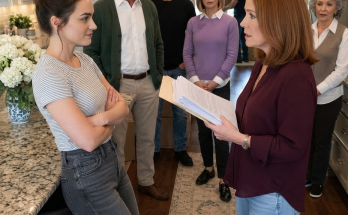
“This is inappropriate.”
“Forgery is inappropriate,” Marcus said from behind me.
I hadn’t come alone.
He moved into view with a process server and a forensic document examiner I had retained that morning.
Elena stayed near the door, phone in hand, because she understood exits better than entrances.
My mother swayed.
One of my cousins reached out instinctively, then stopped.
Alyssa flipped through the pages too fast to understand them.
“This has to be a joke.
Dad?”
Richard said nothing.
That silence told her more than I ever could.
She turned to him fully now, panic crawling up her voice.
“Dad?”
His eyes flicked to the guests, calculating.
Always calculating.
“There’s been a misunderstanding in the paperwork,” he said.
“Jasmine tends to overreact.”
Marcus handed a copy of the forensic summary to the nearest reporter before my
father could stop him.
“The guarantee was supported by identity documents uploaded from Richard Dunne’s personal device,” Marcus said evenly.
“We also have a preliminary finding that the digital signature was extracted from a prior file without consent.”
The first reporter’s face changed instantly.
Not sympathy.
Hunger.
Alyssa looked like the room had tipped sideways.
“You used Jasmine’s name?” she whispered.
My mother reached for her.
“Sweetheart, listen—”
Alyssa jerked away.
“You used her name?”
Patricia’s composure shattered in the ugliest possible way: not with remorse, but with self-protection.
“We were trying to save you,” she snapped.
“You were about to lose everything.
Your father said Jasmine would never know unless the business succeeded.”
There it was.
Not a mistake.
A plan.
Alyssa stared at them both as if seeing them for the first time.
Her voice dropped.
“You forged my sister to save me?”
My father straightened, still trying to retake the room.
“Families help each other.”
I almost admired the shamelessness of that.
“No,” I said.
“Families ask.
Thieves take.”
The process server stepped forward then and handed Richard and Patricia separate envelopes.
Civil notice.
Preservation demand.
Intent to refer for criminal review depending on cooperation.
Clean.
Immediate.
Impossible to spin.
My father didn’t open his.
He crushed it in his fist.
“You would do this to your own parents?” he said.
I looked at him, at the man who had told me to live in the streets while sitting under a chandelier I could have bought ten times over, and felt something colder than anger.
“You did it to yourselves,” I said.
“I just purchased the paperwork.”
Alyssa’s eyes filled, not with the theatrical tears she used at openings, but with the raw kind that arrive when vanity finally loses to humiliation.
She turned toward me, her voice breaking.
“I didn’t know about the forgery.
I swear I didn’t know.”
I believed her.
Not because she was good.
Because her shock was too ugly to be fake.
“Did you know my name was attached?” I asked.
She hesitated.
That was enough.
She covered her mouth and started crying in earnest.
The room split around us then, as rooms always do when truth enters and decor becomes irrelevant.
Donors moved away from my parents.
The reporters stepped closer.
My aunt sat down hard on a bench near the sculpture wall.
My uncle muttered, “Jesus Christ,” like it was both prayer and diagnosis.
My mother tried one last time to salvage herself.
“Jasmine, sweetheart, let’s do this privately.”
I thought of Thanksgiving.
Of the knife.
Of the word shelter dropped into crystal and candlelight while everybody watched.
“No,” I said.
“You liked public lessons.
Let’s keep the format consistent.”
What happened after that moved quickly.
Halcyon, eager to avoid being tied to forged intake files, cooperated.
My father’s device records matched the upload logs.
My mother turned on him within forty-eight hours, claiming she had only “shared documents” and didn’t understand how they were used.
Alyssa shut the gallery for an “indefinite restructuring,” which was a pretty phrase for collapse.
Criminal charges were discussed.
In the end, I allowed the referral to remain available but agreed to a civil settlement first: full admission of falsified authorization, restitution of investigative costs, transfer of my grandmother’s trust property interest that my
parents had been quietly controlling, and permanent removal of my name from any family-related financial instrument, present or future.
They also had to issue a written correction to every lender, donor, and business contact who had touched the forged guarantee.
My father signed because he had no room left not to.
My mother signed because appearances only matter until prison enters the mood board.
Alyssa sold what she could, lost what she couldn’t, and disappeared from social media for months.
The strangest part was what happened next.
Not revenge.
Not reconciliation.
Distance.
Real distance.
The kind that isn’t dramatic.
The kind built from blocked numbers, forwarded mail, and a body that no longer braces when a familiar name appears on a screen.
Alyssa wrote to me six months later.
A real letter, not an email.
She said she had hated me for years because our parents trained her to.
She said being the favorite had felt like winning until she realized favorites are just weapons with birthdays.
She apologized for the smile at Thanksgiving.
She apologized for knowing enough to benefit and not enough to stop it.
I didn’t answer right away.
Forgiveness is not the same thing as access.
Eventually, I mailed back one sentence.
I hope you build a life that doesn’t require a victim.
That was all.
As for my father, the last thing he ever said to me in person was in a mediation room that smelled like stale coffee and expensive fear.
“You always were ungrateful,” he muttered.
I looked at him across the table and realized he would rather lose everything than understand what he had done.
“And you,” I said, “always confused control with love.”
I left before he could answer.
Some people hear this story and say I was ruthless.
Some say I should have protected my parents from public ruin no matter what they did.
Others say the real betrayal wasn’t the forged signature or the money.
It was the years of training everyone in the room to believe I deserved whatever happened to me.
Maybe that’s the part that lingers.
Not the debt.
Not the gallery.
Not even the knife at Thanksgiving.
Just this question: when a family only knows how to value you once they realize what you’re worth, do they deserve a second chance at all?