I remember the weight of my father’s hand on mine, his fingers cold and trembling as he lay in that hospital bed. The machines beeped a slow, mournful rhythm, and the antiseptic smell hung heavy in the air. He pulled me close, his voice a ragged whisper.
“Son,” he said, his eyes locking onto mine with a fierce urgency. “Promise me. Take care of your mother. She’s not strong like you. She needs someone to lean on.”
I squeezed his hand, feeling the bones frail under his papery skin. “I promise, Dad. I’ll never let her down.”
He smiled, a faint, relieved twitch of his lips, and then he was gone. That was twelve years ago. And I kept my promise. Every single day.
For twelve years, I was the one who paid for everything. Her rent, her groceries, her medical bills. Every month, without fail, I transferred money into her account. I didn’t think twice. She was my mother. She had raised me, loved me, sacrificed for me. It was my turn to honor that debt.
My three brothers—Mark, the oldest, who lived two states away; David, the middle child, always buried in his own life; and Kevin, the youngest, who still lived in town but never visited—they contributed nothing. Not a dime. Not a single phone call to check on her. I never asked them for anything. I didn’t want to create drama. I just did what had to be done.
When Mom got sick, I was the one who took her to the doctor. I sat in the waiting room for hours, staring at the clock, my stomach in knots. The diagnosis was gallstones, but she needed surgery. Then rehab. Then more doctor visits. The bills piled up like snowdrifts in a bitter winter. Forty-five thousand dollars. I paid it all without a word.
I remember the day she came home from the hospital, pale and weak but smiling. She hugged me and whispered, “Thank you, sweetheart. I don’t know what I’d do without you.”
I believed her. I believed that she saw everything I had done, that she appreciated it. But love has a way of blinding us to the truth.
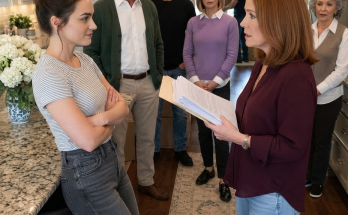
A few weeks later, she called a family meeting. She sat us all down in her living room—me, Mark, David, and Kevin—and announced that she was updating her will. She wanted everything to be fair. She wanted to divide her estate equally. Twenty-five percent each.
I stared at her, disbelief washing over me. “Mom,” I said, my voice slow and measured, “I’ve spent over two hundred thousand dollars taking care of you. I quit my second job just to be here for you. I’ve sacrificed vacations, savings, my own peace of mind. And now you’re going to give them the same as me?”
She looked at me with soft, pleading eyes. “But they’re your brothers, honey. They’re family too. I don’t want to leave anyone out. It wouldn’t be right.”
Kevin leaned back in his chair, a smirk spreading across his face. “Yeah, bro. Fair is fair. Mom’s just trying to keep the peace.”
I felt something snap inside me. Not violently, but with a quiet, final click. I had spent twelve years being the good son, the reliable one, the pillar everyone leaned on. And at that moment, I realized that it didn’t matter. That my sacrifice was invisible to them. That my mother would rather keep the peace than acknowledge the truth.
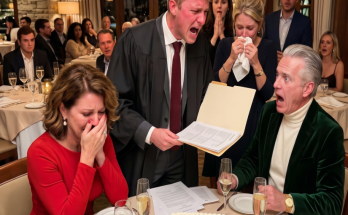
I stood up slowly, calmly, and walked to the small table in the corner where I had placed my briefcase. I took out a thick folder. It was worn, the edges frayed from use. Inside were twelve years of receipts. Bank transfers. Cancelled checks. I spread them across the coffee table like a dealer laying out cards.
“What’s that?” David asked, his eyes narrowing.
“Receipts, bank transfers, everything I’ve paid for Mom,” I said flatly.
Then I reached into the folder and pulled out the last document. It was a single piece of paper, neatly folded, a signature at the bottom. A promissory note. For two hundred thousand dollars. With her house as collateral. Signed by my mother in 2018, the year she had her surgery.
Mom’s face drained of color. Her lips parted, but no sound came out.
“Where did you get that?” she finally whispered, her voice barely audible.
“You signed it two days after your surgery,” I said. “You were groggy, but you were clear. You said, ‘I want to pay you back. I don’t want you to suffer for me.’ And you signed it voluntarily.”
Kevin stood up, his smirk gone. “That’s not legal. You forced her!”
“I didn’t force anyone,” I said. “Her lawyer was present. He notarized it. It’s a legally binding document.”
My mother’s hand trembled as she reached for the note. She read it, her eyes scanning the lines. Tears began to stream down her cheeks.
“I thought it was just… a formality,” she said. “I didn’t think you’d actually use it.”
“I never planned to, Mom,” I said, and my voice cracked for the first time. “But you left me no choice. You wanted fair? I’m giving you fair. You owe me two hundred thousand dollars. Or the house is mine.”
Her lawyer looked at the note, his expression grim. He nodded slowly. “It’s legally binding. If he takes this to court, you would have to sell the house to pay him.”
The room fell silent. I could hear the clock ticking on the mantelpiece. My brothers were staring at me like I was a stranger. Maybe I was.
Mom looked up at me, her eyes pleading. “You would take your own mother to court? After everything?”
I met her gaze. I wanted to feel anger, but all I felt was a deep, hollow sadness.
“No, Mom,” I said softly. “I won’t take you to court. I don’t want your house. I don’t want your money. I just wanted you to see. I wanted all of you to see what love really costs.”
I picked up the folder, leaving the promissory note on the table.
“Keep the note,” I said. “Consider it a gift. But from now on, you don’t have to worry about me. I’m done.”
I turned and walked out the door. I didn’t slam it. I closed it gently, like closing a chapter.
That was three years ago. My mother sold the house eventually, moved into a smaller apartment. She tried to call me, to apologize, but I didn’t answer. My brothers pretended I didn’t exist. And I learned something important: sometimes, the most loving thing you can do is walk away.
I don’t regret a single dollar I spent on her. I don’t regret the years I gave. What I regret is believing that sacrifice would be seen. That love would be returned. But now I know: the best investment you can make is in yourself. And sometimes, the people who should love you the most are the ones who will use you the hardest.
If this story touched you, please like and share it. And don’t forget to follow our page for more real-life stories that will make you think on life, family, and the true meaning of love.