
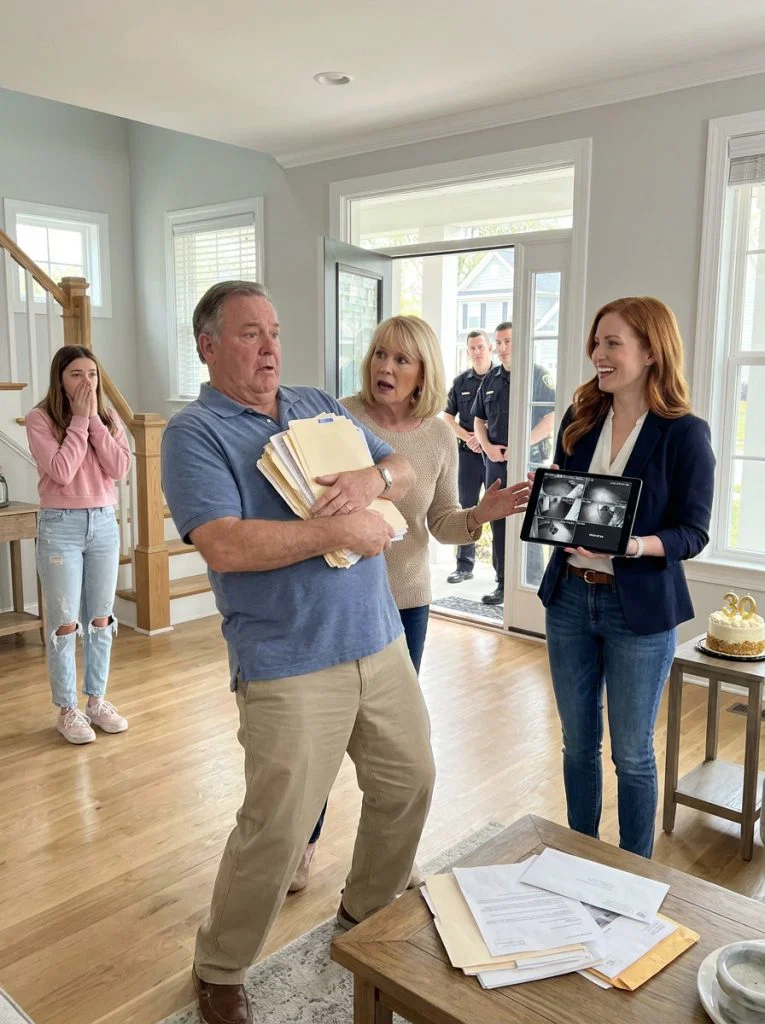
The first thing Felicia noticed on the morning her parents stole her future was the silence. It had a heavy weight to it, sitting in the kitchen before she even entered, thick as fog and filling the corners of the house where birthday wishes should have been waiting.
For thirty years, she had lived under that roof long enough to understand every variety of silence her family possessed. There was her father’s punishing silence, sharp and deliberate, which he used whenever he wanted total obedience without any room for discussion.
There was her mother’s evasive silence, soft and slippery, specifically designed to pretend that cruelty was actually just practicality. There was Hannah’s careless silence, the bright and hollow emptiness that came whenever Felicia’s existence failed to serve her younger sister’s needs.
But this silence was completely different. It felt ceremonial.
Felicia paused at the foot of the stairs with one hand on the banister, feeling the polished wood cool beneath her fingers. The house smelled faintly of roasted coffee and lemon dish soap.
Her mother was already in the kitchen, dressed in a crisp pale yellow blouse, carefully pouring filtered water into the coffee maker as though intense concentration could excuse her indifference. Her father sat at the table in his perfectly pressed dress shirt, his digital tablet open before him, one thumb scrolling through financial reports.
Neither of them looked up as she walked in. Felicia waited one second, then two, but nothing happened.
There was not a single word, not even the small and obligatory acknowledgment that had usually arrived on her birthdays like a dropped coin. “Happy birthday, Felicia,” her mother used to say while reaching for her car keys.
Her father used to say it with the same flat tone he used to confirm that a utility bill had been paid. It had never been affectionate, but it had been there, standing as proof that the date had at least been registered in their minds.
This year, her thirtieth birthday passed over their faces without creating a single ripple. Felicia understood exactly why.
They were not forgetting her birthday, she realized. They were preparing to use it.
“I am leaving for work now,” she said, her voice steady.
Her mother’s shoulder tightened almost imperceptibly at the sound of her voice. Her father did not move or acknowledge her at all.
Then Margaret Reynolds turned away from the counter with a careful, rehearsed smile, one so thin it seemed to be painted on her skin. “Have a very good day, dear,” she said.
George Reynolds did not even look up from his tablet. Felicia stood there for another moment, taking in the room that had shaped her: the square kitchen table where her paychecks had once been dissected, the cabinet where her mother kept Hannah’s imported teas, and the tiled floor she had scrubbed on Sundays after working two long overnight shifts.
Everything looked ordinary, and everything looked clean. That was the secret genius of the house, she thought. It could conceal rot beneath the pleasant smell of coffee and lemon soap.
She picked up her bag and walked out without another word. Outside, the October sunlight fell softly across the long driveway.
Her old sedan sat under the large maple tree, a little faded and a little dented, but still entirely faithful. She slid behind the wheel and closed the door with more gentleness than she actually felt.
For a moment, she rested her forehead against the steering wheel and let herself breathe. Three years.
She had waited exactly three years for this day. Every document she had filed, every digital alert she had set, every bank meeting she had attended, and every performance she had given at the dinner table.
Every calm nod she gave while her father congratulated himself on her obedience. Every smile she had forced when her mother spoke about Hannah’s future as if Felicia’s existence were merely a bridge leading to it.
Now the day had finally arrived. Her hands were perfectly steady as she started the car.
At the pharmacy, the morning unfolded with insulting normalcy. The automatic doors sighed open and closed repeatedly. The high-speed printer spat out labels. Bottles clicked and rattled in the plastic bins.
Customers came in with sore throats, insurance complaints, aching knees, refill requests, impatience, fear, and gratitude. Felicia moved through the work with the precision of someone whose body had learned survival through endless repetition.
She counted pills, verified instructions, answered questions, called doctors’ offices, and smiled at people who never knew they were being helped by a woman standing at the edge of a private catastrophe. Carlos, her floor manager, leaned around the glass partition just before noon and held up a cupcake in a plastic container.
“Happy birthday,” he said with a wink. “Don’t you worry, I did not sing for you.”
Felicia looked at the cupcake, then at him. The frosting was slightly crushed against the clear plastic lid. It was vanilla with a tiny, delicate swirl of blue icing.
Such a small thing, she thought. Such a human thing. Her throat tightened before she could stop it.
“You remembered?” she asked.
“Your employee file remembered, so I just took the credit,” he said. “Take a break for ten minutes.”
She wanted to thank him normally, and she wanted to laugh. Instead, she accepted the cupcake like it was fragile evidence of another kind of life, one where people noticed a date and did not weaponize it against you.
In the staff room, she sat alone at the small table near the vending machine and peeled back the plastic lid. Her phone lay beside her, the screen dark and unmoving.
She stared at it more than at the cupcake. Every hour that passed without an alert stretched her nerves tighter.
She had expected the theft to happen in the morning. Her father liked banking early. He liked being the sort of man who arrived before crowds, who used phrases like efficiency and responsible planning, who believed tellers and managers should respond to him with total deference.
But noon passed. Then one o’clock, and then two o’clock.
For one thin, humiliating moment, doubt slipped through her defenses. Had she imagined the whole thing into something much larger than it really was?
Had her Aunt Martha misunderstood what she heard? Had her parents changed their minds at the last second?
Had three years of preparation been a fortress built around a threat that would never arrive? Felicia closed her eyes and remembered the manila folder.
Her name on the tab. Her birth certificate. Her Social Security card. Her driver’s license copied in color. Employment history. Bank statements. Salary details. Supervisors’ names. Addresses.
Everything a person would need to become her on paper. No, she had not imagined it.
At 2:17 p.m., while she was ringing up Mr. Henderson’s blood pressure medication, her phone vibrated in her coat pocket with the long, urgent pulse she had assigned to one account only. The decoy account.
The sound was soft, swallowed by the hum of the fluorescent lights and the rhythmic beep of the scanner, but Felicia felt it through her entire body. Her fingers tightened around the paper prescription bag.
Mr. Henderson, a retired school principal with very careful manners, was telling her about his granddaughter’s college applications. “She is looking at schools out west,” he said. “Can you imagine that?”
“I told her, Margaret, your grandfather is old, so don’t make me fly across the country just to embarrass you at graduation.”
Felicia smiled automatically. “That sounds like something she will appreciate later,” she said.
Her phone vibrated again in her pocket. She completed the transaction, handed him the receipt, and wished him a very good afternoon.
She waited until he had left the counter and disappeared through the automatic doors before pulling the phone from her pocket. The alert glowed bright on the screen.
Large withdrawal notification. For several seconds, she did not open it.
The subject line alone seemed to divide her life into before and after. Her thumb hovered. Her pulse was steady now, strangely steady, as if the terror had become too large for her body and had simply lifted away.
She tapped the screen. “A withdrawal in the amount of two million, three hundred forty thousand dollars has been processed from your savings account ending in 4591 at the Downtown Branch location. Remaining balance is 1,132 dollars and 14 cents.”
There it was. Not a theory, not a fear, and not a future danger. A completed crime.
Felicia read the numbers once, then twice. She did not cry, and she did not gasp. The pharmacy seemed to fall away around her, its shelves and counters and customers receding into a pale, distant blur.
Her life did not flash before her eyes. Instead, she saw one image with perfect clarity: her father at the kitchen table ten years earlier, opening his black ledger and turning her first paycheck into a family asset.
The bottle in her hand slipped. It hit the floor and scattered vitamin tablets across the white tile.
Carlos looked over from the computer at the sound. “Felicia?”
She bent down to pick them up, but her knees threatened to give way. Carlos came around the counter quickly. “Hey, are you okay?”
She stood up too fast, her phone still in her hand. Her voice came out thin, almost unrecognizable. “I have to go,” she said.
“What happened?” Carlos asked.
“Family emergency,” she replied.
It was the first honest phrase she had spoken all day, though not in the way he understood it. She left her white lab coat on the chair, grabbed her bag, and walked out before anyone could stop her.
By the time she reached the parking lot, the October air felt too bright and too cold. She got into her car and sat still for one breath, then another.
Somewhere inside her, beneath the shock and the fury, something old and wounded whispered that they really did it. Not because they needed to, and not because they were desperate, but because they believed they had the right.
Felicia drove home with both hands tight on the steering wheel. Every traffic light seemed longer than usual.
Every pedestrian at every crosswalk seemed to move underwater. The world had no respect for her revelations, she thought.
It kept moving, ordinary and indifferent, while her parents sat somewhere inside the house preparing to explain why theft was love when it served Hannah. She parked in the driveway.
The front window curtains shifted, just slightly. They were waiting.
Felicia took one final breath. Then she opened the car door, ran up the walk, and burst into the house with panic on her face.
“Mom? Dad?” she shouted.
The living room looked staged. Her mother sat in the armchair with the floral upholstery, a porcelain teacup balanced on its saucer. She only used that cup when she wanted to feel refined.
Her father sat on the sofa with one ankle resting on the opposite knee, a newspaper open, though Felicia doubted he had read a word. They both looked up at her at exactly the same time.
There was no surprise in their faces, only anticipation. “Felicia,” her mother said, softening her voice into its practiced maternal shape. “What is wrong?”
“My account,” Felicia said, letting her breath hitch. “My savings. It is gone. Someone emptied it.”
Her father folded the newspaper slowly. He pressed the crease flat with his palm and set it beside him. It was all theater, that unhurried calm, the performance of a man who believed he controlled the room because he always had.
“It was not stolen,” he said.
Felicia stared at him.
“It was redirected,” he added.
Her mother lowered her teacup with a tiny click. “For Hannah’s future, sweetheart,” she said.
There it was, said with the gentle tone one might use to explain why a dog had to be put down. Felicia made herself look confused. “What?” she asked.
George sighed, already irritated by the need to justify himself. “Your sister has been accepted into an elite medical program. Opportunities like this do not come twice. Your mother and I made a decision for the family.”
“The family?” Felicia repeated.
“Yes, the family,” he said. “A concept you have always struggled with when your own feelings were involved.”
Margaret nodded, her eyes shining with the kind of tears she could produce on command. “Felicia, you have always been responsible. You do not need all that money sitting there. Hannah is young. She has promise. This is about building something bigger than yourself.”
Bigger than herself, Felicia thought. She almost admired the phrase. It was so clean and so noble. It polished the theft until it reflected sacrifice instead of greed.
Her father moved closer and placed a hand on her shoulder. His fingers were heavy and proprietary. “We knew you would react emotionally,” he said. “But one day you will understand. Your money secured your sister’s future. That is something to be proud of.”
Her mother added that she would have wasted it anyway because she never had real plans, not like Hannah did. For one suspended moment, Felicia saw herself at twenty, sitting at the kitchen table with her unopened paycheck between her hands, believing money could become freedom if she worked hard enough.
She saw herself at twenty-two, hiding a five-dollar bill behind a loose brick in the closet. She saw herself at twenty-five, promoted after years of exhaustion, only for her father to increase the percentage he demanded from her.
She saw herself at twenty-seven, kneeling on the floor of his office with the manila folder in her lap, realizing that her own father had built a weapon from her identity. Then she began to laugh.
It rose quietly at first, a breath and a tremor, but then it deepened, cold and sharp enough to cut through the room. Her father’s hand withdrew from her shoulder.
Margaret’s face changed first. The softness vanished, replaced by genuine confusion. “What are you laughing at?” George demanded.
Felicia stopped. She wiped one tear from the corner of her eye, not because she was sad, but because the laugh had forced it out. Then she looked at him. Really looked at him.
Not as a daughter seeking permission. Not as a child bracing for punishment. As an adult studying the man who had mistaken control for intelligence.
“What is funny,” she said, “is that after all these years, you still think I am stupid.”
George’s expression hardened. “Watch your tone,” he ordered.
“No,” she said.
The word landed like a slap in the middle of the room. Her mother inhaled sharply, and her father blinked. In thirty years, Felicia could count on one hand the number of times she had directly refused him.
Each refusal had once cost her something like dinner, peace, permission, money, or dignity. But now there was nothing left in the house that she needed from him.
“No,” Felicia repeated, softer this time. “I am done watching my tone.”
George’s jaw flexed. “You are hysterical,” he said.
“I am not hysterical, I am informed,” she said. She lifted her phone. “You did not steal my life savings. You stole bait.”
The word hung there in the air. Bait. Margaret’s teacup trembled in her hand. “What does that mean?” she whispered.
“It means the account you emptied was not my real account,” Felicia said. “It was a decoy I built for you for three years.”
Her father’s face lost color so quickly it looked almost theatrical. “That is absurd,” he said.
“No,” Felicia said. “What is absurd is committing bank fraud in person with forged documents at 2:19 on a Tuesday afternoon because you assumed your daughter was too obedient to prepare for you.”
Margaret stood abruptly. Tea spilled over the rim of her cup and onto the rug. “Felicia, this is not funny,” she said.
“It was never meant to be funny,” Felicia replied.
George stepped toward her, anger returning because fear had not yet found a language in him. “You expect us to believe you set some elaborate trap? You? You can barely manage your own life without this family.”
Felicia smiled then, and something in that smile made him stop. “My real money is protected in a trust account you cannot see, cannot access, and cannot touch,” she said. “The account you drained exists because I knew exactly what you were planning.”
Margaret’s lips parted, but no sound came out. Felicia opened a folder on her phone and turned the screen toward them. She did not shake. She did not rush.
For the first time in her life, she allowed herself the pleasure of timing. “Do you recognize this?” she asked.
On the screen was a still image from the bank’s security camera. George Reynolds sat at a polished desk across from a branch manager, smiling with the self-assurance of a man who believed paperwork could make theft respectable.
Beside him, Margaret clutched her handbag with both hands, her face anxious but determined. On the desk lay the forms, the signatures, and the copies of Felicia’s identification.
Margaret made a small, wounded sound. George stared at the image, then at Felicia. “How did you get that?” he asked.
“The bank was expecting you,” she said.
His mouth opened and closed once.
“I notified them weeks ago that an attempted fraudulent withdrawal was likely,” she explained. “They flagged the account. They were instructed to document everything. The manager was very helpful and patient, too. He let you explain yourselves thoroughly.”
“You set us up,” Margaret whispered.
Felicia looked at her mother, and for one brief second, the full absurdity of those words nearly broke through her calm. “I set up an account,” she said. “You chose to forge my signature. You chose to impersonate me. You chose to steal more than two million dollars from the person you call your daughter. Do not confuse opportunity with entrapment.”
George’s fear sharpened into calculation. She watched it happen. The old machinery inside him began to turn. How could he regain control? Could he threaten, deny, appeal to duty, or shift blame? He had used all those levers for decades.
“You do not understand what you are doing,” he said. “Accusing your parents of crimes will destroy this family.”
Felicia lowered the phone. “This family was built by destroying me,” she said.
Margaret began to cry. It was quiet at first, controlled sobs placed carefully between words. “Felicia, please, we did what we thought was best,” she pleaded.
“No, you did what was best for Hannah,” Felicia countered.
“She has always needed more support,” Margaret insisted.
“I needed support too,” Felicia said.
The room stilled completely. The words surprised Felicia by their simplicity. They had not been part of her planned speech. They came from somewhere younger, from a girl who had waited too long at too many doorways, hoping to be invited into her own family.
Margaret looked down. George did not.
“You were stronger,” he said, as if that settled the matter.
Felicia’s face tightened. “No, I was useful,” she said.
Neither of them answered. She took out another document from the folder on her phone. “Here is what happens next,” she said. “You have until noon tomorrow to return every dollar to the account you drained.”
“Two million, three hundred forty thousand dollars. If it is not there by noon, the evidence goes to the district attorney, the bank’s fraud department, and the police.”
Margaret’s eyes widened. “Noon tomorrow? Felicia, that is impossible,” she cried.
“Then prison may be easier,” Felicia said.
Her mother flinched as though struck. George’s face darkened. “You would not dare,” he said.
Felicia stepped closer. Not close enough for him to touch her. Never that close again. “For ten years, you took eighty percent of every official paycheck I earned,” she said.
“You increased it whenever I worked harder. You called my employer. You monitored my bank account. You used my labor to buy Hannah a car, vacations, clothes, tuition, comfort, and applause.”
“Then you collected copies of my identity documents and planned to steal what you believed I had saved in secret. You did it on my birthday. So yes, Father. I would dare.”
The use of the word Father seemed to sting more than the accusation. Margaret wiped her cheeks with shaking fingers. “We do not have it anymore,” she said.
Felicia was silent.
Her mother looked at George, then back at Felicia. “We transferred a large portion to Hannah’s university this afternoon,” she admitted. “The program required payment. It was time-sensitive.”
Felicia almost laughed again. Not from humor, but from the stunned recognition that even in crime, they had been extravagant and incompetent. “You stole it and spent it within hours?” she asked.
“It was for her education,” Margaret insisted weakly.
“It was stolen money,” Felicia said.
George grabbed his phone. “We will call Hannah,” he said.
“Do that,” Felicia replied.
His fingers fumbled with the screen. He put the call on speaker without thinking, a habit from years of conducting family business like board meetings. Hannah answered on the fourth ring, her voice impatient.
“Father, I am busy,” Hannah said. “Did it go through?”
Felicia saw Margaret close her eyes. George swallowed hard. “Hannah, we have a problem,” he said.
“What kind of problem?” she asked.
“Felicia knows,” he said.
There was a long pause. Then Hannah laughed, not because she understood, but because she could not imagine consequences applying to her. “What do you mean, Felicia knows?” she asked.
George explained badly. He stumbled over words Felicia had never heard him struggle with before: decoy, bank footage, fraud, evidence, deadline. His voice lost authority with each sentence.
When Hannah spoke again, her voice had risen into a shriek. “She trapped you? Are you kidding me? She set up some weird revenge scheme because she is jealous of me?”
Felicia stood very still. Margaret reached for the phone. “Hannah, please, we need to see if the school can reverse,” she started.
“No! Absolutely not,” Hannah interrupted. “I am not giving up my seat because Felicia is having some breakdown. She has always hated me. Always. She could not stand that I was going somewhere. You told me that money was handled.”
“It has to be returned,” George said.
“Then get it from somewhere else!” Hannah shouted.
Felicia reached out and ended the call. The silence afterward was cleaner than before. Margaret stared at the phone as if it had betrayed her. George looked older.
Felicia slipped her phone back into her pocket. “Noon tomorrow,” she repeated.
Then she turned and walked upstairs. Behind her, her father said her name. Not with authority this time, but with something close to fear. She did not stop.
In her bedroom, Felicia locked the door and stood with her back against it until the shaking started. It began in her knees, then moved through her arms, her hands, and her jaw.
She crossed the room and sat on the edge of the bed, pressing her palms against her thighs to steady herself. For three years, she had imagined that confrontation.
In some versions, she screamed. In others, she cried. In the most satisfying ones, her parents collapsed into remorse, finally seeing what they had done.
But reality was colder than imagination. They had not seen her. Not truly. Even caught and exposed, they had reached first for excuses. Family, Hannah, sacrifice, jealousy, instability. Anything but guilt.
Felicia looked around the room that had held her life in containment. The narrow bed, the thrift store desk, the dresser with one drawer that stuck, the closet where the loose brick still hid the first physical proof of her rebellion. She had once believed freedom would feel like a door flying open.
Instead, it felt like sitting alone in a room while the people who raised her panicked downstairs because they had been denied the right to consume her. The first phone call started twenty minutes later.
Felicia heard her father’s voice through the floorboards, low and furious at first. Then controlled. Then pleading.
He was calling the university. He said there had been an error. He said the transfer needed to be reversed immediately. He said his daughter’s future depended on it.
The words daughter and future passed through the ceiling like smoke. Which daughter? Felicia wondered.
Related posts