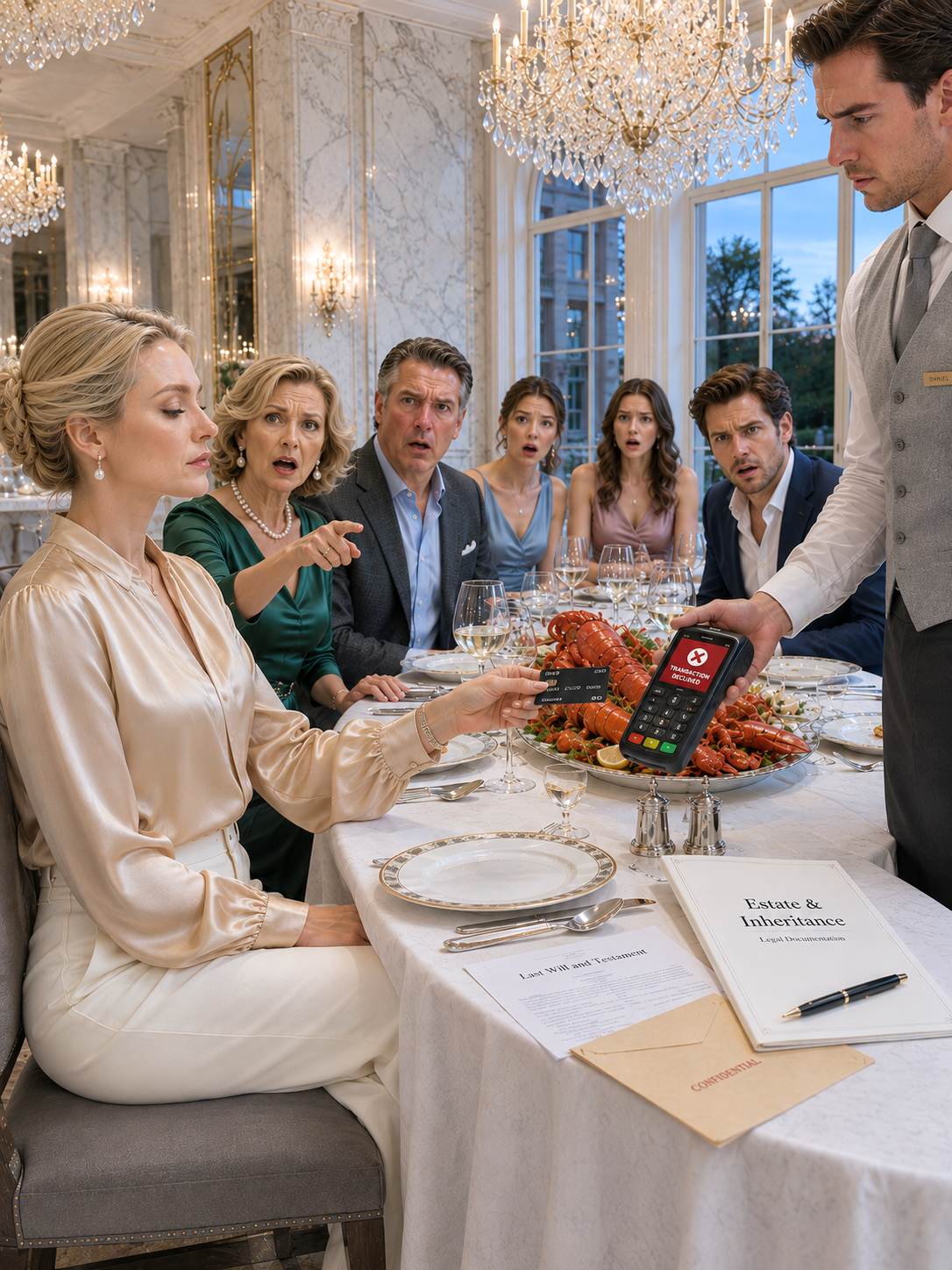
“You’re covering this, right, Emily?” my father asked as he slid the check across the table. Sixteen relatives turned toward me at once, and not a single one looked surprised. That’s when I realized something terrifying: they hadn’t invited me to dinner after three years of silence because they missed me. They had invited me because they expected something from me—and the bill was only the first thing they planned to take.

PART 1: The Dinner They Thought I Would Pay For

The waiter set the black leather check folder in the middle of the table, and my father slid it toward me with two fingers, calm and certain, as if the whole evening had been arranged for that exact moment. “You’re covering this, right, Emily?” he asked, and sixteen people turned their heads toward me at once. Not one face showed surprise, not one person looked uncomfortable, and that told me everything before I even opened the folder.

My mother, Linda, folded her hands beneath her chin and gave me the soft little smile she used whenever she had already decided what my answer should be. My brother, Jason, leaned back in his chair with his face warm from wine, laughing quietly like this was a private joke everyone understood except me. My aunt Denise stared down at the ice melting in her glass, while my cousins lowered their phones after filming their lobster plates and watched me like they had been waiting all night for the final scene.

The restaurant was called Harbor & Stone, an expensive place along the Boston waterfront where the windows overlooked dark water and the dining room glowed with soft gold light. White tablecloths covered every table, servers moved almost silently, and guests spoke in low voices, the kind of place where people did not ask prices because asking would ruin the illusion. It was elegant, polished, and completely wrong for a family dinner that my mother had promised would be small and simple.

Across our table were the remains of a meal I had not chosen and had barely touched. Cracked lobster shells, oyster trays, champagne glasses, steak plates, crab dishes, imported caviar, and desserts decorated like jewelry covered every inch of white linen. My father had proudly announced the price of one bottle of wine as if it made him important, and now all those empty plates sat between us like evidence.

Three years earlier, I had stepped away from my family after my grandmother left me her small lake cottage in Maine and a modest investment account she had built during forty years as a school librarian. My grandmother, Margaret Bell, had been the only person in my family who asked how I was and waited long enough to hear the real answer. After she passed, my parents said the inheritance was unfair, Jason said I must have influenced her, and Aunt Denise told everyone I was dividing the family.

Then they came to my apartment with paperwork and told me to sign my rights over “for the good of everyone.” When I refused, my father called me selfish, my mother cried as if I had broken her heart, and Jason accused me of acting superior because I had a good corporate job downtown. That was the day I stopped answering calls.

For three years, I ignored holiday invitations, birthday messages, family group texts, emotional voicemails, and apologies that sounded carefully rehearsed but never included the words “we were wrong.” I built a quieter life, one where my phone did not decide my mood and where love did not come with a bill attached. Then, on a Tuesday evening, my mother sent a message that made my chest tighten.

Your father and I think it’s time to move forward. Dinner? Just us. No pressure.

I stared at those words longer than I should have. Just us. I knew better, but some old, bruised part of me still wanted to believe my mother might miss me instead of missing what I used to provide. I remembered being a little girl at the kitchen table while she braided my hair and told me family was forever, and even after everything, that memory still had power.

By Friday, I agreed. By Saturday night, I was standing inside Harbor & Stone, realizing I had made a mistake before the hostess even finished leading me through the dining room. Because it was not just my parents. It was everyone.

My father stood as soon as he saw me, spreading his arms wide as if he were welcoming home a beloved daughter instead of presenting me to an audience. “There she is,” he said loudly. My mother’s face brightened with a practiced tenderness, and Jason lifted his wineglass with a grin. “Look who finally came back,” he said, and the words landed colder than the wind outside.

I should have turned around. I knew that even then. But sixteen relatives were watching, other diners were watching, and my father knew how much I hated public scenes. He had counted on it. He knew I had spent my childhood swallowing discomfort because speaking up meant being called dramatic, ungrateful, or too sensitive.

So I walked to the table. I sat down. For the next two hours, I watched the evening reveal itself piece by piece.

My father ordered another bottle without checking the price. My mother said the night was about healing. Jason told the waiter to bring extra lobster for everyone, and my cousins ordered cocktails with cheerful names and expensive garnishes. Aunt Denise told childhood stories that sounded affectionate until the little insults appeared inside them.

“You were always emotional,” she said with a smile. My father nodded and added, “Stubborn too, even when she was small.” My mother reached over and touched my wrist as if she were blessing me. “But we forgive you, sweetheart.”

That was when I understood. They had not invited me to reconnect. They had invited me to accept my role again.

Now the check sat in front of me. I opened the folder and saw the total: $4,386.72. For one second, the number blurred, and then something inside me went very still.

My father gave a light chuckle. “You’re the executive now. Best salary at the table.” Jason smirked. “Think of it as three years of family dues.” My mother’s eyes shone as she leaned closer. “It would mean so much, Emily. A gesture.”

I looked around at the people who had misled me, cornered me, smiled through small insults, and eaten freely because they believed my silence would be cheaper than my self-respect. Then I smiled.

My father’s grin weakened. “What’s funny?”

I closed the folder, raised my hand, and called the waiter over. When he leaned down beside my chair, I whispered two quiet sentences into his ear. His eyes widened just slightly, then he nodded and walked away.

At first, no one noticed. That was the best part.

My mother continued explaining how difficult the last three years had been for her, as if my absence were something that had happened to her instead of something she had helped create. Aunt Denise nodded sadly, Jason poured the last of the expensive wine into his glass, and my father kept glancing between me and the check folder, waiting for a credit card that was never coming.

For the first time all night, I felt calm. Not happy, not cruel, just calm. It was the kind of calm that arrives when you finally stop auditioning for love from people who only understand access.

A few minutes later, the restaurant manager approached in a dark suit, followed by the waiter holding a small tablet. The manager’s face was polite and controlled, the expression of someone trained to handle expensive rooms and uncomfortable guests. “Good evening,” he said. “We need to clarify the payment for this table.”

My father immediately pointed toward me. “She’s taking care of it.”

But the manager did not look at me. He looked directly at my father. “Sir, the reservation was made under the name Robert Carter, with your phone number and your card used to hold the table.”

My father’s smile cracked. “Excuse me?”

The manager remained professional. “Ms. Carter explained that she did not arrange this dinner, did not make the reservation, and did not agree to cover the entire party. Under our policy, the person who books the reservation is responsible unless the guests choose to split the amount voluntarily.”

The silence came fast and heavy. My mother’s hand froze around her glass, Aunt Denise stopped breathing for a moment, and Jason sat forward as if he had heard the wrong ending to a story he thought he controlled.

My father turned slowly toward me. “Emily.”

I folded my hands on the table. “Yes?”

“What did you do?”

“I corrected the misunderstanding.”

Jason stared at me. “Are you serious?”

“Completely.”

My mother leaned closer, her voice low and sweet on the surface, but sharp underneath. “This is embarrassing.”

I looked at the lobster shells, the champagne, the empty wine bottle, and the plates nobody had hesitated to order because they thought the cost would land on me. “Yes,” I said. “It is.”

My father’s jaw tightened. “This is family.”

“No,” I said. “This is a bill.”

The waiter placed the receipt in front of my father. $4,386.72. Aunt Denise inhaled sharply, one cousin whispered under his breath, and Jason’s wife, Melanie, stared down at her plate as if she wanted the tablecloth to swallow her.

My father picked up the receipt and looked at the total. For the first time in my life, I watched him shrink in public. He pulled out his wallet with exaggerated dignity, as though moving slowly could restore control, then handed the manager a black card.

“Run it,” he said.

The manager nodded and stepped away. My mother reached toward my arm, but I moved before her fingers touched me.

“Emily,” she whispered, “don’t make this worse.”

I looked at her directly. “You invited me under false pretenses, brought sixteen people, let everyone order thousands of dollars of food, spent two hours making little comments about me, and then pushed the check in front of me like it was already decided. Somehow, I’m the one making it worse?”

Her lips parted, and her eyes began to shine. I knew that look. I had grown up around those tears. They appeared whenever responsibility walked too close to her.

“You left us,” she said softly. “Do you know what that did to this family?”

“Yes,” I replied. “It stopped you from taking more from me.”

Jason set his glass down hard enough to make the silverware jump. “There it is. Poor Emily, always making herself the injured one.”

I turned to him. “You called Grandma’s attorney behind my back and asked whether her will could be challenged because I was supposedly not thinking clearly.”

His face lost color. Melanie looked up at him. “What?”

Jason gave a short laugh that sounded forced. “That is not what happened.”

Continue to Part 2 Part 1 of 3

Leave a Reply

Your email address will not be published. Required fields are marked *