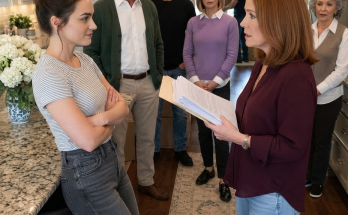
“I showed you documents.”
“And I said I would look into it.”
“But you haven’t.”
Silence.
Real silence now.
Rain tapped softly against the kitchen windows.
David leaned back in his chair slowly.
Then finally said the line that would emotionally destroy readers:
“Mom… I think you’ve been alone too much lately.”
My chest hollowed instantly.
Not because he meant harm.
Because he truly believed loneliness was more believable than betrayal.
Clara lowered her eyes carefully beside the counter.
Performing sadness now.
“David,” she whispered softly,
“don’t.”
Perfect.
Absolutely perfect manipulation.
Protect him from conflict.
Protect herself from exposure.
I suddenly realized Clara wasn’t only stealing money anymore.
She was slowly teaching my son to distrust my reality.
And that—
that terrified me far more than forty thousand dollars.
David rubbed both hands across his face.
“I just want peace between the two people I love most.”
Oh God.
That line almost broke me completely.
Because he still loved me.
That was the tragedy.
He loved me while choosing not to see me clearly.
I stood slowly and carried my untouched soup bowl toward the sink.
Then quietly,
without turning around,
I said:
“David… peace built on lies eventually costs more than conflict built on truth.”
The kitchen went silent behind me.
And for the first time—
David did not immediately defend Clara.
PART 9 — “The Empty Ring Box”
After David left that night,
the silence inside the house felt different.
Not peaceful.
Waiting.
I stood alone in the kitchen staring at the untouched soup slowly cooling beneath the yellow overhead light.
For the first time,
David had hesitated without Clara rescuing the moment completely.
Tiny crack.
But cracks spread.
I washed the dishes slowly, then carried the dry towel upstairs toward my bedroom.
Halfway down the hallway,
I stopped.
The velvet ring box still sat open on the dresser where I had left it days ago.
Empty.
I looked at it for a long moment before finally walking closer.
Funny how absence can become visible.
The indentation where the ring once rested remained pressed into the fabric like memory refusing to flatten completely.
My chest tightened.
Forty years of marriage reduced to:
- heater repairs
- blood pressure medication
- groceries
And somehow the worst part still wasn’t losing the ring.
It was knowing my son never noticed it disappear.
I sat carefully on the edge of the bed and opened the brown leather notebook again.
November 22
David noticed the refrigerator tonight.
For one moment, I thought he finally saw me clearly.
I paused.
Then slowly wrote:
But Clara arrived before truth could fully enter the room.
The words looked heavier tonight.
More tired.
I closed the notebook and slid it back into the drawer beside the empty ring box.
Then my phone buzzed.
David.
Again.
I answered quietly.
“Hello?”
His voice sounded strange now.
Less confident.
“Mom… are you awake?”
“Yes.”
A long silence followed.
Then:
“I keep thinking about what you said.”
Hope flickered painfully inside me again.
Dangerous thing, hope.
“What part?”
“That peace built on lies sentence.”
I stared toward the dark bedroom window.
Rainwater moved softly against the glass.
“I didn’t mean to upset you,” he added quickly.
There it was again.
He still thought emotional discomfort was the problem.
Not deception.
“You didn’t upset me, David.”
He exhaled slowly.
“Clara says this whole thing is becoming unhealthy.”
Of course she did.
Because unhealthy conversations are usually the ones closest to exposing something.
“She says you’re isolating yourself more.”
A pause.
“She’s worried depression may be affecting your thinking.”
My fingers tightened around the phone.
Interesting.
The strategy was evolving now.
Not confusion anymore.
Mental decline.
And the terrifying part?
David sounded worried.
Not manipulated.
“She really cares about you,” he said softly.
I closed my eyes briefly.
“David… has Clara ever been wrong?”
Silence.
Real silence.
Then finally:
“What kind of question is that?”
“The kind people ask before something important breaks.”
Another pause.
I could almost hear him thinking now.
Good.
Very good.
Then—
just as suddenly—
his voice shifted again.
Defensive.
“She’s my wife, Mom.”
Not:
She’s innocent.
Just:
She’s my wife.
And suddenly I understood:
David wasn’t only protecting Clara anymore.
He was protecting his entire understanding of his own life.
If Clara was capable of this,
what did that say about:
- his judgment
- his marriage
- the years he trusted her completely
Truth threatens identity.
That’s why people resist it.
“Mom?”
“Yes?”
“I need you to promise me something.”
My chest tightened.
“What?”
“Please don’t accuse Clara publicly until we figure everything out.”
Publicly.
Interesting word.
Fear was entering now.
Not full belief.
But fear.
I walked slowly toward the dresser and opened the top drawer.
Inside sat:
- folded sweaters
- old photographs
- the empty velvet ring box
My eyes rested on it quietly.
“David,” I asked softly,
“what would you do if someone hurt me intentionally?”
His answer came immediately.
“You know I’d protect you.”
Tears burned suddenly behind my eyes.
Because he meant that too.
That was the tragedy of blind love:
good people can participate in cruelty while believing they are preventing it.
I touched the empty ring box gently.
Then asked the question that would change everything later:
“Would you still protect me if the person hurting me was someone you loved?”
The silence afterward stretched so long I thought the call disconnected.
Finally David whispered:
“Mom…”
Not an answer.
And somehow that hurt most of all.
After we hung up,
I sat alone on the bed for nearly an hour holding the empty ring box in my lap.
Then finally,
very slowly,
I realized something important:
David still had not noticed the missing ring.
But when he finally did—
it would destroy him.
PART 10 — “I’ve Tried So Hard With Your Mother”
The rain started just after midnight.
By morning, the entire town looked washed gray beneath low clouds and dripping power lines. I stood in the pharmacy line holding my refill slip while two women ahead of me discussed holiday travel plans and grandchildren.
Ordinary life continued so casually around private heartbreak.
“Mrs. Hayes?”
I stepped forward.
The pharmacist smiled apologetically.
“I’m afraid your insurance hasn’t processed yet.”
My stomach tightened.
“How much without it?”
He typed briefly.
Then named a number.
Too high.
Much too high.
I looked down at the folded bills inside my wallet:
- twenty
- ten
- three singles
Not enough.
“I can come back later,” I said quietly.
The pharmacist lowered his voice sympathetically.
“If you wait a few days, the insurance issue may clear.”
A few days.
I nodded politely and stepped aside.
Women my age become very skilled at pretending delayed medication is a scheduling inconvenience instead of a financial problem.
Outside, cold rain soaked the parking lot.
I sat inside my Buick gripping the steering wheel while my empty prescription bag rested on the passenger seat beside me.
Then my phone rang.
David.
Of course.
I answered softly.
“Hi, sweetheart.”
“Mom! Perfect timing.”
His voice sounded distracted but cheerful.
“Clara and I are stopping by tonight.”
My chest tightened immediately.
Tonight.
“Is something wrong?”
“No, no.”
A small laugh.
“Clara made extra lasagna.”
Interesting.
Clara only performed kindness after tension.
Damage control disguised as generosity.
“That’s thoughtful,” I answered carefully.
“She’s been really upset about everything lately.”
A pause.
“She feels like you hate her.”
I stared through the rain-covered windshield silently.
Hate her.
Not:
She stole from you.
Instead:
Her feelings are hurt.
David continued gently:
“I know things have been tense, Mom. But Clara’s tried really hard with you.”
The sentence hollowed something inside me.
Because somewhere between lies,
missing money,
and emotional manipulation—
my son now viewed Clara as the wounded one.
“I see,” I whispered.
“She cries about this sometimes.”
Of course she does.
Women like Clara understand something dangerous:
people rush to comfort visible emotion faster than quiet suffering.
And Margaret had always suffered quietly.
That was her weakness.
And her dignity.
“I don’t want this family falling apart,” David added softly.
Family.
Interesting how victims become threats once truth creates discomfort.
The rain hit harder against the windshield.
I looked toward the pharmacy bag beside me.
No medication.
No money.
No ring anymore.
Meanwhile Clara was crying in luxury kitchens about how difficult I had become.
“Mom?”
“Yes?”
“Please try tonight, okay?”
A pause.
“For me.”
Not:
Tell me the truth.
Instead:
Make peace easier.
I closed my eyes briefly.
“Alright.”
Relief immediately entered his voice.
“Thank you.”
Then warmly:
“I love you.”
Oh God.
That almost broke me.
Because he still meant it every single time.
That evening, Clara arrived carrying lasagna, wine, and expensive bakery bread.
Perfect image of devotion.
“Margaret,” she said softly the moment she entered,
“I thought you might enjoy homemade food tonight.”
Homemade.
The woman hadn’t cooked once in fifteen years.
David kissed my cheek warmly.
“You feeling better today?”
I smiled faintly.
“I’m alright.”
Clara unpacked dishes elegantly across the kitchen counter while David opened wine nearby.
Domestic harmony.
Manufactured carefully.
Then Clara touched my arm gently.
“You’ve lost weight.”
David looked up immediately.
“See?”
Clara’s expression filled with concern.
“I told you I’ve been worried.”
There it was again.
She always spoke first.
Defined reality first.
Controlled emotional framing first.
And David followed her version automatically because trust creates mental shortcuts.
I served plates quietly.
During dinner, Clara spoke softly about:
- charity events
- therapy articles
- stress in elderly widows
Not obvious enough to accuse.
Just enough to shape perception.
Then finally she sighed sadly and looked toward David.
“I’ve tried so hard with your mother.”
The room went still.
David immediately reached for her hand beneath the table.
And readers would HATE this moment.
Because Margaret sat there silently while the thief received comfort.
“I know you have,” David said gently.
I lowered my eyes to my untouched food.
Lasagna.
Warm bread.
Red wine.
Luxury sympathy.
Clara looked toward me with carefully wounded eyes.
“I don’t understand why you think I would hurt you.”
Because you already did.
Repeatedly.
But before I could answer,
David spoke again.
“Mom… maybe we all just need a fresh start.”
Fresh start.
Such a beautiful phrase for people who never paid the cost of the old one.
Clara’s eyes softened immediately.
“Exactly.”
Then she leaned against David slightly.
And my son—
my blind, loving son—
wrapped his arm around the woman stealing from his mother while believing he was protecting both of us at once.
I looked down at my bare left hand resting quietly beside the plate.
No ring.
No medication.
No truth reaching him yet.
And suddenly I understood the terrifying thing about manipulation:
it doesn’t only hide reality.
Eventually,
it replaces it.
PART 11 — “The Date Didn’t Match”
Three days later, David called while I was folding laundry in the living room.
His voice sounded strange immediately.
Tighter.
Distracted.
“Mom… can I ask you something?”
I stopped folding one of Frank’s old flannel shirts.
“Of course.”
Silence crackled softly through the line.
Then:
“When exactly did you stop receiving the money?”
My heart stumbled once.
Finally.
“Eight months ago.”
Another silence.
Longer this time.
David inhaled slowly.
“Are you sure?”
Not:
I believe you.
Still:
Are you sure?
But the question itself mattered.
Because doubt had finally changed direction.
“Yes.”
“What month?”
“March.”
I heard papers shifting somewhere on his end.
Good.
Very good.
“Why?” I asked quietly.
“No reason.”
Too quickly.
“I’m just trying to organize everything.”
Organize.
Again that word.
David always reached for order before emotion.
Even as a child.
If toys broke, he lined up the pieces carefully before crying.
Now his marriage was cracking the same way.
“I found something odd,” he admitted finally.
My fingers tightened around the folded shirt.
“What?”
Another pause.
Then:
“Clara told me she started bringing cash personally after your April birthday.”
April.
My pulse quickened.
“She’s lying.”
“Mom—”
“No.”
My voice stayed calm.
“Listen carefully.”
A pause.
“She just changed the date.”
Silence.
Heavy silence.
And suddenly I knew:
David saw it too.
Tiny contradiction.
Tiny fracture.
But enough.
Because lies are strongest when details stay simple.
The moment details multiply,
truth starts breathing.
“I need to talk to Clara again,” he said quietly.
Again.
Still not:
I believe you.
But readers would feel it now:
David sounded unsettled.
Good.
That emotional discomfort was necessary.
“David,” I asked softly,
“did she ever tell you why the transfers weren’t electronic?”
“She said you hated online banking.”
I almost smiled.
“I pay every utility bill online.”
The silence afterward was devastating.
Not dramatic.
Quiet devastation.
Because for the first time,
David had no immediate explanation ready.
I could almost hear his mind trying to protect itself:
- maybe misunderstanding
- maybe confusion
- maybe accounting error
Anything except:
my wife stole from my mother.
Truth arrives slowly when it threatens love.
“Mom…”
His voice sounded smaller now.
“You still have the documents?”
“Yes.”
“I think…”
He stopped.
Then corrected himself.
“I should probably look at them myself.”
Hope flickered dangerously inside me again.
Careful, Margaret.
Hope too early hurts worse later.
“Come by tomorrow,” I said softly.
“Okay.”
But before hanging up,
he added the sentence that showed readers he still wasn’t awake yet:
“Please don’t assume the worst about Clara until we know everything.”
There it was.
Even now—
with contradictions appearing—
his instinct still moved toward protecting her first.
Because emotionally,
he was not ready to survive the alternative.
After the call ended,
I stood quietly in the living room holding Frank’s old shirt against my chest.
Then slowly,
for the first time in months—
I smiled.
Not because David believed me yet.
Because certainty had finally left him.
And uncertainty is where truth begins.
PART 12 — “Maybe There’s Another Explanation”
David arrived the next afternoon carrying tension like a second coat.
I noticed it immediately:
- distracted eyes
- jaw too tight
- movements slightly delayed
Good.
Truth was finally making him uncomfortable.
I opened the front door quietly.
“Hi, sweetheart.”
“Hey, Mom.”
No hug this time.
Not coldness.
Overthinking.
His mind was too crowded now.
I led him into the kitchen where the brown leather notebook sat beside the transfer documents from the bank.
David looked at the paperwork immediately.
Then away from it.
Interesting.
Part of him already knew.
People avoid eye contact with truths before admitting them aloud.
“You want coffee?” I asked.
“Sure.”
I poured two cups while David slowly sat at the table.
Rain tapped softly against the kitchen windows again.
The heater rattled unevenly in the hallway.
Ordinary sounds.
Extraordinary tension.
Finally,
David picked up the bank statements.
I watched his eyes move:
- deposit dates
- account numbers
- transfer history
- Clara’s company name
The silence stretched longer and longer.
Then:
“She told me the money was always cash.”
I stirred cream into my coffee quietly.
“She lied.”
David rubbed one hand across his mouth.
“Maybe the account was temporary.”
Temporary.
There it was.
Readers would GROAN emotionally here.
Because even staring directly at evidence—
David still reached for rescue explanations.
“Eight months temporary?” I asked softly.
He didn’t answer.
Instead he kept reading.
Page after page.
Forty thousand dollars.
I saw the exact moment his breathing changed.
Because suddenly:
numbers stopped being abstract.
Now they looked like duration.
Repeated decisions.
Repeated theft.
“Mom…”
His voice sounded strained now.
“Did Clara ever have access to your information?”
“Yes.”
“When?”
“After Frank died.”
A pause.
“She offered to help organize paperwork.”
David closed his eyes briefly.
Good.
Very good.
Because now memories were rearranging themselves inside him.
That’s how awakening really happens:
not instantly.
Painfully.
The past begins changing shape.
“She handled taxes one year,” he murmured quietly.
I stayed silent.
Let him walk there himself.
That matters.
David stared at the pages again.
Then suddenly:
“Maybe there’s another explanation.”
There it was.
The line readers would both hate and understand.
Because David wasn’t defending Clara now out of blindness alone.
He was defending:
- his marriage
- his judgment
- his identity
- his entire emotional reality
If Clara was capable of this,
then David had failed to protect the two people he loved most.
That realization was terrifying him.
“What explanation would make this acceptable?” I asked quietly.
He looked up sharply.
Pain crossed his face instantly.
Good.
Truth should hurt now.
“I’m not saying acceptable.”
“Then what are you saying?”
David stood suddenly and walked toward the window.
Classic David.
Movement when emotionally trapped.
“She’s been under stress too,” he said quietly.
“The business expansion… the gala… everything lately…”
I almost smiled sadly.
Even now,
he was listing Clara’s pressures before my suffering.
That’s how emotional conditioning works.
“You know what I think?” I said softly.
David turned slowly.
“I think you’re trying to find a version of reality where nobody you love is cruel.”
The sentence hit him hard.
I saw it immediately.
Because it was true.
David wasn’t weak.
He was emotionally desperate.
And desperate people cling to comforting versions of reality long after evidence dies.
“Mom…”
His voice cracked slightly now.
First real crack.
“I don’t know what to think anymore.”
Finally.
Not certainty.
Not defense.
Confusion.
Real confusion.
And confusion is the beginning of collapse.
I opened the brown leather notebook slowly and slid it across the table.
“What’s this?” he asked.
“The months after the money disappeared.”
David frowned slightly.
Then he opened it.
And for the first time—
he started reading what my silence had cost me.
PART 13 — “The Notebook”
David read the first page twice.
I could tell because his eyes returned to the top slowly,
like his mind refused to accept the words the first time.
The kitchen stayed completely silent except for the heater rattling in the hallway.
Finally he read aloud quietly:
“May 13
David believes Clara.
But not completely.”
His voice sounded strained already.
Good.
Not because I wanted him hurt.
Because truth should feel heavy when it arrives late.
David turned the page slowly.
Then another.
And another.
I watched his expression change piece by piece:
- confusion
- discomfort
- guilt
- denial trying to survive
The notebook was not dramatic.
That was its power.
No screaming.
No accusations.
Just dates.
Details.
Quiet suffering documented carefully over months.
David stopped suddenly on one entry.
His eyes froze.
Then he read softly:
“Cut blood pressure pills in half today.
Refill must wait until next Thursday.”
The room changed.
Tiny shift.
But permanent.
“Mom…”
I said nothing.
Let him continue.
David turned another page.
“Church pantry again today.
Mrs. Patterson pretended not to notice I took extra bread.”
His jaw tightened instantly.
Another page.
“Heater stopped working tonight.
Repair cost more than expected.”
His breathing changed again.
Then—
the page.
The one I knew would eventually destroy him.
David stared silently at the entry for nearly ten seconds before reading:
“Sold wedding ring today.”
The notebook trembled slightly in his hands.
Good God.
He finally noticed.
His eyes lifted instantly toward my left hand.
Bare skin.
Empty.
The color drained from his face so fast it frightened me.
“Mom…”
Not confusion anymore.
Pain.
Real pain.
“When?” he whispered.
“Three weeks ago.”
“For the heater?”
“And medication.”
David physically sat back like the sentence hit him in the chest.
I watched him replay months inside his own mind:
- Mother’s Day roses
- empty refrigerator
- cold house
- Clara praising herself
- my missing ring
And worst of all—
his own voice defending her through all of it.
“That’s why you asked if I’d really looked at you.”
Not a question.
Realization.
I nodded slowly.
David lowered his head into one hand.
The notebook remained open beside him.
His wedding anniversary gift to me.
Now filled with evidence against his own blindness.
“That ring was Dad’s.”
There it was.
Not:
your ring
Dad’s.
Because suddenly he understood:
this theft had touched memory,
family,
grief,
love.
Not just money.
“I know.”
The kitchen went silent again.
Outside, rainwater slid down the windows in slow crooked lines.
David stared at the notebook like it might rearrange itself into a kinder version of reality.
It didn’t.
Finally he whispered:
“Why didn’t you tell me?”
The question almost made me laugh.
Not cruelly.
Just sadly.
“I tried.”
His eyes shut immediately.
Because now he heard it too:
- every phone call
- every hesitation
- every moment he chose comfort instead of listening
“I thought…”
He stopped.
Then tried again.
“I thought Clara was helping you.”
I looked toward the old heater humming softly in the hallway.
“She was helping herself.”
David inhaled sharply.
Then suddenly:
“No.”
His voice cracked.
“There has to be something I’m missing.”
Readers would ache here.
Because even shattered certainty still tries surviving.
Not because David was stupid.
Because emotionally,
human beings resist losing the people they trust most.
“I’m going to talk to Clara tonight,” he said suddenly.
Not ask.
Talk.
Important difference.
Good.
Very good.
But before standing,
his eyes fell one last time onto the notebook entry about the wedding ring.
And when he looked back at me—
for the first time in this entire story—
my son finally looked ashamed.