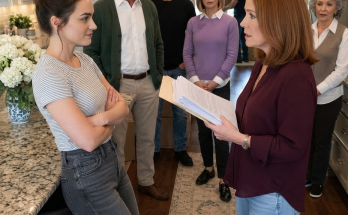
At 10:45, a partner from an old banking family texted to congratulate me on “the calmest public execution” he had ever witnessed. I did not respond.
At 11:30, my mother arrived at my front door.
I saw her through the side window before opening it. Camel coat, oversized sunglasses, flawless lipstick, rigid posture. She looked like someone arriving for a committee luncheon, not a moral reckoning.
I opened the door but didn’t invite her inside.
“Maya,” she said, as though we had arranged brunch.
“Mom.”
She slowly removed her sunglasses. Her eyes looked tired, though not from crying.
From damage control.
“Aren’t you going to let me in?”
“No.”
Her mouth tightened. “Must we make this theatrical?”
I nearly smiled. “You taught me theater.”
That landed.
Good.
The winter air between us smelled like damp leaves and expensive perfume.
“Victoria is devastated,” she said.
“I’m sure.”
“She hasn’t slept. Richard left the house last night.”
That surprised me, though I didn’t show it.
“Did he.”
“He went to his brother’s place. They argued.”
I leaned lightly against the doorframe. “And why are you telling me this?”
“Because things are falling apart.”
“No,” I said. “They’re revealing themselves.”
Her expression hardened. She always hated when I answered too clearly.
“This self-righteousness doesn’t suit you.”
“Neither does selective memory.”
She inhaled slowly, reset herself, and tried again.
“You have to understand how it looked.”
There it was.
Not what they had done.
How it looked.
Everything in my mother’s moral universe was aesthetic before it was ethical.
“How what looked?” I asked. “Me entering a charity gala with an invitation?”
“You kept your life hidden.”
“Private.”
“Hidden,” she repeated. “You allowed people to draw conclusions.”
“No. You drew conclusions because they flattered you.”
For a second, her entire body stilled.
When truth hits someone protected by etiquette for years, it creates the strangest silence—offended, intelligent, almost admiring, and immediately defensive.
“Maya,” she said more quietly, “family should not punish family this way.”
I laughed then. Softly, but genuinely.
“Family should not attempt to have family physically removed from their own property.”
“That is not what happened.”
I stepped fully outside and closed the door behind me.
“That is exactly what happened.”
She lifted her chin. “We didn’t know it was your property.”
“And if it wasn’t?”
Again, that fatal question.
Again, no answer.
She looked away first.
“I came,” she said, “to ask you to reverse the suspension.”
“No.”
“At least shorten it.”
“No.”
“Victoria’s committee positions—”
“Gone.”
“Her social obligations—”
“Consequences.”
“You’re being vindictive.”
I held her gaze.
“No. I’m being clear.”
And that was the moment she finally dropped the act.
The polished tone disappeared. The committee-chair smile disappeared. For one brief second, I saw the real woman underneath it all—angry, humiliated, terrified of losing access to the rooms she had confused with identity.
“You always hated us,” she said.
I blinked.
“No,” I answered quietly. “I wanted you to love me without ranking me.”
She looked startled, almost hurt, as though I had violated some private rule simply by speaking the truth that plainly.
Then she straightened again.
“Well,” she said coldly, “if this is the sort of woman success has turned you into, perhaps it’s better you kept it hidden.”
That might once have wounded me.
It didn’t anymore.
“This is the kind of woman your behavior revealed me to be,” I said. “Please leave.”
She stared at me for several long moments.
Then she slid her sunglasses back on, turned, and walked toward her car.
She never looked back.
I watched her drive away and felt nothing resembling triumph.
Only relief.
Over the next two weeks, the city did exactly what cities always do.
It fed.
The story spread first through club members, then donor circles, then finance and real estate, then every social corridor where vanity and money overlap. Different versions multiplied. In one, Victoria had thrown a drink. In another, I had her escorted out before dessert. In one particularly imaginative retelling, my mother fainted beside the registration desk.
People embroidered the story because the truth was already dramatic enough to deserve sequins.
I corrected no one unless business was involved.
That was the practical difference between my sister and me. She believed reputation was a costume. I understood it was cumulative.
At the office, the incident created an unexpected side effect. Several junior women at my firm began speaking more openly around me. One admitted she had spent years hiding her background because colleagues from wealthier families treated first-generation success like a charming accident. Another confessed she had watched the clip—yes, someone had discreetly recorded part of the confrontation—and for the first time felt that dignity and power might be able to coexist.
I hated that there was a recording.
I was grateful there was a recording.
Reality often needs evidence to survive rich people.
Three weeks after the gala, Richard requested a meeting.
Not through my mother. Not through a mutual acquaintance. Directly through my assistant, with a note so formal it nearly made me laugh:
I would appreciate fifteen minutes regarding a personal matter adjacent to, though not entirely concerning, the events of December 14. I understand if you decline.
I gave him twenty.
He arrived at my office wearing a charcoal coat and the expression of a man who had finally stopped sleeping inside a lie.
Anderson Capital occupied the top two floors of a restored limestone building downtown. Glass conference walls, dark wood, original stone columns, no wasted extravagance. Everything intentional. Everything useful. My mother would have called it severe. Victoria would have called it understated in the tone people reserve for places they cannot afford.
Richard stood by the window for a moment after being shown in, studying the city below.
“I understand now why you never bothered explaining yourself,” he said.
I sat at the end of the conference table. “You requested a meeting, not a revelation.”
He smiled faintly. “Fair enough.”
He remained standing for another moment.
“That night,” he said, “didn’t create the problems in my marriage. It only removed the last excuse for ignoring them.”
I waited.
“Victoria has always needed the room to reflect her back at herself. If it didn’t, she punished it. I thought I could live with that if I managed the angles carefully enough.” He exhaled slowly. “Turns out I can’t.”
“You’re leaving her.”
“Yes.”
That surprised me less than I expected it to.
“What do you want from me?” I asked.
“Nothing strategic. Nothing material. I just thought you deserved to know your family’s version of this story will eventually try to make it your fault.”
I leaned back slightly. “It already has.”
“Not completely. Not yet.” He finally sat down. “Margaret is telling people you set a trap. That you baited Victoria by staying silent. That you weaponized private information to humiliate the family.”
I almost admired the elegance of it.
Turn silence into the crime.
Turn arrogance into the victim.
“And what are you telling people?” I asked.
“The truth.”
I studied him.
“Why?”
He held my gaze. “Because once you see someone clearly, continuing to lie about them starts to feel like rot.”
That was a better answer than most people ever manage to give.
I nodded once. “Thank you.”
He stood to leave, but paused near the door.
“She’ll never forgive you, you know.”
I looked down at the file open in front of me, then back up at him.
“She never respected me. Forgiveness would be a strange place to begin.”
He gave a short, tired laugh and walked out.
The divorce filing became public in February.
That was earlier than anyone expected and uglier than Victoria wanted. Richard contested very little. That offended her more than betrayal ever could have. To someone like my sister, indifference is the ultimate insult. Conflict at least acknowledges value.
My mother threw herself into damage control with the energy of a woman trying to patch a sinking yacht using pearl earrings. She hosted lunches. Called allies. Curated sympathy. She blamed stress, misinformation, marital strain, my secrecy, modern culture, club politics, and once—memorably—the collapse of family values.
The irony was sharp enough to become art.
I did not engage.
At work, we closed two acquisitions, exited a manufacturing investment ahead of schedule, and finalized the redevelopment agreement with the city. In March, I testified before a public planning board about mixed-use redevelopment on the east riverfront. That same week, Victoria was photographed leaving a luncheon looking hollow-eyed and furious.
For the first time in our lives, I occupied the city as substance while she occupied it as aftermath.
Spring arrived slowly.
The club gardens woke first—white tulips, then climbing roses, then jasmine along the terrace walls. Business continued. Events continued. The absence of my mother and sister from the social ecosystem caused less disruption than they would have imagined and more gossip than they deserved.
Absence has a brutal way of measuring importance.
In late April, I received a letter.
Not an email. Not a voicemail. A handwritten letter on cream stationery with my mother’s monogram pressed at the top.
Maya,
I have rewritten this three times. I do not know whether I am apologizing correctly, which may itself explain more than I would like. I spent years believing presentation and survival were the same thing. Your father softened that instinct in you. I hardened it in Victoria. I suspect I also punished you for not needing me in the way she did.
I am not asking you to reverse the suspension. By the time you read this, that will hardly matter. I am asking whether, once it is over, you would consider meeting me somewhere not attached to memory.
Margaret
I read it twice.
Then a third time.
It wasn’t a good apology.
It wasn’t enough.
But it was perhaps the first honest thing my mother had ever written to me.
I didn’t respond immediately.
Sometimes the most radical act in a family built on reaction is refusing speed.
By June, the six months were nearly over.
Catherine scheduled the board review for the first Tuesday after the suspension period ended. Policy required it. Personal history complicated it. Social anticipation practically sponsored it.
The board met in the small west conference room overlooking the river. Catherine. Thomas. Two external members. General counsel. Me.
Membership reinstatement required a majority recommendation.
Catherine opened the file.
“Mrs. Anderson and Mrs. Holloway have each submitted written statements requesting reinstatement.”
She passed the copies around.
My mother’s statement was restrained, formal, self-aware in flashes, still resistant to full accountability but not entirely dishonest.
Victoria’s was worse.
She called the incident unfortunate, emotionally charged, and privately complicated. She expressed regret for the disruption. Regret for “the optics.” Regret for “misinterpretations.” Regret that “all parties experienced distress.”
Not a single sentence acknowledged what she had actually done.
Not one.
When Catherine finished reading, she set the pages down without expression.
“Comments?” she asked.
Thomas spoke first. “Mrs. Anderson’s statement suggests some degree of understanding. Mrs. Holloway’s suggests public relations.”
One board member, a retired federal judge, adjusted his glasses. “I do not recommend reinstating any member who still appears confused about why her conduct was unacceptable.”
I remained silent.
Catherine turned toward me. “Owner’s position?”
I folded my hands together.
“My mother may return under probationary membership terms,” I said. “No committee service for one year. Any future conduct issue results in permanent termination.” I let the words settle. “Victoria Holloway should not be reinstated.”
Nobody looked surprised.
Catherine nodded slowly. “On what grounds?”
“Because she still believes the problem was discovery, not behavior.”
That was the entire case.
The board voted.
The final result was four to one in favor of probationary reinstatement for Margaret Anderson, and unanimous denial for Victoria Holloway.
Catherine signed the notice.
And just like that, the social map shifted again.
My mother called that evening.
This time, I answered.
“Hello, Mom.”
A small pause followed, as though she had prepared herself for resistance and no longer knew what to do with simple acceptance.
“Hello, Maya.” Her voice sounded quieter than I remembered. “I received the notice.”
“I imagine you did.”
“Thank you.”
Not for the probation.
For answering the phone.
I heard it clearly.
“You’re welcome,” I said.
Another pause.
“Victoria is furious.”
“I know.”
“She says you ruined her life.”
“No,” I said, looking out over the city from my office window while dusk turned the glass towers pink. “I think I interrupted the story she was telling herself about it.”
My mother let out something halfway between a sigh and a laugh.
“I would still like to meet,” she said. “If you truly meant you would consider it.”
I thought about her letter. The woman on my porch. The woman at the registration desk asking a stranger to remove me discreetly. All the mothers she had been. All the mothers she had failed to be.
“Yes,” I said. “But not to restore anything. Only to see what’s possible now.”
“That’s fair.”
It was more than fair.
It was generous.
We met the following week at a small café across town, nowhere near the club, nowhere near our old neighborhood, nowhere any of her friends would consider important enough to accidentally witness. She arrived early. So did I.
Age had not changed her beauty.
Honesty had changed her face a little.
We sat.
Ordered coffee.
For a full minute neither of us spoke.
Then she said, “I was harder on you because you frightened me.”
That was not where I expected her to begin.
“How?”
“You seemed to want so little from the world I understood.” Her fingers tightened around her cup. “I knew how to raise a daughter who wanted approval. I didn’t know how to control one who wanted truth.”
There it was again.
Not absolution.
But something real.
“I didn’t want truth,” I said. “I wanted love that didn’t come with an audition.”
Her eyes filled then, genuinely this time.
“I know.”
I believed she knew now.
Late.
Imperfectly.
But knew.
We talked for nearly two hours. Not beautifully. Not smoothly. There were pauses, evasions, corrections, old instincts surfacing and then being deliberately put away. She admitted she had envied my freedom. I admitted I resented Victoria less for her cruelty than for how openly our mother loved her. My father’s name surfaced once and altered the air between us like weather.
When we stood to leave, she asked, “Will we do this again?”
“Yes,” I said. “Maybe.”
That was enough.
It had to be.
As for Victoria, she did what people like Victoria always do once the room stops rewarding the performance.
First she raged.
Then she blamed.
Then she reinvented herself.
By autumn, she had relocated to Palm Beach under the explanation that she was “seeking a healthier environment.” She began appearing in photographs beside a new crowd, softer clothing, captions about reinvention, resilience, and protecting one’s peace. She even gave an interview to a lifestyle website about “choosing authenticity after social betrayal,” which would have been hilarious if it weren’t so aggressively on-brand.
I didn’t read beyond the headline.
Richard finalized the divorce in October. Six months later he had remarried no one, moved into a smaller house, joined a land conservation board, and looked—in every candid photograph I accidentally saw afterward—like a man released from decorative captivity.
My mother came to dinner twice that winter.
Not for holidays.
Just dinner.
The first time she brought flowers and asked before walking into my kitchen. The second time she washed her own wine glass after we ate, and I nearly laughed at how emotional such a tiny gesture felt. Repair, I learned, is almost never dramatic. It is built from awkward repetitions and habits so small they would bore anyone who had not once believed change impossible.
A year after the gala, the club hosted the winter benefit again.
Same chandeliers.
Same river.
Same orchestra, though a better conductor.
This time, when I entered the ballroom, nobody questioned whether I belonged there.
That wasn’t the victory.
The victory was that I no longer needed the room to know it.
Halfway through the evening, Helena Crowe joined me near the terrace doors and handed me a champagne flute.
“You look peaceful,” she said.
“I am.”
“Hard-won?”
“Yes.”
She smiled. “Those are the only kinds worth having.”
Inside, the auction began. Outside, the river carried city light in long broken ribbons. Beyond the glass, people moved through the ballroom in polished patterns, chasing recognition, influence, photographs, donations, partnerships, marriages, rumors, futures.
I thought about the girl I used to be, standing beside a mother who measured worth in polish, beside a sister who measured it in envy, wondering whether quiet competence would ever be enough to protect a life.
The answer, I knew now, was no.
Quiet competence does not protect you from cruelty.
But it does build something stronger than approval.
It builds a self no one else gets to define.
My phone buzzed once.
A message from my mother.
You look happy tonight. Your father would have been proud.
I stood very still after reading it.
Then I typed back:
Thank you.
Inside, applause rose through the ballroom as the first major donation number appeared on the screen.
I slipped my phone into my bag and stepped back through the doors.
My table was waiting.
My name was printed on the program.
My work lived in every corner of the building.
And my place in that room no longer had anything to do with being accepted by people who once believed I should be removed from it.
I walked calmly toward the center of the evening, without hurry, without performance, without apology.
Not because the world had finally learned my worth.
Because I had.
And that was enough.