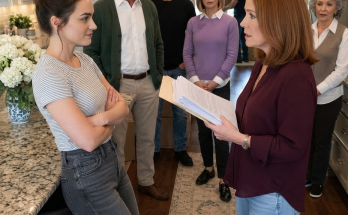
“It is, in fact, entirely possible,” Thomas said. “It is also public record.”
My mother’s lips parted, but no sound emerged.
That shocked me more than anything else.
My mother always had words.
I stepped forward at last, retrieving my invitation from where it still rested bent and forgotten on the desk.
“I purchased the portfolio eighteen months ago,” I said. “Before that, my firm acquired a substantial interest in the holding group. Before that, I spent twelve years in private equity, asset restructuring, and investment management. I’ve been ‘someone who accomplished something’ for quite some time.”
Victoria looked down at my dress again, as though the navy silk itself had deceived her.
“You drive a Honda,” she whispered.
“Yes,” I said. “It’s dependable.”
A sound escaped somewhere in the crowd. Not quite laughter. Something more dangerous.
Recognition.
The story had shifted, and everyone knew it.
“You work in an office,” my mother said weakly, still trying to drag reality back into its old shape.
“I own an office building too,” I replied.
A few people laughed softly then, unable to stop themselves.
Color flooded Victoria’s face so violently it looked painful.
“This is insane,” she said. “Why would you hide this?”
“I didn’t hide it,” I answered. “I just didn’t perform it for you.”
That struck harder than I expected.
Because it was true.
I had never lied. I simply never advertised. I didn’t post luxury vacations online, didn’t casually drop designer brands into conversation, didn’t parade numbers around like evidence of existence. I let my work remain my work. My life remain my life. My mother and sister had filled the silence with assumptions because arrogance despises empty space.
“But—” Victoria’s voice cracked. “But you let us believe—”
“You believed what you wanted to believe,” I said.
Richard looked at me then with something close to admiration. Not because of the money. Because of the discipline it took not to become cruel when cruelty would have been effortless.
My mother recovered first.
“Maya,” she said, stepping closer and lowering her voice into that intimate tone she used whenever she wanted to rewrite reality in real time. “Why didn’t you tell us?”
I looked at her.
Because you never asked with love, I thought.
Because every question you ever asked was really an inventory.
Because I learned early that privacy was the only space in this family no one could redecorate.
Out loud, I said, “Would it have changed how you spoke to me before this moment?”
She flinched.
There it was.
The real wound.
Not exposure.
Recognition.
Victoria jumped in instantly, desperate and scrambling. “Of course it would have changed things.”
“Yes,” I said. “That’s the problem.”
Silence again.
Long. Merciless. Intelligent silence.
I turned slightly, enough to include the room without performing for it.
“My sister asked to have me removed because she believed I lacked status. My mother supported her because she believed I lacked social value. Neither of them objected to humiliating me publicly. They only objected once they realized it was strategically stupid.”
The crowd remained motionless.
Truth, when spoken plainly in rooms built entirely on performance, always lands like a soundless explosion.
Victoria’s eyes filled with bright, furious tears. “You’re twisting this.”
“No,” I said. “I’m clarifying it.”
She stepped toward me. “I didn’t know.”
“You knew I was your sister,” I said. “And you still treated me like something to scrape off a shoe.”
That did it.
Her face broke.
Not with guilt.
With fear.
Because suddenly she understood what the crowd understood, what James understood, what Richard may have understood for years.
This was no longer just family drama.
This was social annihilation.
Every single person in that room would tell this story.
A woman tried to have her own sister thrown out of a charity gala for not looking wealthy enough. Then discovered her sister owned the entire building.
There are scandals people recover from.
And then there are stories people become.
My mother reached for my wrist.
“Maya, please. This has gone far enough.”
I stepped away before she could touch me.
“No,” I said quietly. “It hasn’t.”
James clasped his hands behind his back. He didn’t smile, though I could tell it took effort not to.
Catherine asked the question that officially transformed humiliation into consequence.
“Ms. Anderson,” she said, “how would you like the club to proceed?”
I looked at my sister.
At my mother.
At the room still absorbing them.
For one heated second, a dozen possibilities crossed my mind. Permanent revocation. Public ban. Immediate removal with a full board notice. There was power in every option, and I could feel the room wondering what sort of owner I truly was.
But I had not built my life on impulse.
I had built it on discipline.
“Victoria Holloway and Margaret Anderson are suspended from club property and all affiliated facilities for six months pending board review,” I said. “Effective immediately.”
My mother gasped as if I had physically struck her.
Victoria just stared.
Then let out one disbelieving laugh.
“You can’t be serious.”
“I’m entirely serious.”
“For six months?” she snapped. “That’s half the season.”
“Yes,” Catherine replied coolly. “That would be the point.”
Victoria turned toward the board president in horror. “You’re actually enforcing this?”
“We enforce policy,” Catherine said. “And the owner’s directive aligns with policy regarding member conduct, harassment, and disruption.”
My mother finally found her voice again. “Maya, think carefully. This will create talk.”
“It already has,” I replied.
“People will ask what happened.”
“They watched what happened.”
Victoria’s breathing turned sharp and uneven. “The governor’s holiday reception is here next month.”
“I know.”
“The hospital chairman’s dinner. The New Year board mixer. The spring donor planning brunch—”
“I know the calendar,” I said. “I approved half of it.”
The crowd made that dangerous sound again, part amusement, part admiration, part hungry delight.
This was no longer merely satisfying.
It was elegant.
My mother’s composure cracked at last. “How could you do this to us?”
The question was so openly absurd that for the first time all evening, genuine laughter rose in my throat. I swallowed it, barely.
“How could I do this?” I repeated. “You asked staff to remove me from my own event.”
Victoria shook her head frantically. “Because I didn’t know!”
“And if I had been exactly who you thought I was?” I asked.
That stopped her cold.
“Would I have deserved it then?”
Her mouth opened.
Closed.
No answer came.
Because there wasn’t one.
James discreetly signaled two security staff standing near the edge of the room. Not aggressively. Not theatrically. Just enough.
The sight of them unraveled Victoria more effectively than any shouting could have.
“This is insane,” she whispered. “You’re choosing a stranger over your family.”
I held her gaze.
“No,” I said. “I’m choosing dignity over cruelty.”
My mother’s eyes filled with tears. She rarely cried. Only when tears could function as leverage.
“You’re humiliating us.”
I almost said, Now you know how it feels.
But I didn’t.
Instead I said, “No. You humiliated yourselves. I’m simply refusing to save you from it.”
That sentence moved through the room like fire catching silk.
I saw it in the faces around us—the subtle shift when people recognized the line they would repeat tomorrow over lunch, over text messages, over golf, over cocktails. It would survive tonight. Maybe survive all of us.
Richard finally stepped forward.
“Victoria,” he said gently, “you need to stop.”
She rounded on him instantly. “Don’t you dare. Don’t you dare take her side.”
“I’m not taking sides. I’m telling you that you’ve made this worse every single time you opened your mouth.”
For a moment, even I forgot how to breathe.
Victoria stared at him as if betrayal had been physically impossible right until the moment it arrived.
My mother looked between them and realized there were now two disasters unfolding instead of one.
“Richard,” she said sharply, “this is a family matter.”
He laughed once, exhausted and bitter. “That’s exactly the problem, Margaret. You keep saying that like it excuses anything.”
The room became even quieter, impossibly enough.
My sister’s humiliation had just gained witnesses inside her own marriage.
“Enough,” Victoria hissed.
“No,” he replied. “Not enough. You insulted her. You tried to throw her out. You did it because you believed she was beneath you. And the worst part isn’t that she owns the place. The worst part is that you would have felt completely justified if she didn’t.”
I looked at him differently then.
Not warmly.
But differently.
Because very few people ever told Victoria the truth while the lights were still on.
Her entire face trembled. “You’re embarrassing me.”
Richard studied her for a long moment. “You did that yourself.”
She slapped him.
Not hard enough to injure.
Hard enough to echo.
A collective flinch moved through the room.
And there it was—the final fracture. The perfect family image. The polished social façade. The carefully controlled performance. Gone in one sharp sound.
My mother grabbed Victoria’s arm. “Stop this. Right now.”
But she was already too late.
Far too late.
James spoke with polished finality. “Mrs. Holloway. Mrs. Anderson. I’ll have your wraps brought to the front. Security will escort you out.”
Victoria looked at me then with pure hatred, the honest kind stripped of makeup, posture, and polished vowels.
“This isn’t over,” she said.
I believed her.
But I also knew something she didn’t.
It was.
At least the version of life she understood was over.
Because power can survive insult.
Status can survive gossip.
But vanity rarely survives exposure.
My mother straightened herself with whatever dignity she could still gather from the wreckage.
“We’re leaving,” she announced, as though it had somehow become her decision.
“Yes,” Catherine replied. “You are.”
They turned. Slowly at first, then more quickly as the awareness of seventy watching eyes became unbearable. The crowd parted for them with exquisite manners and total mercilessness. No one spoke. No one needed to.
Richard didn’t follow immediately.
He remained where he was, one hand at his side, the red mark on his cheek already fading.
Then he looked at me.
“I’m sorry,” he said.
There was too much inside those two words for any simple response.
So I gave him the truest one I had.
“I know.”
He nodded once, then followed his wife out.
Only after the foyer doors closed behind them did the room finally begin to breathe again.
Conversation returned in fractured bursts. Music resumed. A server finally moved the champagne tray he had been holding like an offering to the gods of scandal. But the atmosphere had permanently shifted. Everyone knew the benefit would raise money tonight. Everyone also knew no speech, auction, or donor announcement would outshine what had happened near the entrance.
Catherine turned toward me. “That was restrained.”
Thomas added, “Extremely.”
Margaret closed her folio. “Legally impeccable, if that helps.”
I released a breath I had been holding for years, not minutes.
“Please tell the orchestra they can stop pretending not to stare at me,” I said.
That made Catherine laugh.
James stepped closer, quiet enough not to carry across the room. “Your table is ready, Ms. Anderson. We moved the governor to your left and the foundation chair to your right, as requested.”
“Thank you.”
I should have felt triumphant walking into the ballroom afterward.
Instead I felt something heavier.
Not guilt.
Maybe grief.
There is a very particular sorrow in realizing your family never misunderstood you.
They simply valued the wrong things.
The rest of the evening should have blurred together. Usually events like that do—too many introductions, too many polished smiles, too much money disguised as benevolence. But I remember every detail with strange clarity.
The governor did, in fact, want to discuss our proposed property expansion and a public-private redevelopment partnership. He spoke in the confident, careful tone of a man who understood charm functioned as currency. Across from him sat Helena Crowe, chair of the children’s oncology foundation we funded that year, a woman who had built three medical nonprofits and had never once asked what label anyone wore.
To my left, donor tables gleamed.
To my right, a string quartet played jazz arrangements.
And underneath all of it, the story moved like an underground current from table to table, mouth to mouth.
I caught the glances. The quick look away when I noticed. The restrained smiles. The sharpened curiosity. A city feeds on stories like that because they reassure everyone they are not the fool in the room—at least not tonight.
Still, nobody approached me with vulgar curiosity. Wealth teaches people manners even when it fails to teach them decency.
By dessert, my pulse had steadied.
By the live auction, I was bidding against a pharmaceutical executive for an art retreat in Santa Fe and winning easily because I had no emotional attachment to victory, only to disciplined pricing.
By the end of the evening, we had exceeded the fundraising target by nearly twenty percent.
Money, after all, has a very short attention span. It enjoys scandal so long as the returns remain strong.
When the final donors drifted away and the ballroom finally emptied, I stepped onto the terrace for air.
Below the club, the river moved dark and smooth beneath the winter lights. Across the water, downtown shimmered with the clean, deceptive beauty cities wear best from a distance. From far enough away, everything looks orderly. Permanent. Earned.
Behind me, the doors opened.
I expected James.
Instead it was Richard.
He had removed his bow tie and looked older than he had two hours earlier.
“I hope I’m not intruding,” he said.
“You are,” I replied. “But I’ll allow it for a minute.”
He nodded as though that was fair.
“Victoria went home with your mother,” he said. “Or rather, your mother dragged her home before she started screaming at people in the parking lot.”
“That was probably wise.”
He gave a humorless smile. “Not a word often connected to tonight.”
The cold sharpened the silence between us.
Finally he said, “You really never told anyone?”
“Very few people. Not deliberately. I value privacy.”
“Victoria always said you lacked ambition.”
I looked at him.
He looked ashamed.
“Did you believe her?” I asked.
“At first? A little.” He exhaled slowly. “Then I realized she described everyone as lacking something she valued. Beauty. Polish. Status. Submission. Eventually I understood that meant very little.”
That interested me.
Not because I cared what Richard thought.
But because self-awareness in a man like him was rarer than sincerity in a campaign speech.
“Why are you still with her?” I asked.
He laughed once, stopped, then answered with more honesty than I expected.
“Because leaving someone like Victoria isn’t one decision. It’s a hundred. You make one, then another, then another, and by the time you finally admit the marriage is hollow, your entire life is full of structures built to defend it.”
That sounded painfully true too.
I folded my arms against the cold. “Then maybe tonight helped.”
“It might have.” He stared out over the river. “You didn’t destroy her, you know.”
“No?”
“No. You exposed her. Different thing.”
He was right. Exposure only feels like destruction to people whose lives depend on illusion.
“Your mother will try to repair this,” he said after a pause.
“I know.”
“She’ll say family is family.”
“She already has.”
“What she means is: please restore the old hierarchy.”
That drew the faintest smile from me. “You do understand them.”
“Unfortunately.”
He stood quietly for another moment before turning toward me fully.
“For what it’s worth, I’m impressed by what you built. Not the money. The discipline. The silence. The fact that you never needed any of us to witness it for it to be real.”
That landed harder than praise should have.
Because he had accidentally named the central truth of my life.
I built without an audience.
Not because I was noble.
Not because I was above validation.
Because I learned very early not to expect it from the people who should have given it freely.
“Good night, Richard,” I said.
He inclined his head, accepting the boundary.
“Good night, Maya.”
Then he left.
I stayed there long enough for the cold to settle into my bones. Afterward, I went home to the house my sister once described as “cute” in the tone people use for a child’s finger painting. Modest by old-money standards. Beautiful by mine. Every piece chosen because I loved it, not because it photographed well.
I removed my heels, poured a glass of water, and sat in my kitchen just after midnight listening to the hum of the refrigerator and the distant wind through the trees.
My phone lit up.
James.
Everything concluded without incident. Your mother requested reconsideration twice. Denied, as instructed. Also—if I may say so—it was a privilege watching you hold the line.
I typed back:
Thank you. Get some sleep.
A minute later another message appeared from an unknown number.
This is Helena Crowe. I didn’t want to say this at the table, but what you did tonight mattered. Not because of the gossip. Because every staff member in that room saw an owner refuse to reward cruelty. That’s rare. Proud to partner with you.
I read that message twice.
Then turned the phone face down.
The next morning, the storm arrived.
Not publicly at first. Wealthy scandals prefer private channels before they mature into social folklore.
My mother called at 7:12 a.m.
I let it ring.
She called again at 7:16, 7:19, and 7:24.
Then came the voicemail.
“Maya, this has gotten out of hand. Victoria is devastated. You made your point. Call me so we can discuss this like adults.”
Like adults.
Meaning: privately, where truth could still be negotiated.
I ignored it.
At 8:03, a florist delivered white peonies and apology roses roughly the size my ego was apparently expected to become. There was no card, only a note from the shop explaining the order had been placed by Margaret Anderson.
I redirected them to the children’s hospital.
At 9:10, Catherine sent the formal board notice confirming the six-month suspension had officially entered policy record.