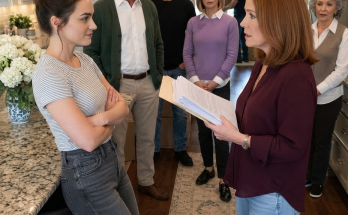
“I thought you worked in logistics or administration or something,” Tyler said. I almost smiled. “Technically, sometimes I did.” “Grant said diplomats?” I said nothing. His eyes widened. “Jesus.” “Don’t turn it into a movie,” I told him calmly. “Operations are not like that.” He nodded slowly, then surprised me. “Dad’s scared.” I frowned. “Scared?” Tyler looked toward our father. “He built his whole identity around being the military man in this family—the tough one, the authority. Now he realizes he never understood the actual soldier standing right in front of him.”
By sunset, most of the relatives began leaving, but the atmosphere stayed strange. People hugged me differently now, more carefully, as though I had become unfamiliar. That always bothered me. Respect built on secrecy is not understanding. It is intimidation. Aunt Denise squeezed my arm near the driveway and said, “You should have told us.” I answered honestly, “You never wanted to know.” Her face fell because she knew I was right.
The only person who refused to soften was my father.
He sat beside the grill long after the food was gone, drinking whiskey now instead of beer, watching me like he was still searching for the lie. Eventually, my mother came over quietly. “Your father wants to talk.” Every muscle in my body tightened. Thirty-six years old, a colonel in the United States Army, and still one sentence from my mother could make me feel sixteen again.
I crossed the darkening yard and stopped beside him. He did not look up. “You embarrassed me,” he muttered. I blinked. Out of every possible reaction, that almost made me laugh. “You embarrassed yourself.” His jaw tightened. “Grant made me look stupid.” “No,” I said calmly. “You did that alone.” Finally, he looked at me, and beneath the anger, I saw confusion—real confusion. “How did this happen?” he asked roughly, as if my success was a betrayal.
“I worked,” I said simply. “That’s not enough to become…” He gestured vaguely at my uniform. “That.” I stared at him for a long moment before asking the question I had buried most of my life. “Would it have mattered if I failed?” His expression shifted just enough, and I knew the answer. No. My father had never expected greatness from me. Only obedience. Tyler’s failures were temporary. Mine were inevitable.
Dad looked away first. “You were always angry.” “No,” I said softly. “I was ignored.” That struck harder than yelling would have. He swallowed before speaking again. “Grant says people know your name.” “They know my work.” “What’s the difference?” Everything. But I was too tired to explain. “You wouldn’t understand.” His anger flared instantly. “There you go, acting superior.” I almost answered, then stopped, because suddenly I understood something freeing. I no longer needed him to understand.
For years, I thought success would finally force my father to love me correctly. But people do not transform just because reality humiliates them. Some only dig in deeper. “I have to leave before dawn,” I said quietly. “Running away again?” he asked. I looked at him calmly. “No. Returning to work.” Then I walked away, and for once, I did not feel guilty.
I stayed overnight at my mother’s house because driving back to Fort Liberty that late made no sense. My childhood bedroom felt smaller than I remembered—the pale yellow walls, the narrow bed, the old track medals still hanging near the closet. Nothing in that room suggested the life I had built. Maybe that was fitting. Around midnight, I heard footsteps outside my door, followed by a soft knock. My mother entered with two mugs of tea and sat beside me in silence.
After a while, she whispered, “I’m sorry.” Simple words, twenty years too late. I stared into my cup. “You knew.” It was not a question. She nodded slowly. “Not specifics. But enough.” “Enough to stop him.” Tears filled her eyes. “You don’t understand your father.” “No,” I replied evenly. “I understand him perfectly.” She flinched, and suddenly I saw something I had missed as a child: fear.
My mother had not stayed quiet because she agreed with him. She had stayed quiet because she had spent decades surviving him—not physical violence, but something quieter. Control. Dismissal. The slow erosion of confidence. “He was harder after you left,” she admitted. “How?” “He thought the Army turned you against him.” I laughed bitterly. “No. He did that himself.” She looked exhausted, older than I remembered. “You know he talks about you constantly?” I frowned. “What?” “He tells people his daughter is an officer.” I stared at her. “He’s proud,” she whispered. “No,” I said. “He’s possessive.” Her eyes widened because she knew I was right.
There is a difference. One loves who you are.
The other loves claiming ownership over what you have achieved. My mother hesitated, then asked quietly, “Are you really in danger all the time?” I smiled faintly. “No more than anyone else in my field.” “That is not comforting.” “It is not supposed to be.” She looked down at her tea, then finally asked the question no one in my family had ever asked. “Are you happy?” That stopped me. I considered it carefully. “Yes,” I said eventually. And surprisingly, I meant it. Not perfectly happy. Not movie happy. But purposeful. Useful. Respected. Things I had never felt in that house. My mother smiled sadly. “I’m glad one of us escaped.”
At 4:30 the next morning, pounding on the front door jolted me awake. Training took over before consciousness fully caught up. I was out of bed and halfway across the room before remembering where I was. Another hard knock echoed from downstairs, followed by urgent male voices. I reached automatically for the sidearm that was not there, then remembered regulations had prevented me from carrying after drinking earlier. My stomach tightened. Something was wrong.