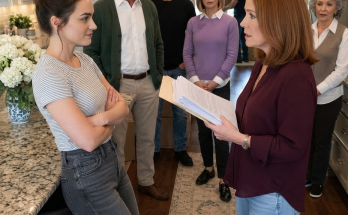
“This house,” I cut in, “was purchased three years before I met you. Your name has never been on the deed.” He went pale for half a heartbeat, then flushed hard from the collar up.
Constance hissed as if I had insulted her bloodline. “We will call the police again. You cannot erase a marriage in one night.”
“Funny,” I said. “That is exactly what Jasper did.” Blair rolled her eyes. “So dramatic.”
Margot stood there fidgeting with the rental truck keys, and that was when I noticed it, she was not standing in strength at all. She was beginning, in real time, to understand what she had actually married.
Not some brave romantic hero escaping a loveless wife. Not a truth teller who had finally chosen passion. Just a sloppy man who thought cruelty was power and logistics were something women existed to handle for him.
A rental company driver waited near the curb, already looking as though he regretted this route. Margot stepped forward, swiped a card through the handheld reader. Declined.
She frowned and tried again. Declined. She dug another card from her purse and swiped that one too. Declined.
The driver coughed politely. “Ma’am, if the balance is not covered.” Jasper yanked his wallet out and thrust his own card toward the machine. “Use mine.”
Margot turned toward him. “I thought.”
“Shut up,” he snapped. There it was. The first visible crack in the fantasy.
The new wife blinking in the July heat while the old patterns emerged the second reality asked for payment. I crossed my arms. “Looks like the Las Vegas glow wore off pretty fast.”
Blair snapped, “You think you are so smart, Matilda. But you are bitter, alone, thirty four. What do you even have left?”
I stepped close enough that some of her bravado thinned under direct eye contact. “What do I have left?” I said softly. “My house. My career. My freedom. And I do not have Jasper. Honestly, that is the best part.”
Jasper flinched so slightly most people would have missed it. Margot turned to him again. “Did you know she canceled all your cards?”
Panic flashed through his face before anger rushed in to cover it. I let that moment breathe. Let her see him. Let him know I saw that she saw him.
Then I said, almost sweetly, “Oh, and Margot? Your new husband’s company has a strict no fraternization policy. I wonder how human resources will feel about a Las Vegas marriage between coworkers.”
Her head snapped toward him. “You said it would not matter.”
“Margot,” he said through his teeth, “shut up.”
The air in the garage thickened. Constance made one last attempt to seize control through volume alone. “You are vindictive, Matilda. This is exactly why Jasper left. You always had to be in charge. Always making everyone feel small.”
I almost admired how smoothly she could step around a son who married his mistress in Nevada and still land on me as the problem.
“You know what,” I said, “you are right about one thing. I do like being in charge of my own house.” I looked at Jasper. “You have one hour to load up and leave. After that, the locks get checked again and whatever remains goes into storage under your name.”
They argued, naturally. Constance called me cold. Blair called me pathetic. Jasper muttered vague threats about lawyers he could not afford.
Margot stood in the middle of it all with her wrinkled white dress and failing certainty, learning too late that she had not stepped into a love story. She had stepped into a liquidation. But they packed.
Box after box came down the driveway while the summer heat pressed against the pavement and the neighborhood pretended not to watch. Constance kept issuing commands no one followed. Blair sneered at every load she had to lift. Margot went increasingly silent.
Jasper sweated through the back of his shirt by the third trip and looked steadily less like a newly married man and more like someone dragging the full weight of his own stupidity uphill. I stood in the garage doorway with the remote in one hand and watched.
Let them carry it, I thought. Every lie. Every fantasy. Every convenience they built by hollowing out my life from the inside.
I did not have to anymore. When the truck finally drove away and the street settled back into afternoon stillness, the house did something unexpected. It exhaled.
The furniture had not moved. The rooms looked the same. The refrigerator still chimed if the door did not seal all the way. The clock still ticked upstairs.
But some invisible pressure had lifted, the kind you do not even realize you are carrying until it is suddenly gone. I should have known peace would not last. It rarely does when wounded egos still have internet access.
Two mornings later, I woke to my phone vibrating so hard on the nightstand it sounded like panic. Not one notification. Not a few. A flood.
Texts. Tags. Missed calls. Facebook mentions. Instagram alerts. Even LinkedIn, which should be protected by law from family drama and somehow never is. For one disoriented second, I thought someone must have died.
In a way, someone had. Jasper’s public dignity, maybe.
By the time I opened the first post, I understood exactly what had happened. Jasper had gone to war, digital war, which is really just old fashioned character assassination with better lighting and more audience participation.
And he had brought Constance and Blair with him like backup singers in a pathetic little opera. They were everywhere.
Facebook first, because Constance liked an audience broad enough to include distant acquaintances and people from church who still believed tears meant truth. Instagram next, because Blair never saw a chance to perform that she did not seize. LinkedIn after that, because apparently no platform is too inappropriate when your family’s need for public sympathy becomes desperate enough.
Their story was absurd, coordinated, and polished just enough to fool the kind of people who never pause before taking sides. Matilda Halloway is abusive. She trapped Jasper in a loveless marriage. She controlled him. Manipulated him financially. Humiliated him for years.
He finally escaped and found real love.
Constance posted a tearful selfie with some nonsense about praying for sons who suffer in silence. Blair uploaded a photo of herself with Margot and captioned it like she was shielding a wounded family member from toxicity. And Jasper posted the centerpiece, he and Margot under a filtered desert sunset, smiling stiffly, with some variation of finally found peace.
The lies themselves did not hurt me. What hurt were the comments.
People I knew. People who had eaten in my home. People who had toasted us at New Year’s parties and asked me where I bought my flowers.
“Wow, I always thought something was off about Matilda. She did seem controlling. Good for you, Jasper. Everyone deserves happiness. Proud of you for getting out.”
My hands shook so badly I had to set the phone down on the comforter before I dropped it. It was not just gossip. It was a campaign.
And for a few hours, if I am honest, it worked on me, not because I believed any of it, but because public lies still have a way of invading the body. I got hot, then sick, then so furious I had to sit on the bedroom floor and breathe through it.
Not because strangers thought badly of me. Because Jasper was trying to erase what he had done by replacing it with a cleaner story in which I was the villain and he was the brave man who had finally chosen joy. He had always hated facts.
That afternoon, I called Quentin. Every woman should have at least one friend whose brain is so technical and so morally uncomplicated that when you say, “Someone is lying about me online,” his first response is not, “Ignore it,” but, “Let us see what proof they forgot to hide.”
Quentin had known both Jasper and me for years. He was the kind of man who could fix a router with a paper clip, despised fuzzy thinking, and once rebuilt my home office network after Jasper spilled beer into the modem and suggested maybe the house wiring just sucked. He was also completely immune to charm, which meant Jasper had never quite known how to manage him.
Quentin answered on the second ring. “Hey. You okay? I have seen some things.”
“They are everywhere,” I said, and heard my own voice shake. “He is turning people against me.”
“You start,” Quentin said, “by not panicking. Then you start by fighting back. I think I know how.”
By evening, he was sitting at my kitchen table with a laptop open, his glasses halfway down his nose, fingers moving so fast over the keys they blurred. He muttered to himself while he worked, a mix of irritated engineer and opportunistic detective.
“Jasper thinks he is clever,” he said. “But he is careless. Always has been. Same password patterns. Same recovery questions. Same synced browser sessions. He never clears anything because he assumes nobody else is looking.”
“That sounds familiar,” I said.
“Oh, I am sure it does.” I made coffee neither of us needed. Outside, the windows reflected us back in the dark. Inside, Quentin swore softly at software and kept going.
He was not breaking into a bank. He was doing what smart people do when arrogant people leave doors open because they do not believe anyone else knows where the handles are. Then he stopped.
“Jackpot,” he said. He turned the screen toward me.
The messages ran in blue and white columns, a year’s worth of backup conversations between Jasper and Margot preserved in all their own vicious stupidity. At first, it was the sheer volume that hit me. Then the words.
“She is so stupid. Been siphoning money from her grocery account for months. Almost saved enough for our dream wedding, babe.” Another one. “You think she will notice the missing cash?” And Jasper’s reply, “Nah. Matilda is too boring to check.”
Another. “She is basically funding our escape and does not even know it. That is kind of hilarious.”
Another. “When this blows up, play victim. Your mom will back you.” I gripped the edge of the table so hard it hurt.
Quentin kept scrolling. Hotels. Gift purchases. Plans. Petty jokes about my habits, my routines, my work hours, which cards I used most, when I usually shopped, how easy it was to skim in amounts too small to notice quickly.
I did not cry. Later, that would surprise me. But some betrayals are so ugly they skip grief and go straight to clarity.
Jasper had not simply cheated. He had used me as infrastructure for the affair. My labor. My steadiness. My discipline. My boring, reliable competence. Everything he mocked had been the invisible platform under his fantasy.
Quentin looked at the screen, then at me. “This is gold,” he said, then winced. “Bad wording.”
“No,” I said. “It is accurate.”
“You want me to package it?” I nodded.
An hour later, I had a clean folder of screenshots, timestamps intact, names visible, context untouched. No dramatic captions. No emotional essays. Just proof. Proof never needs much makeup.
I posted them with no commentary at all. No speech. No personal statement. No lesson in female survival. Just the images, one after another, like evidence under bright fluorescent light.
The internet flipped. It happened almost instantly. Comments calling me controlling vanished. New ones appeared.
“Wait, he was stealing from her grocery account? This is vile. So he funded the wedding with money he siphoned from his wife? Margot married a clown.”
Constance’s post disappeared before midnight. Blair’s vanished not long after.
Jasper’s desert sunset peace photo hung on the internet a little longer, collecting increasingly hostile comments until it too disappeared sometime after 1 a.m.
People who had rushed to pity him started messaging me privately, eager to reposition themselves on the right side of truth. I answered almost none of them. I had no appetite for loyalty that changed direction based on whichever screenshot had posted most recently.
For the first time since that text message, I exhaled. Not because it was over. Men like Jasper never know when they have lost. But because he had chosen public perception as his battlefield, and I had answered with his own words.
Desperation made him sloppy. First came the phone call from his father, Victor. If Constance specialized in elegantly shrill emotional warfare, Victor preferred sheer volume.
He was the kind of man who had spent decades sounding aggrieved in the booming voice of someone who believed his age and gender ought to exempt him from consequences. He left a voicemail for my boss claiming I was stalking Jasper, harassing his new wife, and creating an unsafe environment for the family.
I found out because my boss, Fiona, called me into her office the next morning. Fiona was one of those women whose competence was so complete it looked almost effortless.
She never raised her voice, never rushed, and had the rare gift of making one sentence do the work of an entire lecture. She closed the office door, opened her laptop, and said, “You should hear this.”
Then she hit play. Victor’s voice thundered through the speaker. “Emotionally unstable, trying to ruin his career because she cannot accept that he moved on, if you have any integrity at all, you will rein her in.”
Fiona muted it midway and looked at me over the top of the screen. “Your former in laws,” she said dryly, “have apparently decided this is a feudal dispute.”
I laughed before I could stop myself. “Sorry,” I said.
“Do not apologize. It was the correct reaction.”
Then came the attempted break in. Three nights after the social media collapse, my security app pinged at 11:18 p.m.
Motion detected, rear entry. I opened the live feed. There he was at my back door, face lit bright and ugly under the porch light, yanking the handle and whisper shouting into his phone. “She locked me out! My stuff is still in there!”
Every second was recorded. He rattled the knob again, then bent toward the glass as if trying to peer in, like the house itself had betrayed him by forgetting his shape.
I stood in the dark upstairs hallway watching the feed and felt no fear at all. Only contempt. I forwarded the clip to Diane, my attorney.
Her reply came back less than ten minutes later. “Noted.” That was all. But when the woman handling your divorce can reduce attempted trespass to one word and make it sound like the lid closing on a coffin, it has a calming effect.
Then came the rumors. He told people I had killed his cat.
At first I laughed because we had never owned a cat. I am severely allergic. Once, years earlier, Jasper had insisted we consider fostering a kitten because he thought it would make the house feel warmer, and I had spent twenty minutes sneezing in a pet store parking lot just from standing near the adoption booth.
The idea that I had secretly murdered a feline that had never existed should have ended his credibility on the spot. Some people still believed him. That was the exhausting part.
Not the stupidity of the lie, but the willingness of people to accept anything if it helped preserve the version of a charming man they preferred. When outrage, slander, and trespass failed, Jasper reached for the oldest weapon men like him know.
Pity. He called my mother.
I was sitting beside her on the couch when her phone rang. She had come over with soup, fresh bread, and the kind of quiet maternal presence that does not crowd your pain but refuses to let it isolate you either.
My mother, Irene, has always had a way of making rooms feel sturdier. She frowned at the unknown number and answered anyway.
By the second sentence, I knew it was him. “Mrs. Halloway,” he said, voice cracked and miserable, “I made a mistake. Margot means nothing. Matilda is my life.”
My mother’s face changed in slow, beautiful stages. Surprise first. Then disgust. Then something colder.