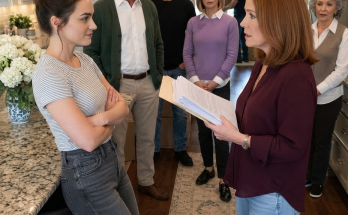
“So?” she asked as soon as the slices hit the table. “Did you fire him?”
“Not yet,” I said, folding a slice in half. “We set up some conditions. He’s going to have to change, or he’ll be out.”
She chewed thoughtfully. “Do you think he will?”
“I think people change when the pain of staying the same finally outweighs the advantage,” I said. “We’ll see how much discomfort he can tolerate.”
Zoey wrinkled her nose. “That’s a very grown-up answer.”
“That’s because I’m wearing my grown-up blazer,” I said. “It makes me talk like that.”
She laughed, then sobered. “That woman—Diane—called you ‘the help’ like helping people is bad.”
“There’s nothing wrong with helping,” I said. “Your grandmother was a housekeeper. She helped families keep their homes livable. She raised me on the money she earned cleaning other people’s messes.”
Zoey traced a circle in a smear of sauce on her plate. “So why did it hurt?”
I thought of my mother’s hands, raw from bleach. Of the way homeowners would walk past her as if she were part of the furniture.
“It hurt,” I said slowly, “because she used ‘the help’ to mean ‘beneath me.’ Like the people doing the work that makes her life comfortable are somehow less deserving of respect. Not because of anything they did, but because of what they wear, how much they earn, what door they come in.”
Zoey’s jaw set. “That’s messed up.”
“Yes,” I said. “It is.”
“You’re worth more than all of them put together,” she declared.
“I don’t know about that,” I said, smiling. “But I know I’m not worth less because I don’t wear diamond bracelets to a company party.”
She studied me for a long time. “I’m glad you’re making them change,” she said finally. “For the people who work for you. And for me.”
“For you,” I agreed quietly.
The next six months were some of the most exhausting of my professional life.
The external auditors arrived a week after the meeting—clipboard-wielding consultants with bright eyes and a slightly predatory air. They interviewed employees at every level, pored over promotion data, tracked who got plum assignments and who got sidelined, analyzed salary bands, read through anonymous feedback surveys.
Not everyone welcomed them.
A senior engineer complained loudly about “witch hunts.” A sales VP rolled his eyes through the entire first training session, making snide comments about “snowflakes” until I called him into my office and asked, point-blank, if he wanted to continue working for a company that actually cared whether people felt safe coming to work.
Some employees, though, seemed to breathe easier just seeing the consultants’ badges in the halls. Sandra later told me there’d been a noticeable spike in HR walk-ins—not to complain, necessarily, but just to say, “Maybe things will be different now.”
Gregory went through leadership coaching like a man getting his teeth drilled. Present, technically cooperative, visibly uncomfortable.
The first time I sat in on one of his sessions—at the coach’s invitation—he talked about vision, strategy, shareholder value. When the coach asked him how he thought his leadership style made people feel, he looked genuinely baffled.
“They’re professionals,” he said. “They’re here to do a job. How they feel is… not my primary concern.”
The coach glanced at me.
“That,” I said, “is what we’re trying to fix.”
Slowly—so slowly it sometimes felt like watching paint dry—things shifted.
We implemented a new complaint process that allowed employees to report issues through an anonymous hotline staffed by an outside firm. HR now reported dotted-line to an independent board committee as well as operational leadership. The executive team went through training that involved uncomfortable role-playing scenarios where they had to practice calling out each other’s biased comments in real time.
Some surprised me.
The eye-rolling sales VP ended up being one of the loudest voices pushing back when a regional director made a sexist joke on a call. “Not cool,” he said immediately. “We don’t talk like that here anymore.”
I heard about that exchange through three different channels. Gossip travels fast in any company. So does hope.
The audit results were sobering.
Promotion rates for men outpaced women and people of color at every level above mid-management. Certain teams, particularly those led by the same executives named in multiple HR complaints, had significantly higher turnover. Employees from underrepresented backgrounds reported feeling “invisible,” “talked over,” and “not part of the real decision-making.”
One anonymous comment lodged in my brain and refused to leave: I love the work I do here. I hate how small I feel doing it.
We disseminated the findings in an all-hands meeting. Gregory stood onstage with me, his shoulders a fraction slumped, his usual easy charm dialed down.
“I thought that if the numbers were good, we must be doing something right,” he said into the microphone. “I see now that’s not enough. I’ve ignored warning signs. I’ve dismissed concerns. I’ve been careless with my words and with people’s trust.”
It wasn’t a perfect apology.
But it was something.
Afterward, a junior developer approached me, her hands trembling slightly.
“I didn’t think you knew,” she said. “About how it felt. To be here.”
“I’m learning,” I said. “I should have learned sooner. But I’m listening now.”
She nodded, eyes bright. “Thank you.”
At home, Zoey tracked the progress like other kids watched TV shows.
“How’s Season One of ‘Fix the Company’ going?” she’d ask, sprawled on the couch, textbook open and forgotten beside her.
“We just passed the ‘everyone cries in the conference room’ episode,” I’d say. “Next up: ‘please fill out this employee survey and actually be honest this time.’”
She grinned. “That one sounds intense.”
“It is.”
One night, about four months in, I walked past her bedroom and noticed the light still on. She was sitting at her desk, frowning at her laptop.
“Homework?” I asked, leaning in the doorway.
“Kind of,” she said. “We’re supposed to do a project on leadership. Most kids are picking presidents or whatever. I, uh, wrote mine about you.”
My chest tightened. “You did?”
She nodded without looking up. “Yeah. My teacher said we could use ‘real-life examples.’ You’re pretty real life.”
“May I read it?” I asked.
She hesitated, then turned the screen toward me.
The title at the top made my eyes sting:
Leadership Isn’t Just Being the Boss: How My Mom Changed Her Company
I read about myself through my daughter’s eyes—about late nights at the kitchen table, about the gala, about my mother’s housekeeping job. About the meeting where I told the CEO that making money wasn’t enough if people were being hurt along the way.
By the time I reached the end, my vision blurred.
Zoey watched me carefully. “Is it okay?” she asked.
“It’s… more than okay,” I said. “It’s… a lot.”
“Too much?” she asked quickly.
“No,” I said. “Exactly enough.”
She let out a breath. “I didn’t make you sound too much like a superhero, right? I mean, you’re still kind of messy.”
“Thank you,” I said dryly. “I treasure being described as ‘kind of messy.’”
She grinned. “It’s accurate.”
Six months after the night at the Ritz, the second gala rolled around.
“Wear the red dress,” Sandra suggested over coffee the week before. “Make them choke on their assumptions.”
I considered it. I owned one red dress, bought on a whim, that made me feel like someone who might order champagne just because she liked the bubbles.
In the end, though, I reached for the black dress again.
“Really?” Zoey asked, flopping on my bed as I held it up. “You’re going back in… that?”
“In this,” I corrected. “There’s a difference.”
She narrowed her eyes. “What difference?”
“Last time, I wore it trying not to take up too much space,” I said. “This time, I’m wearing it because I know exactly how much of this room belongs to me.”
“That’s… kind of badass,” she admitted.
She pulled a different black dress from her own closet—a simpler version of mine, knee-length, sleeves capped, the fabric soft and forgiving.
“Matching?” she asked.
I smiled. “Matching.”
At the Ritz, the ballroom looked the same as it had the previous year. Crystal chandeliers. Ice sculptures. Tables with centerpieces that probably cost more than my mother had made in a week of cleaning.
But something in the air felt different.
Maybe it was me.
Maybe it was knowing that the HR hotline calls now led somewhere other than a dead end. Maybe it was the sight of more women in the clusters of executives, more people of color at the tables near the front. Maybe it was just knowing that I’d stopped letting other people’s comfort dictate my silence.
As we stepped into the room, a few heads turned. Someone at the bar nudged a colleague and nodded in my direction. I caught snatches of my name in the hum.
“Is this what famous feels like?” Zoey whispered.
“This is what accountable feels like,” I said. “It’s less glamorous than it looks.”
Gregory found us near the silent auction table. His tux was as sharp as ever, but there were faint lines around his eyes that hadn’t been there a year ago.
“Ms. Monroe,” he said. “Zoey. You both look… fantastic.”
“Thank you,” I said. “So do you.”
He cleared his throat. “I wanted to let you know the latest retention report is on your desk. The numbers are… better.”
He sounded almost surprised.
“I’ve read it,” I said. “It’s a start.”
He nodded. “There’s still a long way to go,” he said quietly.
“There is,” I agreed. “But it’s not the same road we were on before.”
Zoey watched him go with a thoughtful expression.
“He seems different,” she said.
“People tend to when they realize their job depends on growth,” I said.
Across the room, Diane stood near a cluster of spouses, sparkling in a silver gown, her hair in soft waves. For a moment, I considered avoiding her entirely.
Then I saw her see me.
Her confident social expression faltered. She said something to the woman next to her, then started moving in our direction, her steps slower than they’d been the year before.
“Ms. Monroe,” she said when she reached us. The words were careful, measured. “Zoey.”
She remembered my daughter’s name. That surprised me more than it should have.
“Mrs. Ashworth,” I said.
She drew a breath. “I owe you an apology.”
“You do,” I agreed.
Her eyes widened a fraction.
“I was… unspeakably rude to you last year,” she said. “I made assumptions based on your appearance, and I spoke to you as if you were beneath me. It was ugly. And I am sorry.”
I studied her.
Her makeup was flawless. Her hands were perfectly steady. But there was something new in her posture—a slight tension in her shoulders, as if she was ready for me to refuse her.
“It was ugly,” I said. “Yes.”
She flinched.
“I accept your apology,” I added.
Relief flooded her face, loosening something in her jaw.
“Thank you,” she said. “Greg has… talked to me a lot, this year. About the culture at the company. About things he’s said. About things I’ve said. I’ve had to—”
She stopped, searching for words.
“Re-evaluate?” I offered.
“Yes,” she said. “That.”
Beside me, Zoey shifted. “You really hurt my mom’s feelings,” she said. Her voice was steady. “And mine.”
Diane looked down at her. For the first time, I saw genuine shame in her eyes.
“I know,” she said softly. “You’re right to be upset. I can’t undo that. But I can try not to be that person again.”
Zoey considered this like she was evaluating a science experiment.
“Okay,” she said finally. “But if you’re ever mean to her again, I’ll tell everyone at school you have bad fashion taste.”
“Zoey,” I murmured, suppressing a smile.
Diane let out a startled laugh. “That might be the worst threat I’ve ever received,” she said. “Duly noted.”
She hesitated, then nodded once more and drifted back toward her group, shoulders a little straighter.
“That was weird,” Zoey said when she was gone.
“Growth usually is,” I said.
“Do you think she really changed?” she asked.
“I think she means it right now,” I said. “Whether it lasts depends on what she does when no one’s watching.”
“Isn’t that what you said about character?” Zoey asked. “How you treat people when you think they can’t do anything for you?”
“Yes,” I said. “Exactly that.”
A server passed with a tray of sparkling water. Zoey grabbed a glass and raised it.
“To… what are we toasting?” she asked.
“To help,” I said.
She wrinkled her nose. “Seriously?”
“Yes,” I said. “To help. To all the people who carry the plates and mop the floors and keep the servers running and the code compiling. To all the people who do the work that lets someone else stand up onstage and give a speech.”
She clinked her glass against mine. “To help,” she echoed.
Later, as Gregory took the microphone to deliver his keynote, I stood at the back of the room, Zoey beside me. He talked about innovation and growth and new markets, about the numbers we liked to brag about. But he also talked about the audit. About the changes. About the responsibility of leadership.
“We are, all of us,” he said, “the help. We help our clients solve problems. We help each other build careers and lives. And if we do this right, we help make the world just a little fairer than we found it.”
“Did you write that for him?” Zoey whispered.
“No,” I said. “But he might have listened to me while he wrote it.”
She slipped her hand into mine.
“You know,” she said, “I used to think being ‘the help’ sounded like a bad thing.”
“And now?” I asked.
“Now it sounds… kind of powerful,” she said.
We stood there for a moment, the applause washing over us, the lights bright, the future uncertain but somehow more ours than it had ever been.
I thought of my mother, hands chapped from cleaning other people’s sinks. I thought of that first tiny apartment, the glow of my laptop screen at 2 a.m., the code that would eventually become a company. I thought of the woman at the Ritz who’d once told me to use the side entrance, and the one who’d just apologized in front of my daughter.
People change, or they don’t.
But I had changed.
I was no longer the silent partner in my own creation. I was no longer content to let someone else define who belonged in the room I had built.
I’d spent twelve years helping build something that mattered. Helping people find work that challenged them, helping clients solve problems, helping a scrappy idea grow into a global company.
And I wasn’t done helping.
Not by a long shot.
THE END