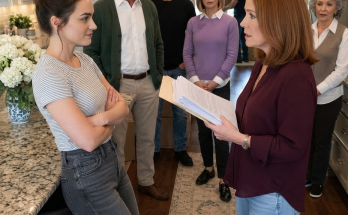
She thought about that for a moment, then nodded. “Okay. Good.”
As I grabbed my keys, she hopped off the stool and wrapped her arms around my waist.
“You’re going to be amazing,” she mumbled into my blazer.
“I’m going to be firm,” I corrected. “That’s a little different.”
“Same thing,” she insisted, then let go. “Text me when it’s over?”
“I will,” I said.
On my way out, I touched the frame of my mother’s photo in the hallway.
“Meeting time, Mami,” I said under my breath. “Wish me luck.”
The Ashford Technologies headquarters took up nine floors of a downtown glass-and-steel monument to ambition. The elevator ride to the executive floor was the same as it had always been—cool, reflective surfaces, my own face staring back at me in four directions, the soft whoosh of air conditioning.
But as I stepped out onto the carpeted hallway, I felt something else under my feet: ownership.
Not theoretical ownership in the form of share certificates and legal documents. Not abstract ownership that could be reduced to a number in a quarterly report.
This was the hallway I’d imagined, years ago, sitting in that cramped apartment. Back when Ashford Technologies had been nothing but code and coffee and a stubborn refusal to quit. Back when the company “HQ” had been my kitchen table.
I passed framed photos of team-building retreats, award ceremonies, ribbon cuttings. In most of them, Gregory stood front and center, all tailored suits and photogenic charisma. In a few, I could see myself at the edges—smaller, quieter, a blurred figure in the background.
Today, I had no intention of standing at the edge.
The executive conference room was already half full when I walked in. The mahogany table gleamed under recessed lighting. Floor-to-ceiling windows looked out at the city skyline, a view we liked to show to investors and potential partners. It said: We’re serious. We’re substantial. We’re successful.
Harold, the oldest board member, straightened his tie as I entered. Lauren, a relatively new board addition with private-equity money behind her, flicked her eyes up from her phone. Two other members—Mark and Julia—sat with their laptops open, the glow of spreadsheets reflecting off their glasses. At the far end of the table, across from the chair I’d always chosen, sat Gregory.
He had taken that seat—at the literal head of the table—years ago. No one had challenged him. Not then.
Sandra from HR was there too, a notebook in front of her, pen poised. Her expression when she met my gaze was a strange mix of hope and caution.
“Good morning,” I said, moving to the opposite end of the table—the end that, technically, belonged to the board chair. Me. “Thank you for coming on such short notice.”
“Of course,” Harold said blandly. “Always a pleasure, Eleanor.”
Gregory’s smile did not reach his eyes. “Perhaps,” he said lightly, “we should start with some context. I understand there was a… misunderstanding at last night’s event.”
I looked at him. At his perfectly knotted tie, his gleaming cufflinks, the small muscle jumping in his jaw.
“There was,” I said. “But that’s not where we’re starting.”
He frowned. “Then what—”
“We’re starting with data,” I said.
I nodded at Sandra.
She opened her laptop, fingers moving quickly over the keys. “Over the past three years,” she began, “female employee turnover has increased by forty-seven percent.”
Harold adjusted his glasses. “Forty-seven?”
She clicked to another tab. “Yes. Overall turnover has risen, but the spike is disproportionately among women. In exit interviews, the most commonly cited issues include hostile work environment, lack of advancement opportunities, and dismissive or inappropriate behavior from senior leadership.”
“Those are subjective perceptions,” Gregory cut in. “People leave for personal reasons. Family, better offers, relocation. You can’t—”
“Sixty-three percent of departing female employees,” Sandra continued, “specifically mentioned interactions with senior leadership as a contributing factor in their decision to leave.”
The room went very still.
“Interactions in what sense?” Lauren asked, leaning forward. “We’re talking about performance feedback? Personality clashes? Or something more… formal?”
Sandra hesitated, then plunged ahead. “We’ve had fourteen formal complaints about inappropriate comments in the last eighteen months. Many more informal reports that didn’t escalate to HR files. Three of those formal complaints specifically named executives.”
Lauren’s gaze flicked to Gregory.
“None of those complaints,” Sandra added, “resulted in disciplinary action.”
“We followed procedure,” Gregory snapped. “Every complaint was investigated. Every one was found to be based on misunderstandings or interpersonal conflicts. We can’t punish people every time someone gets their feelings hurt.”
I opened the folder in front of me.
Last week, faced with yet another quiet mention of “another woman leaving from R&D,” I’d asked Sandra to send me the HR investigation summaries for the last three years. I’d spent two nights reading through them, my eyes burning, my stomach turning.
“The problem,” I said, “is that the pattern is impossible to ignore once you look at them together.”
I slid copies of a chart across the table. “Same handful of names appear over and over. Same departments. Same language in the findings, even. ‘Insufficient evidence.’ ‘Perception of bias not substantiated.’ ‘No further action required.’”
“That’s standard legal phrasing,” Gregory said. “You know that.”
“Legal phrasing protects us in court,” I replied. “It does not protect our people.”
Julia cleared her throat. “Eleanor, are you suggesting the executive team has been… what? Bad actors? Negligent? I mean, we see employee engagement scores every quarter. They’re solid.”
“Engagement scores are based on who stays,” I said. “They don’t measure the people we’ve already lost.”
Harold shifted in his seat. “This is all very concerning, of course, but what does it have to do with what happened last night? I assume your email refers to that.”
I took a breath.
“Last night,” I said, “at an event celebrating the success of this company, the CEO’s wife approached me, looked me up and down, and asked if I was ‘the help.’ Then she suggested that catering staff should use the side entrance.”
Mark winced. “Oh.”
“She didn’t know who you were,” Gregory said quickly. “I already told you. If she had—”
“And that’s the point,” I said. “She looked at a woman in a simple black dress, without obvious status symbols, standing at the edge of an executive circle. Her reflex was to assume I didn’t belong. That I was there to serve.”
“That’s not fair,” Gregory protested. “You’re extrapolating a whole worldview from one—”
“I’m extrapolating from that moment,” I interrupted, “combined with three years of HR data, the exodus of women from leadership tracks, and the language I’ve heard from you in this very room about ‘diversity hires’ and ‘culture fits.’”
Silence dropped like a curtain.
Lauren watched me with sharp, assessing eyes. “What language?” she asked.
I looked at Gregory. He shifted, his jaw tightening.
“Last February,” I said, “when we were discussing the candidates for VP of Product, you referred to one of the women on the shortlist as ‘a quota candidate.’”
“That’s not what I—”
“Two months later,” I continued, “in a strategy session, we were talking about implementing more flexible work arrangements. You joked that if we did that, ‘the mommy track would become a highway.’ Half the room laughed.”
“That was—”
“A joke,” I supplied. “Yes. I know. But jokes tell people what you really think is funny. They tell them what’s safe to laugh at.”
Harold cleared his throat. “We all say things in private meetings—”
“These things weren’t private,” I said. “They were said in front of women who work for you. In front of men who take their cues from you. In front of HR.”
Sandra looked down at her notebook.
“So what exactly are you proposing?” Harold asked finally, his voice carefully neutral.
“Several things,” I said. “First, a comprehensive culture audit conducted by an external firm. Not an internal survey, not a box-checking exercise—an in-depth review of our practices, our promotion patterns, our complaint processes.”
Gregory grimaced. “That’ll take months. And it’ll cost—”
“We generated forty-seven million in profit last year,” I said. “We can afford to invest in the environment that makes that possible.”
“You’re talking about bringing in outsiders to pry through our dirty laundry,” he said. “That’s a PR nightmare waiting to happen.”
“What we’re living with now is a lawsuit nightmare,” Lauren countered quietly. “If even half of what Sandra just described is accurate and we don’t address it, this board is failing in its fiduciary duty.”
I nodded to her. “Second, mandatory training for all executives on inclusive leadership. Real training, not the ninety-minute click-through e-learning modules everyone ignores while checking email.”
Harold grimaced. “I hate those things.”
“So do I,” I said. “We’ll do better. Third, a complete overhaul of our complaint process. Right now, HR reports to the COO, who reports to the CEO. That’s a problem when complaints involve the executive team. Investigations need to be meaningfully independent.”
Sandra exhaled, just once, like someone had cracked a window in a stuffy room.
“And finally,” I said, “we need to talk about leadership accountability.”
Gregory’s eyes flashed. “Meaning what, exactly?”
I held his gaze.
“Meaning we need to decide whether the current CEO is the right person to lead this company through the changes we need to make.”
The words took up all the oxygen in the room.
“You’re questioning my position?” he asked. His voice had gone soft, which was more dangerous than the snapping.
“I’m questioning your willingness to change,” I said. “And your understanding of the harm that’s been done under your watch.”
“This feels like a witch hunt,” he said.
“It feels like consequences,” I replied.
Harold rubbed his temples. “Eleanor, with all due respect, you’ve always been a… more silent partner. You step in for the big strategic decisions. You let Greg handle—”
“I have been silent,” I agreed. “Too silent. That was my mistake. I assumed that operational excellence would naturally go hand in hand with decent leadership. That if the numbers looked good, the culture must be fine.”
I looked around the table, letting my gaze rest on each person for a moment.
“I was wrong.”
Lauren folded her hands. “So what does non-silence look like to you, going forward?”
“It looks like the majority owner of this company taking an active role in shaping its leadership,” I said. “I own sixty-two percent of Ashford Technologies. That’s not just a number. It’s responsibility. To our employees. To our clients. To my conscience. And to the fourteen-year-old who watched me get treated like a servant at our own gala.”
Harold’s brows rose. “You brought your daughter last night?”
“Yes.” My throat tightened, but I kept my voice steady. “She saw all of it. She asked me this morning if I was going to fire Greg.”
The corners of Lauren’s mouth twitched.
“I told her,” I continued, “that it depended on this conversation. So, Gregory—” I turned back to him “—I’m going to ask you directly. Are you willing to participate in meaningful culture change? To be held accountable for metrics beyond revenue? To acknowledge that things have gone very wrong on your watch, and that you have been part of the problem?”
He stared at me. For the first time since he’d been hired, the confident CEO mask slipped completely. I saw the man underneath—sharp, ambitious, used to being the golden boy in every room.
“And if I say no?” he asked quietly.
“Then we negotiate your exit,” I said. “And I start looking for someone who understands that leadership is more than good quarterly reports and charming investors.”
The room held its breath.
Harold looked like he wanted to sink into the table. Mark patted his pockets for a nonexistent stress ball. Julia and Lauren watched Gregory with the intense curiosity of people witnessing a turning point that would be discussed in business schools one day.
Finally, Gregory exhaled.
“What does ‘accountability’ look like?” he asked. The word tasted sour in his mouth.
“For starters,” I said, “a probationary period. Six months. During that time, the external audit proceeds, with full access to data and employees. You participate fully in leadership coaching. We identify specific metrics: reduced turnover among underrepresented groups, improved internal survey results, concrete progress on promotion equity. HR no longer reports solely through you. Complaint investigations involving executives go to an independent committee that reports directly to the board.”
“And if I don’t meet these metrics?” Gregory asked.
“Then your severance package gets activated,” Lauren said briskly. “And we begin a search for your replacement.”
He looked at her, then back at me.
“This is my reputation,” he said. “My career. You’re talking about hanging me out to dry while some consulting firm trashes my leadership.”
“I’m talking about giving you a chance,” I said. “One that many of our former employees never got.”
His gaze slid to Sandra. She met his eyes for the first time since the meeting began.
“I’ve been raising concerns for two years,” she said quietly. “Nothing changed. Maybe now it will.”
He flinched.
Three hours later, we had the framework.
The external audit firm was shortlisted. The outline of the new complaint process was sketched. A draft of the CEO’s performance metrics—including culture and retention targets—was agreed upon in principle.
None of it was perfect. All of it was better than silence.
As the meeting broke up, Harold shuffled over to me, looking older than I’d ever seen him.
“Eleanor,” he said, “I hope you know what you’re doing.”
“I don’t,” I admitted. “Not entirely. But I know we can’t keep doing what we’ve been doing.”
He gave a humorless chuckle. “That’s usually how change starts.”
Lauren stepped up next. “If you need support pushing any of this through,” she said, “call me. I’ve pulled a few CEOs through culture crises. Some emerge better. Some… don’t.”
“I appreciate it,” I said.
When the board members had drifted out, it was just me and Sandra.
She gathered her notebook, hesitated, then looked up.
“Thank you,” she said.
“For what?” I asked.
“For listening,” she said. “Finally.”
Guilt pricked at me. “I should have listened earlier.”
“You’re listening now,” she said. “That matters.”
That evening, I let Zoey pick dinner.
She chose pizza. Always pizza.
We sat at our usual corner booth, the red vinyl sticky against the backs of our legs, a pitcher of soda sweating between us. The air smelled like cheese and oregano and childhood.