
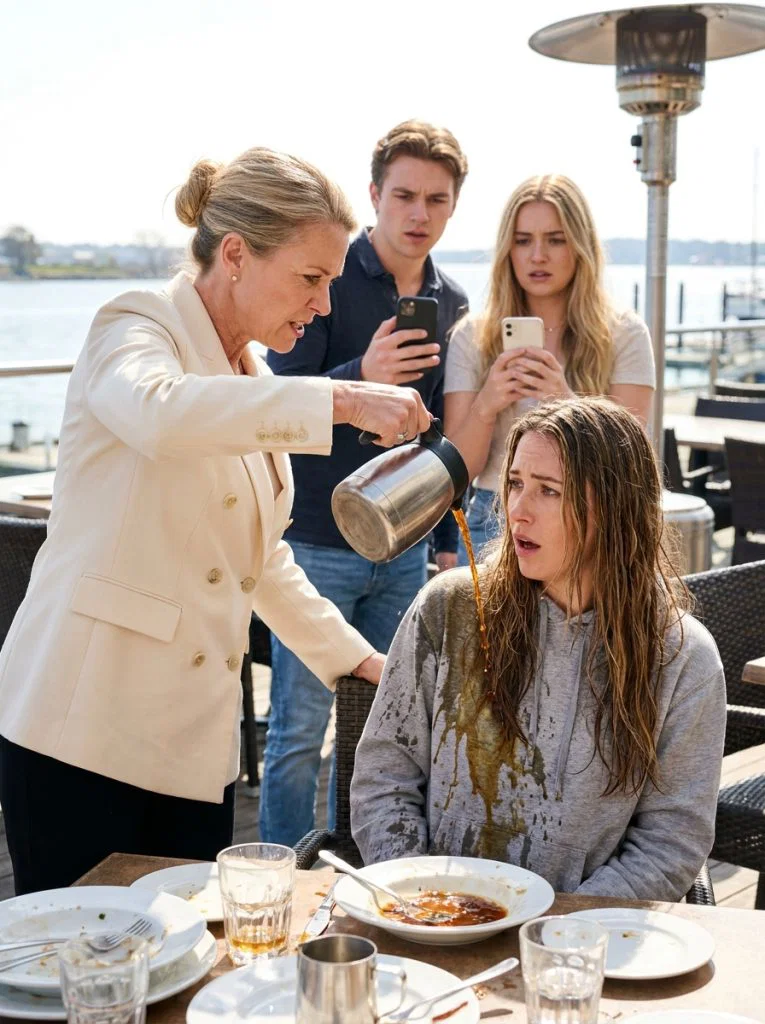
“You selfish piece of trash.”
My mother’s voice didn’t just cut across the patio of the Obsidian Resort; it sliced the morning air in half.
I watched the ceramic carafe tilt in her hand a split second before my brain actually registered what was happening.
For some reason, I assumed she was just going to slam it down on the glass table for emphasis, the way she always did when she demanded our undivided attention.
I expected the china to rattle and the silverware to chime like nervous bells, but instead, gravity simply took its toll.
The heat hit me first as a concept, and then as sharp, stinging physical pain.
Freshly brewed coffee, still nearly boiling, cascaded directly over my head.
It slashed across my scalp like liquid fire, ran down the side of my face, and soaked instantly through the hood of my inexpensive gray hoodie until it seeped into my collar.
My neck felt like someone had pressed a heavy, scorching iron against it and simply forgotten to lift it away.
My lungs completely forgot how to breathe, and for a moment, there was nothing but a ringing whiteness in my skull as if my brain had short-circuited from the sheer shock.
Then the sound came screaming back into focus.
There were no gasps, and there were no horrified murmurs from the other guests.
Instead, there was laughter.
Wet, scalding coffee dripped from my eyelashes as I blinked blindly, trying to orient myself in the sudden chaos.
My chair screeched backward on the stone terrace as I tried to pull away.
Someone at a nearby table muttered, “Oh my God,” in that half amused way people reserve for drama that doesn’t actually belong to them.
My brother Caleb’s laugh cut through the rest of the noise, sharp and mean and high on adrenaline.
When my vision finally focused, his phone was already in his hand, angled perfectly toward me with the red recording light blinking steadily.
Beside him, my sister Maya had her device out as well, her mouth twisted into the kind of smile she used for her social media updates, a little too wide, with teeth a little too white and eyes sparkling with the joy of someone else’s humiliation.
Their cameras looked like twin little cyclops eyes aimed directly at me, unblinking and predatory.
It was content.
The back of my neck sizzled in the morning sun, and I could feel the coffee seeping down between my shoulder blades, hot and sticky and clinging to my skin through the thin cotton.
I smelled burnt hair and bitter roast, and the pain radiated outward like a halo of heat around my head.
My mother, Beatrice, stood over me with the empty carafe dangling from her limp hand.
Her chest heaved, her face was flushed, and her elegant features were distorted into something feral and unrecognizable.
A single lock of her perfectly highlighted hair had worked loose from her chignon, sticking to her temple with sweat.
“That,” she hissed, breathing hard, “is exactly how we treat trash.”
Somewhere in the corner of my vision, a waiter hovered, frozen in place while balancing a tray of champagne flutes.
He looked like he was desperately unsure whether to intervene or simply pretend he was invisible for the rest of his shift.
I could have screamed then, and it would have been justified.
I could have lunged across the table, knocked her over, and sent her sprawling into her own cold omelet and half eaten fruit bowl.
I could have slapped the phones out of my siblings’ hands and watched them skitter across the stone, their screens shattering like their fake, polished composure.
The urge was there, a wild and animal thing clawing at my throat.
Instead, I heard my own voice as if it were coming from someone far away.
It said absolutely nothing.
I stood up slowly, the chair legs scraping harshly against the stone.
Coffee dripped from the ends of my hair, spattering the white tablecloth in ugly brown stars.
My scalp pulsed in time with my frantic heartbeat, and every tiny movement sent fresh waves of pain lancing across my skin.
I didn’t look at Beatrice, and I didn’t look at Caleb or Maya.
I turned on my heel and walked across the terrace, my boots thudding on the stone, through the archway and into the cool, polished lobby of the Obsidian Resort.
Each click of my heels on the marble floor sounded absurdly loud in the quiet space.
People glanced up as I passed, including a businessman scrolling through emails, a couple in matching resort wear, and a little boy with a chocolate smeared face.
Some of them stared outright at the woman with wet hair and coffee streaming down her neck, but none of them said a word.
Of course they didn’t, because this was the Obsidian, and absolute discretion was built into the premium room rate.
I followed the gold lettered sign toward the restrooms, where the hallway smelled of citrus cleaning solution and expensive perfume.
Inside the women’s bathroom, which was gleaming white and chrome, I locked myself in the furthest stall and then stepped back out to face the mirror.
For a long moment, I just stared at my own reflection.
The coffee had soaked my hair until it clung in thick, dripping ropes around my face.
My hoodie was a damp, mottled mess that clung to my shoulders and chest.
Just along my hairline, the skin was already turning an angry pink, marching toward a deep, dangerous red.
A blister had started to rise behind my left ear, the skin puckering and becoming shiny.
I looked like someone who had been caught in a freak accident, not a daughter who had just been “disciplined” at a Sunday brunch.
The urge to scream rose up again, a physical pressure in my throat that demanded to be released.
It wanted to pour out of me hotter than the coffee, a sound that would shake the mirrors and send the crystal light fixtures trembling.
I wanted to scream, to break something, to smash the world into pieces.
My fingers dug into the edges of the porcelain sink until my knuckles went white.
Then, my eyes met my own in the glass.
They should have been teary, and they should have been glassy with fresh humiliation.
Instead, they were flat and cold.
That look, more than the burn, more than the laughter outside, and more than the ceramic pot hitting empty, was the moment something shifted within me.
It was the moment I realized the bridge wasn’t just burned, it had been nuked from orbit.
I imagined walking back out onto the terrace and unleashing all of it, years of being the family scapegoat, of being the weird one, the difficult one, the one who did not fit into Beatrice’s curated social media feed.
I saw myself in my mind’s eye grabbing the tablecloth and yanking it, sending plates and glasses and Beatrice’s carefully curated image crashing to the floor.
I imagined the gasp of the surrounding diners, the chorus of phones being lifted, and the instant explosion of chaos.
It would feel so satisfying for about eight seconds.
Then what would happen?
Then it would just be more content for them.
If I screamed, I gave them a show, and if I cried, I gave them a story.
They would slice it, edit it, and caption it.
They would say, “Look at the crazy one. Look how unhinged she gets over nothing. Look how unstable she is.”
My family did not thrive on love or connection; they thrived on drama.
They drank conflict like it was expensive champagne.
My mother, with her obsession with appearances and her ferocious need to look perfect even as everything underneath her was held together with credit and denial.
Caleb and Maya, with their hunger for clicks and for validation from total strangers.
They weren’t people, not in the way families should be.
They were black holes and ring lights.
They were vampires of reaction.
My hurt was their fuel, and my anger was their favorite meal.
A fight meant I still cared, and a fight meant I was still in the ring with them, still playing by their rules.
Silence, though, silence is a mirror.
When you don’t scream back at a monster, it is left screaming into the void, listening to the echo of its own ugliness.
Eventually, if there is nothing reflecting your cruelty back as power, all you see is yourself.
I took a slow, steady breath, and then another.
Then I reached for the stack of paper towels.
Each dab against my neck made me hiss through my teeth because it felt like sandpaper on sunburn, but my face stayed neutral.
I watched myself in the mirror as I carefully blotted away the worst of the coffee, leaving my skin uncovered.
I wanted to see exactly what they had done.
I wanted the image stamped into my memory with surgical clarity.
The burn, the wet hair, and the empty calm in my eyes.
This is the price of saying no, I thought.
This is what fifty thousand dollars costs in my family.
I tossed the damp paper towels into the trash.
The mirror, framed in brushed silver, stared back at me, a stranger and a familiar ghost.
I straightened my hoodie, tugged it away from the angriest patches of skin, rolled my shoulders back, and walked out.
The hallway felt longer on the way back.
The hum of the air conditioning seemed louder.
My boots clicked out a measured rhythm.
When I stepped back out onto the terrace, the sunlight hit my face and made me squint.
A breeze carried the scent of salt from the lake, the sweetness of someone’s Belgian waffle, and the sharp tang of my own cooling coffee on my clothes.
The table had gone quiet.
The performance was over, and the actors were just waiting for notes.
Caleb sat with his phone still in his hand, screen up.
The smugness on his face had settled into something tighter, like he wasn’t sure whether this was going to go viral or just be saved for family group chat amusement.
Maya’s fingers danced over her screen, her bottom lip caught between her teeth, as she was probably already workshopping the perfect captions.
Beatrice stood with her arms crossed.
Her designer coat, a cream wool piece she claimed she’d gotten on sale but I knew had swallowed half a mortgage payment, was perfectly spotless.
Not a single drop of coffee had landed on her.
She looked at me like a queen waiting for a servant to apologize for bleeding on the floor.
I didn’t sit down.
I stepped to my chair, reached into the pocket of my damp hoodie, and pulled out my wallet.
The leather stuck slightly to the fabric, and the bills inside felt faintly damp when I slid them free.
I counted out four twenties.
Eighty dollars.
My share of the brunch I hadn’t even eaten.
The eggs and avocado toast I’d ordered were still sitting there, congealing on their plate, untouched.
Beatrice’s mimosa glass was half empty.
The coffee pot, its crime committed, sat where she’d dropped it, a few leftover drops pooling in its spout like guilt.
I placed the bills next to it on the white linen.
Not tossed, and not crumpled.
I smoothed each bill so it lay perfectly flat.
For a second, the green of the money, the brown of the coffee stain, and the white of the tablecloth formed a strange little flag, a symbol of everything wrong and everything right about this moment.
I could feel all three sets of their eyes on me, along with the curious weight of several strangers’ stares.
No one said anything.
Good.
I turned away from the table.
“That’s right, run away,” Caleb called after me, his voice sharp with performative triumph. “Go cry in your truck, Emma.”
My hand tightened around my wallet.
I kept walking.
I didn’t look back.
Their silence followed me like a shadow.
It was heavy and thick.
It was the kind of silence you get at the end of something, not the middle.
It was the sound of a door closing.
Not gently.
It was bolted.
Locked.
Welded shut.
They thought they had just banished me.
Sent the trash to the curb.
They had no idea they had just filmed their own execution.
Outside the hotel, the winter air slapped my face.
Chicago, or anywhere in the north during December, is not kind.
The resort’s heated terrace and fireplaces made it easy to forget that the city itself is capable of cutting through any coat, any pretense, at thirty miles an hour off the lake.
My breath puffed out in little white clouds as I crossed the drive.
Valets in neat black jackets flitted around polished cars, keys jangling, and tires crunching over salt.
My Subaru sat toward the back of the lot, under a bare tree.
It was ten years old, faded blue, and had one scratch on the rear bumper from where I’d misjudged a parking post three winters ago.
It was paid off in full.
No one looked twice at it.
I liked that about it.
As soon as I opened the driver’s door, the smell of stale takeout and coffee grounds in the cup holder wrapped around me.
Today, there was a new top note of burnt coffee and singed hair.
My hoodie squelched against the seat, leaving cool dampness seeping into the cracked fabric.
I sat with my hands on the steering wheel and let the tremor roll through me.
Not from fear.
From adrenaline.
The thing about surviving a moment like that isn’t the moment itself.
It’s the crash afterward.
The way your body, having sprinted through the fire, suddenly realizes you’re sitting still and decides to replay everything.
My scalp throbbed in jagged pulses.
Beatrice’s face as the coffee poured.
Caleb’s laugh.
Maya’s phone held high.
I saw it all again in the span of two heartbeats.
I closed my eyes and forced my thoughts somewhere else.
Back.
To twenty minutes earlier.
To when this had just been brunch.
Beatrice had insisted on the Obsidian Resort.
Of course she had.
“It’s where the regional board meets,” she’d said over the phone, her voice dripping with self satisfaction. “We’ll get a good table. Very visible. If the Arts Council folks see us together, it will show unity.”
I hadn’t asked why my presence mattered to her image that day.
It was already unusual enough for her to invite me anywhere public that wasn’t a holiday obligation.
“Caleb has big news about his business,” she’d added. “And Maya needs content. You can at least do that much, Emma. Just show up.”
At least do that much.
I had been halfway through reviewing a pull request when she called.
My cabin’s wood stove crackled quietly in the background, and snow tapped softly at the windows.
My dog, Pixel, snored on the rug by my feet.
I could have said no.
I almost did.
But there’s a part of you, no matter how logically you know better, that still wants your mother to want you there.
That still reaches for the Christmas card version of family, the one with the matching sweaters and shared laughter.
Besides, I told myself, I’d sold my company three weeks ago.
The ink was dry, and the payout was sitting in accounts so large they didn’t feel real yet.
Maybe this brunch would be different.
Maybe we could talk like adults.
Maybe I could finally come clean.
Ha.
The Obsidian had been Beatrice’s stomping grounds for years.
She loved the terrace with its heated lamps and sweeping views of the lake.
She loved that people saw her there, clinking glasses with board members and donors, air kissing other women in cashmere coats.
When I arrived, she’d already claimed a table near the railing.
Her coat was draped just so over the back of her chair, label visible.
Maya sat to her right, scrolling on her phone.
Caleb was pacing, his thumb flying over his screen, checking whatever markets he pretended to care about that week.
“Em,” he’d said when he saw me, flashing that salesman smile that used to get him out of trouble with teachers. “Look, she actually came.”
“Hi, Mom,” I’d said, leaning in to brush my cheek against Beatrice’s.
Her skin smelled like expensive moisturizer and cold disapproval.
“You’re late,” she murmured, her lips barely moving. “And what are you wearing? That hoodie looks cheap.”
“It was a last minute invite,” I replied evenly, taking my seat. “I didn’t realize there was a dress code.”
She pursed her lips, meaning: you should have known.
Maya gave me a once over that felt like a TSA scan.
“You could at least dress aspirational,” she said. “You know how the lighting is here.”
“She can’t afford aspirational,” Caleb joked, dropping back into his chair. “She lives in the woods, Maya. Thrift stores and flannel are their runway.”
“Cabin,” I corrected, reaching for my water. “And flannel is warm.”
“Cabin,” Beatrice echoed, tasting the word like it was a cheap wine. “Honestly, Emma. You’re not a teenager at summer camp. You’re almost thirty. Don’t you ever think about security? Stability? You could have moved back home after college like your brother and sister. Saved. Built a real life.”
A real life.
The waiter appeared then, and I clung to the interruption like a lifeline.
Menus.
Specials.
Brunch cocktails.
I ordered coffee and avocado toast without really listening.
My scalp itched under my beanie, dry winter air, and I pushed it off, running a hand through my hair.
That’s when Caleb leaned across the table.
“Hey, so I’m glad you came,” he said, lowering his voice dramatically, like this was a movie and the plot was about to kick in. “I wanted to talk to you about an opportunity.”
There it was.
Not “How are you?”
Not “I’m sorry I haven’t called since forever.”
An opportunity.
“For you,” I said. “Or for me?”
He laughed like I’d made a joke.
“For both of us. Win win. You know my luxury car dealership is doing crazy numbers, right?”
I knew he leased a nine hundred dollar a month vehicle and had posted at least three social media clips complaining about cheap customers who didn’t understand luxury.
I also knew he’d borrowed money from Beatrice three times in the last year for inventory.
“Business is booming,” he went on. “But inventory is tight. Supply chain crap. I’ve got a line on some limited edition pieces that would take us to the next level, but I need capital. Just a bridge. Fifty thousand. Short term. I’d pay you back in six months. Eight, tops.”
He said “fifty thousand” like other people said “fifty dollars.”
Maya started filming her mimosa, the glass catching the light.
“I’ll tag the hotel,” she murmured, more to herself than anyone else. “They might repost. We should get a family pic too. Like, before the food comes, before you spill anything.”
She side eyed me as if I routinely flung omelets around public spaces.
“I don’t do bridge loans,” I said to Caleb quietly. “Especially not on brunch napkins.”
“It’s not a napkin deal, Em.”
He laughed again, glancing toward Beatrice.
“It’s family. You know mom’s already in for some; she believes in me. You just have better credit.”
Ah.
There it was.
He had no idea that my better credit was the least interesting thing about my finances.
I sipped my water.
I imagined, briefly, what it would feel like to say it out loud.
I sold my company.
I’m not your poor sister in a cabin.
I could buy this hotel and turn your dealership into a parking lot, Caleb.
But that fantasy came with a montage of reactions I didn’t want to live through.
Beatrice, suddenly sweet as honey, gushing about how proud she was, all while drafting a mental list of things she needed.
Caleb, calculating exactly how much he could bleed from me before I set limits.
Maya, turning me into boss sister content while quietly resenting every follower I got from it.
They didn’t want me.
They wanted what I could give them.
“No,” I said simply. “I can’t lend you money.”
His expression flickered.
“What do you mean, you can’t?” he pressed. “You don’t have fifty grand?”
“I mean I won’t.”
The smile dropped from his face like someone had cut a string.
“You’re so selfish,” he snapped. “You know mom pays for everything for us right now while we’re building. Maya’s got her coaching brand, I’ve got the dealership, it’s all future upside. You just sit in your little cabin coding in your pajamas. You can’t even help family?”
Beatrice’s fork clinked against her plate.
“Caleb,” she said, loud enough for the neighboring table to hear. “Don’t pressure her. Emma is different. Not everyone is meant for success.”
The worst part was, she believed that.
To her, success wasn’t about building something.
It was about being seen having it.
I looked at the woman who had once cried because I’d been accepted to a college out of state, because what will people think if my daughter leaves?
I saw the teenagers she insisted into ballet and piano and lessons, not because we liked it, but because her friends’ kids were doing them.
Beatrice didn’t understand my world.
Sleep deprived hackathons, whiteboards covered in machine learning diagrams, the nauseating exhilaration of watching the first prototype flag a piece of extremist content correctly.
Years of ramen and second hand laptops, of meeting with investors who looked at me like a curiosity before I made them very rich.
She understood handbags.
“Mom doesn’t pay for me,” I said quietly. “I pay for me. I pay for everything I have.”
“You have what?” Caleb demanded. “A truck and a shack? And you can’t even help with a loan? God, you’re pathetic.”
Maya’s phone angled slightly toward us.
Related posts


