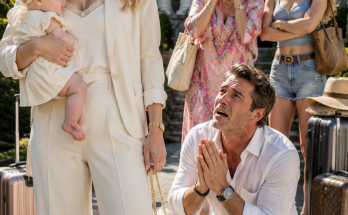
The mimosas started before the sun had even finished hauling itself up over the oak trees in my parents’ backyard.
I was at the kitchen counter, pouring myself plain orange juice in a heavy crystal glass that probably cost more than my entire outfit, when my mother swept past me with an armful of linen napkins and a cloud of floral perfume.
“Claire, sweetheart, don’t drink out of those,” she said, not looking at me, hip-bumping the dishwasher closed. “Those are for the guests. Use the regular glasses.”
“I am a guest,” I said, but quietly, like it was a joke meant only for me.
She didn’t hear me—or pretended not to.
The dining room had been transformed. My mother lived for days like this. Easter, Thanksgiving, Christmas, any chance to turn the house into something suitable for a magazine spread. The table was set with the Easter china: pastel pink plates with a delicate gold trim, matching cups and saucers I’d never seen anyone actually drink from. Fresh lilies stood tall in crystal vases, their scent fighting with the smell of honey-glazed ham and yeast rolls to dominate the air. Deviled eggs were arranged in perfect concentric circles on cut-glass platters—little yellow islands in white oceans.
The whole scene looked expensive and fragile, like if you breathed too hard the illusion might crack and show the drywall underneath.
“Don’t those lilies bother your allergies?” I asked, leaning against the doorway, watching my mother fuss over the placement of a bunny-shaped salt shaker.
“They’re beautiful,” she said, which was not an answer.
I took my usual place at the far end of the table, the end nearest the kitchen door, where people flowed past me with platters and dishes and empty glasses but rarely stopped to talk. It was the seat I gravitated to at every family gathering, because from there I could observe the performance without being required to join in.
My sister’s laughter floated in from the living room before she did. Jessica’s laugh could be heard through walls—bright, effortless, just loud enough to command attention without seeming like it was trying to. She was already holding court on the couch, legs crossed just so, her blond hair styled in loose waves that said “I woke up like this” and actually meant “I spent an hour with a curling iron.”
“…three thousand eight hundred and forty-seven dollars,” she was saying, phone screen held out like a prize. “Can you believe it? That’s just my refund. Not even Brad’s. We’re putting it toward a girls’ trip to Nashville. There’s this amazing Airbnb right downtown—hot tub on the balcony, open brick walls, the whole thing is so Instagrammable—”
“Oh my God, that sounds amazing,” Cousin Megan breathed. “You two deserve it. You work so hard.”
Jessica laughed modestly. “Well, you know. Three days a week at the office, two days home with the kids. It’s all about balance.”
I slipped past her audience and into the dining room before anyone could drag me into a conversation I didn’t want. I sat, set my orange juice down beside the precisely folded napkin at my place, and let my mind drift in the way it did when I was reviewing code—zooming out to see all the moving parts at once.
Somewhere between the lilies and the deviled eggs and Jessica’s tax refund, I lost track of time. The front door opened and closed every few minutes: an uncle booming greetings, an aunt complimenting the house, the high, thin voice of my grandmother asking who would take her hat. Coats went onto the guest bed. Bottles of wine lined up on the kitchen counter. My father’s laugh rose and fell from the back porch as he supervised the grilling of asparagus no one would eat.
And then Aunt Patricia arrived.
I heard her before I saw her. Patricia always moved with purpose, heels striking the hardwood like punctuation marks. She swept into the foyer with a gust of cool March air and Chicago efficiency, coat already half off her shoulders, a fitted navy dress that looked like it had been tailored for her and probably had.
“Happy Easter,” she said, kissing my mother’s cheek, handing over a bottle of champagne with the label angled just so. “The house looks beautiful. Is that a new mirror in the foyer?”
My mother brightened in the way she only did around people she was trying to impress. “HomeGoods,” she said. “Sixty percent off.”
“Good eye,” Patricia said, and she meant it as a compliment. Patricia’s compliments were like rare coins—you collected them and kept them somewhere safe, proof that you had, at least for a moment, met a standard even she respected.
She moved through the living room, dispensing greetings, and then spotted me at the far end of the table. Her mouth quirked in something that wasn’t quite a smile but wasn’t not a smile either.
“Claire,” she said, taking the seat directly across from me. “How’s life in the world of ones and zeros?”
I huffed a tiny laugh. “Chaotic and profitable.”
Her eyes sparked with interest, but before she could say anything, my grandmother was being ushered in, carefully settled at the head of the table, and the rest of the family began to file into their places like actors taking their marks.
Twenty people, two tables pushed together, plates elbow to elbow. My father at the opposite end from my grandmother, carving knife in hand, ready to play the role of Provider of Meat. Jessica and Brad in the center, the sun to which everyone else turned. Aunts and uncles and cousins filling in the spaces around them. Me and Patricia, oddly paired, at our own quiet corner.
Brad had barely sat down before he launched into a monologue about interest rates.
“I mean, we locked in at three point one,” he was saying, “so we’re basically geniuses. People who waited, man, they’re screwed now. You should’ve seen the appraisal on our place last month.”
“We’ve already gained like, fifty thousand on paper,” Jessica added, glowing. “It’s just such a blessing. The Lord really provided.”
My mother beamed. My father nodded approvingly. Owning property was the pinnacle of success in their world. Actual intellectual property, on the other hand, might as well have been fairy dust.
I buttered one of my mother’s famous rolls, the crust crackling under my knife, the steam curling up in a fragrant twist. My stomach was hungry, but my nerves were already simmering. Holidays did that to me—the crush of bodies, the overlapping conversations, the way everyone slid into their familiar roles like grooves worn into an old record.
Jessica, the Golden Child. Brad, the Loud Husband. My parents, the Proud Grandparents. Me, the Single Disappointment at the far end of the table.
It had been that way my whole life.
When I brought home straight A’s, my mother had smiled and said, “That’s nice, dear,” before turning to ask Jessica how cheerleading tryouts had gone. When I’d gotten into the honors program at UT Austin, my father had frowned at the tuition numbers and said, “Think you can get a scholarship or something? We’ve got your sister’s wedding to plan.” When I graduated summa cum laude, there had been a cake with “Congrats Jess & Claire!” written in pink icing because Jessica’s baby shower fell on the same weekend.
It wasn’t that they didn’t love me. I knew, intellectually, that they did. They fed me, clothed me, taught me to say please and thank you. They hugged me on Christmas. They sent me links to church sermons they thought I should watch. But when it came to where their attention naturally flowed, it flowed to Jessica.
Jessica, who had given them grandchildren. Jessica, whose life looked, from the outside, like a brochure for suburban success.
My life looked like…what? A furnished-but-uninspired downtown apartment with IKEA bookshelves and a secondhand couch. A twelve-year-old Honda Civic that rattled slightly over potholes. A job no one understood.
“What do you even do all day?” my father had asked once, years ago, when I still worked for a small cybersecurity firm and actually tried to explain.
“I write code,” I’d said. “I design encryption algorithms, build secure databases, test for vulnerabilities in—”
He’d waved a hand before I’d hit the second clause. “As long as they’re paying you,” he’d said, turning back to the Cowboys game.
They were paying me. Later, I would pay myself even more. But that wasn’t what mattered to him then.
“Claire, this ham is incredible,” Aunt Carol said now, cutting into her slice. “Beth, you’ve outdone yourself.”
My mother flushed with pleasure. “Family recipe. I brined it for three days.”
“Three days,” Brad repeated, eyes wide, like he’d just learned about a secret sacrament. “That’s dedication.”
Jessica, ever the spotlight magnet, seized the lull. “Speaking of dedication,” she said, turning her phone screen toward Aunt Carol, “look at this Airbnb we’re staying at in Nashville. It has a hot tub on the balcony. On the balcony. And it’s, like, right downtown.”
A chorus of appreciative noises rose around her. Questions about Broadway Street and country music and honky-tonks. I sipped my orange juice and let the conversation wash over me. I knew the cadence by heart: Jessica and Brad describe their blessings, everyone reacts, my parents glow.
I was halfway through my second roll when Jessica’s eyes slid down the table and landed on me.
“What about you, Claire?” she called, voice bright. “Any plans? Trips? Adventures?”
Twenty heads turned, briefly interested.
I swallowed. “I’m speaking at a conference in Seattle in June,” I said. “TechSec West. I’m doing a presentation on—”
“You’re going to Seattle?” Aunt Carol interrupted. “Oh, you should go to Pike Place Market. They throw the fish there. The flying fish place. And get chowder in a bread bowl. Oh! And those little donuts—”
“And the Space Needle,” Cousin Megan added. “You gotta take a picture of the city from the top. Oh my God, imagine living somewhere with no humidity.”
“Is this work or vacation?” my father asked, but the question was already half an afterthought, trailing behind the other voices.
“Work,” I said. “It’s a cybersecurity—”
“Well, good for you,” my mother said, with the same tone she used when the sermon ended on time. “Travel while you’re young. Before you have kids and can’t.”
Conversation drifted back to Jessica’s trip, Brad’s interest rates, my parents’ church activities. The moment—my moment—evaporated, as it always did. I let it go, as I always had.
Almost always.
A few minutes later, when Jessica bragged that some of us knew how to maintain happy marriages, I felt something inside me twitch.
“Jess earned it,” Brad said, grinning. “She works hard.”
“Three days a week,” I murmured, barely loud enough for the napkin ring to hear.
But Jessica heard. Or maybe she just sensed attention slipping away and grabbed at it like she always did.
Her smile stiffened. “What was that?” she asked, voice sugary but with a serrated edge.
I looked up. Every instinct told me to backtrack, to deflect, to make a joke and move on. I was good at that. Years of practice.
Instead, something rebellious and long-suppressed made my tongue move.
“I said,” I repeated, a little louder now, “you work three days a week. Which is fine. But it’s not exactly—”
“Not exactly what, Claire?” Her voice sharpened, cutting through the clink of silverware. Conversations nearby quieted, sensing a disturbance.
“Not exactly…” I searched for a word that wouldn’t be nuclear. “…full-time?”
There was a tiny beat, like the moment between pulling a pin and the explosion.
Jessica’s eyes flashed. “Oh,” she said, leaning back. “I get it. Not like your real job. Sitting in your depressing little apartment doing…whatever it is you do. At least I have a family. At least I contribute to society. What do you do besides collect a paycheck?”
“Jessica,” my mother hissed. “Not at the table.”
“I’m just saying,” Jessica insisted. “She sits there judging everyone. Like she’s above us because she works…what is it, again? Computers?”
A laugh snickered somewhere down the table. My father shifted, uncomfortable but not intervening. Heat rose up my neck, a familiar, choking mix of humiliation and anger.
I opened my mouth, not sure yet what was going to come out.
And that was when Aunt Patricia set her fork down.
The sound—tiny in itself—landed like a gavel against the cacophony of plates and glasses. The table seemed to pause. Even my father stopped slicing ham.
“Claire,” Patricia said, in the clear, carrying voice she used in courtrooms and boardrooms. “I’ve been meaning to ask you something.”
The hairs on the back of my neck stood up. I knew that tone. It was her cross-examination voice.
The table quieted. People were still chewing, still lifting forks to mouths, but the conversational volume dropped to a murmur and then to silence, like someone had reached over and turned the dial.
“Did that one point nine million dollar royalty check clear yet?” she asked.
The word “million” hit the room like a dropped glass.
Everything stopped.
Jessica’s mouth hung open, her next remark about Nashville hanging there with it. Brad’s fork clattered against his plate. My mother’s hand froze halfway to her water glass. My father choked on his mimosa, coughing violently, eyes watering.
Twenty pairs of eyes whipped toward me.
Patricia, I thought, feeling my stomach plunge, what are you doing?
My father recovered enough to rasp, “Patricia,” in a strangled whisper. “What check?”
I stared down at my plate for half a second, watching yolk seep from the deviled egg I’d cut. Then, very deliberately, I picked up my knife and resumed buttering my toast. Slow, even strokes, spreading it all the way to the edges. It gave my hands something to do while my brain scrambled to triage the situation.
Across from me, Aunt Patricia leaned back in her chair and swirled her mimosa, entirely at ease. “The royalty check from the licensing agreement Claire signed in February,” she said. “For her encryption algorithm. I helped negotiate the contract.”
She glanced around the table, eyebrows raised. “I assume she told you.”
If the room had been quiet before, it was now cathedral silent—a vacuum of sound where even breathing felt intrusive.
My mother’s face went an odd, blotchy shade between white and red. Her hand trembled as she set down her glass with a small, betraying clink. “Claire,” she said slowly, carefully, like she was stepping onto thin ice. “What is Patricia talking about?”
I finished buttering the toast. I put the knife down, cut the toast in half, took a bite. Chewed. Swallowed. The delay felt theatrical, but really it was just self-defense. Every second gave me more time to decide how honest I was willing to be.
“I licensed some software I developed,” I said finally, looking at my plate instead of their faces. “To a cybersecurity firm. They’re paying royalties.”
“One point nine million dollars,” Patricia supplied helpfully. “Initial payment, with quarterly royalties projected at four to six hundred thousand annually for the next seven years, depending on adoption rates.”
There. Cards on the table. Or chips. Or grenades.
A sound escaped Brad, somewhere between a laugh and a wheeze. Jessica’s eyes were so wide they seemed to swallow the rest of her face. Down the table, Uncle Mike muttered “Holy…” and caught himself before finishing.
“That’s…” my mother stammered. “That’s not…Claire doesn’t… she works for some tiny company.”
“I work for myself,” I corrected, finally lifting my gaze. “I left the company three years ago. I’m an independent contractor now.”
“Doing what?” my father demanded. His voice had recovered some strength, but there was a crack threading through it.
I almost laughed. It was the first time he’d asked that question in years.
“Developing proprietary encryption algorithms,” I said. “Security systems for financial institutions. Database architecture. I consult, I build, I license. I have twelve corporate clients and three licensing agreements in place right now.”