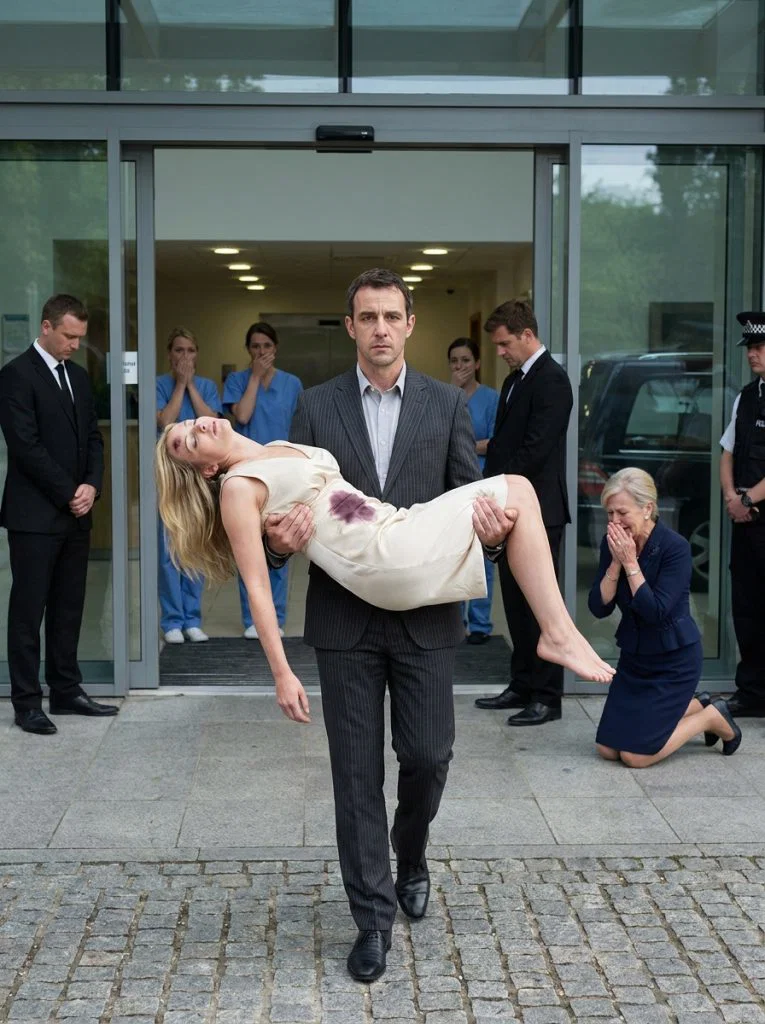
The Blackwood Estate in the hills of Vermont was less a home and more a monument to suffocating history. It was a sprawling, Gothic revival fortress of cold marble floors, vaulted ceilings, and corridors that echoed with centuries of unearned arrogance.
I moved through those shadowed hallways like a ghost haunting my own life, my hand perpetually resting beneath the heavy, agonizing weight of my nine month pregnant belly. My lower back throbbed with a dull, relentless ache, but I did not dare stop to rest because in this house, every floorboard that creaked beneath my weight felt like a mortal sin.
“I do not belong here,” I whispered to the empty air, pressing my palm against the chill of a stone pillar as a sharp contraction tightened my stomach. “I am nothing more than a trespasser in my own marriage.”
In the grand dining room, the air was suffocatingly thick with the scent of silver polish and expensive imported tea. My mother in law, Genevieve Vane, sat at the head of the mahogany table, draped in a vintage couture suit that likely cost more than the modest, suburban home I grew up in.
She did not look up from her tablet as I crossed the threshold into the room.
“You are lumbering again, Sophia,” Genevieve remarked, her voice a perfectly modulated drawl of pure disdain.
She took a slow, deliberate sip of her tea before glancing at me.
“The household staff walks with more grace than you do,” she continued. “It is painfully clear you were not bred for these halls, as you sound exactly like a draft horse.”
I swallowed the hot lump of humiliation in my throat, forcing my eyes to the floor to avoid her gaze. I had learned early on that defending myself only prolonged the torture.
“I am sorry, Genevieve,” I managed to say, my voice trembling slightly. “I am just having a difficult day with the pregnancy.”
Just then, the heavy oak doors opened and my husband, Julian, walked in.
He was a jarring contrast to the oppressive formality of the room. Wearing a faded gray hoodie, soft denim jeans, and carrying a small silver tray with my prenatal vitamins and a glass of water, he looked like a college student who had wandered into a museum.
“Leave her alone, Mother,” Julian said softly.
He set the tray down on the table between us.
His voice was gentle, lacking the sharp, domineering bite that Genevieve constantly complained a true man of our standing should possess.
Genevieve sneered, the corners of her perfectly painted lips curling in disgust at his appearance.
“Look at you,” she spat, her eyes raking over his casual clothes with obvious loathing. “You are jobless, aimless, and tethered to a commoner.”
She stood up slowly, her gaze sharpening.
“You spend your days hovering over her like a nursemaid,” she snapped. “You should have married the heiress from the southern estate, because at least she knows how to walk without announcing her presence to the entire county.”
Julian did not flush with anger or raise his voice to match hers.
He just smiled, a small, enigmatic, almost pitying curve of his lips that never quite reached his eyes.
He turned his back on the matriarch of the family empire, gently cupping my face and pressing a warm kiss to my forehead.
“Let them talk, Sophie,” Julian whispered, his thumb brushing a stray tear from my cheek. “We have everything we need right here in this room.”
He handed me the water glass with a tender look.
“I have to run a brief errand downtown,” he said quietly. “I will be back in an hour to help you pack your hospital bag, so please just try to rest.”
I nodded, watching him walk out of the room.
The moment the front door clicked shut, the temperature in the room seemed to drop ten degrees.
I turned to leave the dining room, desperate for the sanctuary of our bedroom upstairs.
As I reached the doorway, I glanced back at the table.
Genevieve was standing up, her manicured hands gripping the edge of the mahogany table.
Her eyes were narrowed and fixed on the doorway Julian had just exited, gleaming with a dark, predatory calculation that made the hair on the back of my neck stand up.
“This farce ends today,” she whispered to the empty, echoing room.
The silence of the house pressed against my eardrums as I carefully navigated the grand, sweeping staircase later that afternoon.
My throat was parched, and I was heading down to the kitchen for ice water.
The marble steps were wide and slick, and I kept a death grip on the polished mahogany banister.
My baby was restless, kicking sharply against my ribs.
“Just a few more days,” I told myself, taking it one agonizing step at a time. “Just a few more days and he will be here, and we can finally leave this awful place.”
I was halfway down, twelve steps from the foyer floor, when I heard the sharp, rhythmic click of Genevieve’s heels behind me on the landing.
I did not turn around because I was too afraid.
I just tried to move a little faster, to get out of her way.
Suddenly, a sharp, violent shove caught me squarely between the shoulder blades.
The world tilted violently on its axis, and my hand was ripped from the banister.
For a split second, I was suspended in the cold air, my mind unable to comprehend the sheer impossibility of what was happening.
Then, gravity reclaimed me.
I tumbled down the twelve marble steps, and the world became a chaotic blur of white stone, shattering pain, and sickening impacts.
My shoulder hit first, then my hip, and then, with a terrifying, hollow thud, the side of my heavy abdomen struck the sharp edge of a stair.
Every impact was a jagged bolt of pure agony tearing through my flesh and bone.
I landed at the bottom in a crumpled, broken heap.
I could not breathe.
The wind had been entirely knocked out of my lungs, replaced by a searing, white hot fire radiating from my stomach.
I gasped, my vision swimming with black spots, as a terrifying warmth began to pool beneath me, staining the pristine white stone of the foyer a brilliant, horrifying crimson.
“My baby,” I wheezed, my voice barely audible. “Oh god, please save my baby.”
From above, the rhythmic clicking of heels resumed, unhurried and steady, like the ticking of a metronome counting down my final seconds.
Genevieve stepped gracefully down the stairs, carefully avoiding the smears of my blood.
She knelt beside me, the scent of her expensive perfume nauseatingly strong in the confined space.
But she did not reach out to help me.
She did not check my pulse or offer comfort.
She leaned in close, her face hovering inches from mine, her breath cold against my ear.
“I told you that you walked too loud,” Genevieve hissed, her eyes completely devoid of human empathy. “Now, you have finally stopped.”
I tried to speak, to beg for help, but only a wet, copper tasting bubble of blood slipped past my lips.
“Listen closely, girl,” she whispered, her voice a venomous rasp. “Lose the baby or lose your life, because my son needs a wealthy wife to save this legacy, not a breeder from the suburbs.”
She stood up, looking down at me with pure hatred.
“If the fall did not do it, I will make sure the surgeons finish the job,” she threatened.
My eyes began to roll back in my head.
Through the dimming tunnel of my vision, I watched her stand up and pull her phone from her pocket to dial emergency services.
As the line connected, her face twisted into a grotesque mask of theatrical grief, her voice pitching up into a flawless imitation of a hysterical, terrified grandmother to be.
“Help! Please, send an ambulance to the estate! My daughter in law fell down the stairs!”
The distant wail of sirens bled into the roaring in my ears.
As the paramedics finally burst through the heavy oak doors and began frantically loading my broken body onto a stretcher, my consciousness tethered by a thread.
Eleanor leaned over me one last time, brushing a strand of sweaty hair from my face for the benefit of the medical team.
Under the guise of a comforting whisper, she delivered her final sentence for the day.
“Do not bother waking up.”
I would learn later, piecing together the fragmented nightmares of my emergency surgery and the hushed, terrified testimonies of the hospital staff, exactly what transpired while I was being sliced open to save my dying child.
Genevieve sat in the VIP surgical waiting room of the medical center, her posture impeccable, crossing her legs at the ankle.
She casually checked her reflection in a gold plated compact mirror, wiping a microscopic smudge of my blood from her designer shoe.
With steady hands, she pulled out her phone and sent a discreet, coded message to a wealthy heiress she knew.
“Julian will be navigating a tragic transition soon,” the message read. “Let us arrange lunch.”
In Genevieve’s mind, the chessboard had been cleared.
The parasite was removed, the legacy was secured, and her son would finally be forced to step into the role she had designed for him.
She was entirely unprepared for the reality of the world she lived in.