My name is Emily, and until that 4:30 a.m. wake-up call, I firmly believed I was the master architect of a perfect, enviable life. I believed in the transformative power of infinite patience. I believed that if I just worked a little harder, smiled a little wider, absorbed enough of the family’s toxic friction, and polished the rough edges of our days, I could maintain the peace.
When I married Mark, he was the man every ambitious woman in our affluent county wanted. He was attentive. He was the guy who remembered your favorite obscure author and exactly how you liked your steak cooked. We built a relationship that felt solid, or at least, I had been the one on my hands and knees doing the masonry, mixing the mortar with my own sweat, while he stood back, sipping wine and admiring the view.
The shift in our dynamic didn’t happen with an explosion; it happened with a slow, silent erosion. I didn’t even notice the walls closing in until I was suffocating.
It began when we moved into his parents’ sprawling estate, the aforementioned Whitmore Manor, ostensibly on a temporary basis.
“Just for a few months, Em,” Mark had promised, kissing my forehead in our cramped city apartment. “Just until the paperwork and renovations on our own place in the valley are finalized. It makes financial sense.”
Those few months bled into a year, and then two. By the time I realized I was pregnant, the renovations on “our” house had stalled indefinitely, and I had seamlessly transitioned from an independent financial auditor into an unpaid, glorified servant in the relentless rhythm of the Whitmore household.
I was the one who woke up at dawn to ensure his father’s specific blend of coffee was exactly 175 degrees, not a degree warmer, lest a tantrum ensue. I was the one who spent hours huddled over spreadsheets, helping his mother, Evelyn Whitmore, manage the guest lists and caterers for her endless, self-aggrandizing charity galas. I was the woman who smiled graciously through passive-aggressive comments that were always surgically precise in their cruelty.
“You’re so incredibly lucky Mark works such grueling hours for you,” Evelyn would say, her cold, appraising eyes tracking the way I folded the organic linens, her tone dripping with mock sweetness. “It’s so good you decided to stay home and take care of the real work. Family comes first, sweetheart. After all, a woman with your… modest background needs the stability.”
I told myself it was normal. I gaslit myself into believing this was the “sacrifice” older women talked about in marriage counseling. But Mark stopped asking about my day. He stopped noticing the exhaustion bruising my eyes or the way my shoulders slumped under the weight of his family’s expectations. When Leo was born, the emotional gap between us didn’t close with the joy of a child; it fractured into an impassable abyss. I became a ghost haunting my own life—a silent caregiver who was expected to physically disappear into the background the moment the “real” Whitmores started discussing business or legacy at the dinner table.
But there were signs. Blaring, neon signs that I had deliberately chosen to ignore to keep the peace.
The late nights at the office that inexplicably didn’t align with his firm’s project deadlines. The hushed phone calls he took on the Juliet balcony, his voice dropping to a conspiratorial, urgent whisper the moment I entered the room. The way the joint bank statements stopped arriving in the mail, replaced by digital formats locked behind passwords he decided I “didn’t need” to access anymore, citing my “baby brain.”
I didn’t ignore them because I was stupid. I ignored them because I was terrified. I knew that if I pulled at one loose thread, the entire tapestry of my marriage would unravel, leaving me naked in the cold.
But that morning, Mark didn’t just pull the thread; he doused the tapestry in gasoline and struck a match.
I drove for twenty minutes through the winding, tree-lined roads, heading toward the only place in the county that felt like a sanctuary: a small, weathered pale-blue house on the edge of town, boasting a narrow porch and a set of heavy brass windchimes that sang a mournful, haunting song in the morning breeze.
Martha Henderson’s House.
Martha had been my neighbor years ago, back when I was a single, fiercely independent woman living in a studio apartment, armed with an accounting degree and convinced the world was mine for the taking. She was a widow in her late sixties, sharper than a shard of broken glass, and the kind of woman whose gaze could see through three layers of polite societal lies.
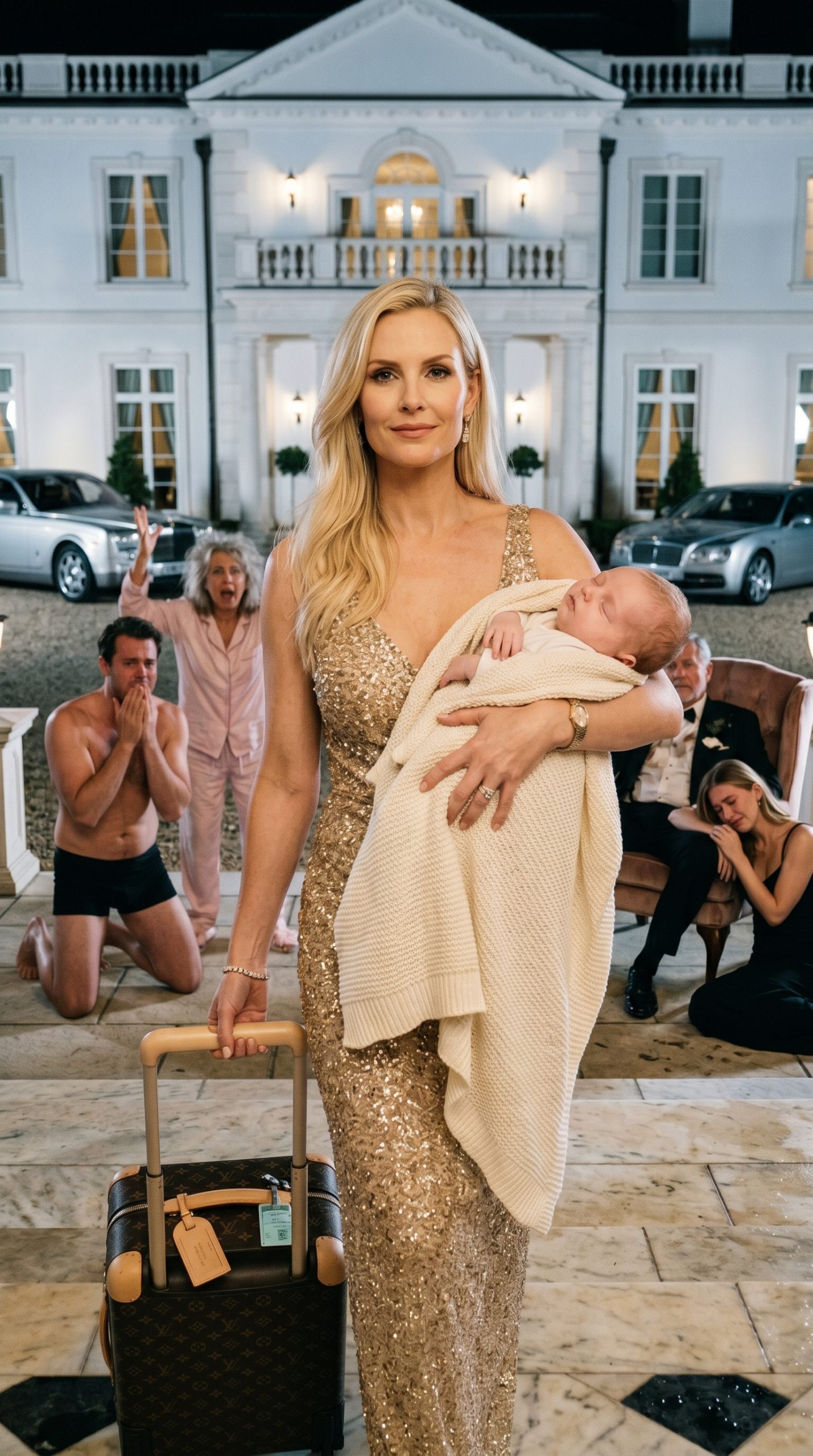
When she opened her heavy oak door at 5:15 a.m. and saw me standing on her porch—disheveled, shivering, holding a sleeping infant and a single suitcase—she didn’t ask for an explanation. She didn’t gasp or offer empty platitudes. She took one look at my eyes, simply unlatched the screen door, and said in her raspy, commanding voice, “The kettle’s already on, Emily. Bring that boy inside before he catches a chill.”
It was the first time in three years I felt like I could actually let go of the steering wheel of my life without crashing.
As I sat at her scarred wooden kitchen table, watching the steam rise from a delicate porcelain cup of Earl Grey, the icy clarity I felt in the manor didn’t fade. It sharpened to a razor’s edge.
“He said divorce,” I whispered, the word tasting like poison on my tongue.
Martha sat across from me, her weathered, vein-mapped hands folded neatly over a floral tablecloth. “And you left without a fight. Good.”
“You don’t think I should have stayed? Screamed at him? Fought for my marriage and his fatherhood?”
“Emily,” she said, her tone devoid of pity but full of fierce respect. “Men who casually drop the word ‘divorce’ at 4:30 in the morning to a woman holding their newborn child aren’t looking for a fight. They’re looking for a clean, cowardly exit. You just gave him exactly what he wanted, but I suspect, not in the way he expected.”
I looked over at my battered navy suitcase resting in the corner, then down at my leather tote. “They think I’m entirely helpless, Martha. Evelyn always made sure I felt like a charity case. They think I have nowhere to go, no resources, and no way to survive a legal war with the Whitmore empire.”
Martha leaned forward, the dim kitchen light catching a dangerous, thrilling twinkle in her dark eyes. “Then let them keep thinking that. Sun Tzu said all warfare is based on deception. Let them think you are a wounded deer. It’s the greatest tactical advantage you’ll ever possess.”
I looked down at Leo, who shifted in his sleep, his breathing soft and even. Then I looked back at my mentor. The ghost of the terrified wife shed its final skin. I wasn’t just a rejected mother or a discarded wife. I was a senior forensic bookkeeper. I understood the language of numbers better than I understood the language of men.
And it was time to audit the life I had been living.
I reached into my tote bag, bypassing the diapers, and pulled out the small, sleek metal hard drive. I placed it gently on the wooden table. It sat there, heavy with encrypted secrets.
Martha raised a silver eyebrow. “What is that, Emily?”
I met her gaze, a cold smile finally touching the corners of my mouth. “That, Martha, is the Whitmore empire. Every single cent. And it’s bleeding.”
Before the dark era of the Whitmore Manor, I had worked in high-stakes corporate accounting. I specialized in finding money that people had spent millions trying to hide. I understood fundamentally how wealth moved. I understood that numbers were never just sterile digits on a glowing screen; they were living, breathing stories. They documented greed, they mapped out affairs, and they outlined betrayals.
And for the last fourteen months, while playing the dutiful, sleep-deprived housewife, I had been reading the horrific subtext of our household finances.
I never confronted Mark about the glaring discrepancies because I hadn’t been ready to face the truth that my marriage was a financial sham. But I had been diligent. I was a professional. Every time a stray statement was carelessly left on the marble counter, every time a tax document arrived via FedEx, every time Mark left his laptop unlocked to take a call, I had made copies. I had created a secure digital folder, heavily encrypted and hidden on a cloud server, containing a meticulous map of every cent that had flowed in and out of the Whitmore accounts, trusts, and LLCs.
I knew about the inheritance—the two hundred thousand dollars I had received when my father died—that I had foolishly contributed to the “renovations” on a house my name wasn’t even on. I knew about the exorbitant “consulting fees” Mark had been routing into a holding company that looked suspiciously like a massive slush fund for a parallel life I wasn’t invited to.
“I need a lawyer,” I told Martha that afternoon, once Leo was settled in a makeshift crib in the guest room. “Not just any lawyer. I need a monster.”
Martha took a slow sip of her tea. “I know exactly the monster you need. Harrison Sterling. He’s mostly retired now, operates out of a dusty office downtown. But he hates bullies. And he possesses a specific, venomous disdain for old-money families who think they can buy reality. Especially the kind that hide their cruelty behind silk ties and charity galas.”
Meeting Harrison was like stepping into a different century. His office, located above a failing bakery, was filled with the heavy scent of old legal parchment, floor wax, and pipe tobacco. He didn’t use a laptop; his massive mahogany desk was covered in legal pads, and he wrote with a heavy gold fountain pen. He was a large man with a booming voice and eyes that missed nothing.