
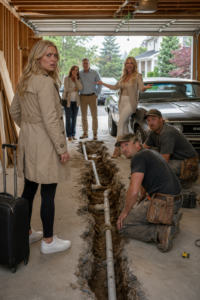
I came home early and found my family tearing open my $880,000 house
By the time my sister called screaming about the five police cars in front of her townhouse, I was sitting in my attorney’s conference room with a paper cup of burnt coffee cooling between my hands and a folder in front of me thick enough to make the truth feel heavier than it already was.
“Briana, what did you do?” Meline shrieked through the speakerphone.
Across the polished walnut table, Evan Cole, my real estate attorney, lifted one finger, silently warning me not to answer too fast. He had the kind of calm that made other people’s panic feel badly dressed. I had known him since he handled the closing on my house eight months earlier, back when the biggest problem in my life had been whether the county recording office had spelled my middle name correctly. Now he sat across from me in a charcoal suit, with copies of forged documents spread out like autopsy reports, while my sister screamed loud enough to rattle the speaker.
On the other end of the call, doors slammed. A dog barked. Someone—my mother, probably—was crying in the dramatic, breathy way she saved for audiences. Meline’s voice cracked again, sharper this time, almost theatrical. “There are five police cars outside. Five, Briana. The whole neighborhood is watching.”
I looked down at the folder. Photographs of torn drywall. The locksmith receipt. Screenshots of messages. The contractor’s invoice. A copy of the stolen key she had made without my permission. A work authorization bearing my forged signature.
I did not laugh.
Not quite.
I said, “Then I guess they finally found the right house.”
The whole thing began with a flight home from Frankfurt and the kind of exhausted happiness that makes a person foolish enough to believe her life is waiting exactly where she left it. I had been in Germany for sixteen days, long enough for hotel carpet to start looking familiar and room-service coffee to taste normal. My company had sent me overseas to oversee the final security rollout for a logistics client, the kind of project that sounded impressive in meetings and felt, in reality, like being locked inside a windowless conference room while six executives argued about passwords as if civilization depended on them.
By the end, my eyes hurt from spreadsheets, translated policy documents, and the blue-white glow of my laptop. I had lived on airport sandwiches, espresso, and the stubborn idea that soon I would be back in Oregon, barefoot in my own kitchen, listening to nothing.
Nothing mattered to me in a way most people did not understand. Quiet mattered. Empty rooms mattered. A locked front door mattered. After a childhood spent in a house where every mood belonged to someone else, I had grown into a woman who considered silence a luxury item. My family never understood that. To them, silence looked like vacancy. Space looked like waste. A woman alone in a house looked less like an owner and more like a temporary obstacle.
My house sat in a quiet neighborhood outside Portland, not far from Cedar Mill, on a street where people watered their lawns at dawn and complained online about coyotes, recycling bins, and whether someone’s fence stain was too dark for the architectural guidelines. It was not a mansion. It was not a palace. It was a three-bedroom contemporary with wide windows, clean lines, a cedar fence, and a garage I had designed down to the last recessed light.
It had cost me $880,000.
People always reacted to that number like the house had dropped from the sky into my lap. They did not picture the fourteen-hour workdays. They did not picture the years when I rented a studio behind a Thai restaurant and kept my clothes in plastic bins because I was paying off student loans and funding my own business certifications. They did not picture the nights I fell asleep with my laptop open on my chest and woke at two in the morning to the blue glow of error logs. They did not picture the promotions I chased, the projects I saved, the humiliation I swallowed from men who called me “detail-oriented” when they meant difficult.
They just heard $880,000 and saw something they thought was too much for one woman.
Especially one single woman.
I was thirty-four, unmarried, childless, and apparently that made every square foot of my life available for redistribution.
That was my family’s math.
My younger sister, Meline, had always done math differently. If I had savings, she had emergencies. If I had a weekend free, she had errands. If I said no, she called our mother, who called our father, who sighed like a disappointed judge and reminded me that family was supposed to show up for family. Meline was twenty-nine and permanently in transition. Between jobs. Between apartments. Between relationships. Between financial crises. She was beautiful in the exact way that made strangers forgive her before she finished explaining herself—big brown eyes, soft voice when she wanted something, wounded voice when she did not get it.
I knew the pattern.
I still loved her.
That was how people like Meline got through doors.
My garage was the one room in the house that felt almost sacred to me. It held my dark green 1967 Mustang fastback, the one absurd purchase I had allowed myself after selling my first software patent. I did not race it. I barely drove it. I polished it, maintained it, sat near it sometimes after a hard day and listened to old radio under museum-grade lights. The floor was sealed in slate-gray epoxy. The cabinets were matte white. Every socket, shelf, tool drawer, and storage rail had a reason.
I had built that space because, for most of my life, I had lived in places where I had to ask permission.
The garage was mine.
So was the house.
So was the silence.
When the Frankfurt project wrapped three days early, I nearly cried in the elevator of the client’s office. I changed my flight before anyone could invent another meeting, packed in ten minutes, and slept badly on the plane, wedged between a man who snored like an engine failing to start and a college student who watched action movies without headphones until a flight attendant finally intervened. I landed at PDX with my hair flattened on one side, my body aching from recycled air, and a level of happiness so simple it felt childish.
I did not tell my family I was coming home early.
That was the first mercy I accidentally gave myself.
The Lyft driver was a retired school principal named Roy who talked about his granddaughter’s soccer team all the way from the airport. Usually I would have made polite noises while answering emails. That day I listened with genuine affection because every mile brought me closer to my own front door. I pictured the white quartz island in my kitchen. I pictured the soft hum of the HVAC. I pictured setting my suitcase in the laundry room, taking a shower, and eating cereal for dinner because no one could stop me.
Then we turned onto my street.
Roy slowed near my driveway. “Looks like you’ve got some work going on.”
At first I thought he meant the neighbor’s house.
Then I saw the white van parked half across my curb.
It had no company logo on the side. The back doors were open, and inside I could see insulation rolls, buckets, a folded ladder, and lengths of white PVC pipe. A stack of lumber leaned against my cedar fence. Someone had set a sweating bottle of Mountain Dew on top of my mailbox.
My mailbox.
I paid Roy, thanked him too quickly, and stepped out into the smell of sawdust and wet primer.
That smell did not belong to me.
A drill screamed from the garage.
Not a normal drill. Not the quick sound of a handyman hanging a shelf. This was a brutal, grinding noise, the kind that cut into studs and concrete. Men’s voices echoed under it. Something heavy dragged across the floor with a scrape that went through my teeth.
For a few seconds, I stood on the sidewalk with my hand still wrapped around my suitcase handle while my brain refused the evidence.
Maybe there had been a mistake.
Maybe a contractor had the wrong address.
Maybe my neighbor’s job had spilled over.
Then I saw the garage door.
It was open halfway.
My suitcase tipped against my leg when I let go of it.
I walked up the driveway slowly at first, then faster. The drill stopped just as I ducked under the raised door, and the sudden quiet made everything worse.
The left wall of my garage had been torn open.
Not scratched. Not scuffed. Torn.
Drywall hung in jagged sections. Insulation spilled out in dirty pink clumps. Framing stood exposed like ribs. My custom cabinets had been removed and stacked crookedly against the Mustang’s front bumper, close enough that one cabinet door handle nearly touched the paint. The epoxy floor had been cut in a long ugly trench from the back wall toward the side entrance. White pipe lay in the groove like bone.
Three workers froze when they saw me.
So did my parents.
My mother stood near the workbench with a Starbucks cup in one hand and a rolled-up sheet of graph paper in the other. My father leaned against my tool chest, laughing at something, his khaki jacket sprinkled with dust. And Meline stood in the middle of the destruction wearing white jeans, wedge sandals, and the triumphant smile of a woman unveiling a prize.
“Briana?” my mother said.
She sounded inconvenienced.
Not startled. Not guilty. Inconvenienced.
Meline recovered first. She swept both arms wide, as if the ruined garage were a stage and I had arrived for curtain call.
“Surprise,” she said. “We’re expanding the house.”
I looked at the trench in my floor.
Then at her.
“What?”
She laughed, bright and sharp. “I’m going to renovate the garage and turn it into a living space. A studio. Maybe with a little kitchenette. I’m going to live here.”
The words reached me in pieces, each one too ridiculous to attach to the next.
My father chuckled under his breath. My mother smiled with wet-eyed tenderness, like she was watching sisters reunite in a holiday commercial.
“You’re home early,” Mom said. “We wanted more done before you saw it.”
More done.
As if the problem were timing.
I walked farther in, careful not to step into the cut floor. My hands felt light and cold. “Who gave you permission to do this?”
Meline blinked. “Permission?”
“Yes,” I said. “Permission. To enter my house. To hire workers. To destroy my garage.”
My father straightened, his face already settling into the expression he used when he wanted me to feel like a difficult teenager. “Don’t start with that tone.”
I laughed once, because my body had to put the pressure somewhere.
It came out wrong.
“Don’t start?” I asked.
Mom stepped closer. “Honey, listen before you get upset. Meline’s lease is ending, and the rent on her place is outrageous. You know how the market is. She needs stability. You have all this space. It only makes sense.”
“It only makes sense to whom?”
“To everyone,” Meline said.
She said it so easily I almost admired her.
“I mean, look at this house,” she continued. “You’re single, Bri. You live alone in an $880,000 house with three bedrooms and a garage nicer than most apartments. Family should be able to use it. Right?”
There it was again.
$880,000.
Not the cost of my labor. Not the value of my sanctuary. A number big enough, in their minds, to cancel ownership.
One of the workers cleared his throat. “Ma’am, we were told the owner approved everything.”
“I am the owner,” I said.
The three workers looked at Meline.
Meline’s smile twitched.
My mother waved her hand, irritated by the interruption. “Briana, don’t embarrass us in front of the contractors.”
I turned to her. “You hired contractors to tear apart my garage while I was overseas.”
“We paid them,” Dad said, as if that solved anything.
“With whose money?”
His mouth tightened.
Mom’s eyes flicked to Meline.
I understood before anyone answered.
“You used your emergency fund,” I said to my mother.
She stiffened. “That is not the point.”
“It is very much the point.”
Meline rolled her eyes. “Can we not do the interrogation thing? It’s already started. The contractor said once the plumbing is roughed in, turning back is a nightmare. So maybe just calm down and let people work.”
I stared at her.
Something inside me went quiet.
Not peaceful quiet.
Dangerous quiet.
“How did you get in?” I asked.
Meline’s face changed for a fraction of a second. It was small, almost nothing, but I caught it. A flash of calculation. Then she reached into her purse and pulled out a key ring.
On it was a silver key with a chipped blue plastic cap.
My old house key.
My stomach dropped so hard I felt dizzy.
“That,” I said, “is mine.”
“No, this is my copy.” She lifted it between two fingers, almost playful. “You left your keys on the kitchen counter during your housewarming party. I borrowed this one for, like, fifteen minutes. There’s a little hardware place by Mom and Dad’s. They copied it while we were picking up ice.”
The garage seemed to tilt.
My housewarming party had been six months earlier. I remembered Meline refilling the cooler. I remembered my mother distracting me with a question about serving platters. I remembered feeling happy enough not to guard my own kitchen.
“You stole my key.”
Meline scoffed. “I borrowed it.”
“You copied it.”
“For family.”
My father said my name with warning in it. “Briana.”
I held up one hand.
The workers were no longer pretending not to listen.
“Stop working,” I said.
The foreman, a broad man with dust on his beard, looked deeply unhappy. “We’ve got a signed work authorization.”
“Signed by whom?”
He glanced toward my mother. “Carol Wexler.”
“That is my mother,” I said. “She does not own this property. She has no authority to authorize renovation, demolition, plumbing, electrical, or anything else. If you continue after being informed, I will include your company in the report I file today.”
The word report changed the air.
The foreman lowered his drill.
“Okay,” he said slowly. “Everybody pack up.”
Meline spun toward him. “No. We paid you.”
“And she owns the house,” he said, pointing at me with the drill. “This is above my pay grade.”
My mother made a small offended sound. “This is ridiculous.”
“No,” I said. “This is trespassing. This is property damage. This is fraud. And this is over.”
My father’s face darkened. “You are not calling the police on your family.”
I looked at him, then at the torn wall, then at the blue key still dangling from Meline’s hand.
For one insane second, I wanted to laugh.
Not because anything was funny.
Because the audacity was so complete it had become almost elegant.
Instead, I pointed toward the driveway.
“Get out of my house.”
Meline’s mouth fell open. “You’re kicking me out?”
“You do not live here.”
“I was going to.”
“No.”
Mom’s eyes filled instantly. “Briana, please. Don’t be cruel. Your sister has been under so much stress.”
I heard the old hook in her voice, the one that had caught me since childhood. If Meline cried, I was selfish. If I protested, I was dramatic. If I protected anything, I was cold.
It almost worked.
Then a worker lifted one of my white cabinets and I saw a long scratch across the side panel.
“No,” I said again, softer this time.
That made it worse for them.
Meline stepped close enough that I could smell her vanilla perfume under the dust. “You won’t sue us. You won’t even file a report. You talk big because you like feeling important, but you always fold. You’ll yell, Mom will cry, Dad will get mad, and in two weeks I’ll be living here because you know what happens if you don’t help me.”
“What happens?” I asked.
“You’ll be alone.”
There was the threat, bare at last.
My family had always treated loneliness like a cage they could lock from the outside.
I looked at all three of them.
“Leave.”
The workers were already carrying tools to the van. My father muttered something about ungrateful daughters. My mother dabbed at her eyes with a napkin she must have taken from my kitchen. Meline walked backward down the driveway, still holding the copied key until she realized I was watching it. Then she shoved it into her purse.
“This isn’t over,” she called.
I believed her.
That was why I did not waste time pretending it was.
After they left, the silence inside the garage was not the silence I had missed. It was a wounded silence. Dust floated through the late afternoon light. My Mustang sat under a gray film, one headlight exposed like an eye. The trench in the floor looked worse without workers moving around it. Someone had left a pencil on the hood. Just a pencil, yellow and ordinary, but seeing it there made my throat close.
I picked it up carefully.
Then I sat down on the bare concrete because my knees stopped trusting me.
I had spent years building a life my family could not rearrange. I had bought locks, paid insurance, signed mortgage papers, filed property taxes, joined the HOA, learned the water shutoff valve, and argued with a roofer about flashing. I had done all the adult things. All the official things.
And still, my sister had walked in with a stolen copy of my key and a smile.
For a while, I did nothing.
I just sat there, breathing dust.
My phone buzzed in my coat pocket.
Mom.
I let it ring.
Dad.
I let it ring.
Meline.
I watched her name flash until the screen went dark.
Then a text appeared.
You made a scene in front of people who were trying to help. Mom is crying. Hope you’re proud.
Another.
We can discuss this when everyone is calm. Please don’t do anything rash.
Another.
You owe your sister an apology.
That one steadied me.
Anger can be foggy at first. It can fill a room until you cannot see the door. But sometimes one sentence slices through it.
You owe your sister an apology.
I stood up.
My best friend Heather answered on the second ring.
“Tell me you’re back from Germany and calling because you brought chocolate,” she said.
I opened my mouth, and for a humiliating second nothing came out.
Her voice changed. “Bri?”
“They tore up my garage.”
“Who?”
“My family.”
There was a pause so sharp I heard traffic behind her. “I’m coming over.”
“You don’t have to—”
“I’m coming over,” she repeated. “Lock your doors.”
“I can’t.”
“What do you mean you can’t?”
“Meline copied my key.”
Heather said one word I will not repeat, then said, “Call a locksmith. Now. Send me your location even though I know where you live. Do not answer your family. Do not let them back in. I’ll be there in twenty.”
Heather had been my roommate sophomore year at Oregon State. She knew the version of me who ate instant ramen for dinner and cried quietly in the library because my father had told me computer science was a nice hobby but not a personality. She had seen my family’s little cuts before I had names for them.
When she arrived, she did not gasp theatrically or say it could be fixed.
She walked into the garage, looked around once, and said, “We need pictures before anyone touches anything.”
That was Heather.
Where I had emotion, she brought sequence.
We photographed everything. The torn wall. The trench. The scraped cabinet. The pencil on the Mustang hood. The pile of PVC pipe. The half-empty paint bucket with a receipt from Home Depot taped to the side. The contractor’s van leaving my curb. The tire marks in the driveway. The dust on my car.
While I took pictures, Heather called a 24-hour locksmith and used a voice so calm it made people obey.
“Yes, the house key was copied without permission,” she said. “Yes, the owner is present. Yes, tonight. Front door, back door, garage side door, and interior garage entry. High-security cylinders if you have them.”
I heard the word tonight and breathed a little easier.
The locksmith arrived after dusk in a navy van that looked blessedly legitimate. His name was Omar. He had kind eyes and did not ask invasive questions after Heather said, “Family issue. Unauthorized key.”
He changed every exterior lock.
The old silver key with the chipped blue cap became useless piece by piece.
I watched him remove the front door cylinder and felt something inside me loosen. The sound of his drill was not like the construction drill. It was precise. Restorative. Every new lock clicked into place like a boundary being spoken aloud.
Front door.
Back door.
Garage side door.
Laundry entrance.
By the time Omar handed me the new keys, my palms were gritty with dust and my eyes burned from exhaustion.
“These are restricted blanks,” he said. “Harder to duplicate. Not impossible in the universe, but nobody’s doing it at a kiosk while buying ice.”
Heather gave me a look.
I almost smiled.
Almost.
Omar also installed temporary reinforcement plates and recommended security cameras. Heather wrote everything down. I paid by credit card and asked for an itemized receipt.
“Good,” Heather said before I could ask why.
After he left, we sat on my living room floor because I did not want to be too far from the garage but could not stand to look at it anymore. Heather ordered Thai food. I ate three bites of pad see ew and then stared at the container like I had never seen noodles before.
My phone kept lighting up.
Family group chat.
Cousins.
Aunt Linda.
A number I did not recognize.
Heather took the phone gently from my hand, turned on Do Not Disturb, and set it face down.
“You’re going to want to defend yourself,” she said. “Don’t. Not tonight.”
“I can’t believe they did this.”
“I can.”
That hurt, because I knew what she meant.
“You need an attorney,” she said.
“I have one. Well, I used him for the closing.”
“Call him in the morning.”
“My father will say I’m overreacting.”
Heather leaned forward. “Briana, they broke into your home while you were in another country. They demolished part of your garage. They copied your key. Your sister announced she was moving in. This is not a misunderstanding. This is a plan.”
A plan.
That word settled over the room.
I thought about Meline at my housewarming party, walking into my kitchen, lifting my keys, copying one while my mother kept me busy. I thought about my father laughing in the garage as workers cut into my floor. I thought about the way all three of them looked surprised to see me, but not ashamed.
They had planned it.
The locks were not enough.
Around midnight, the doorbell camera Heather had helped me reconnect sent a motion alert to my phone.
We both froze.
On the screen, my parents stood on my front porch. Meline hovered behind them in a hoodie, arms crossed. My mother was whispering fiercely. My father held out a key.
The old key.
He shoved it into the new lock.
It did not turn.
He tried again.
Meline stepped forward, grabbed it, and tried herself.
I watched her face change when it failed.
First confusion.
Then anger.
Then fear.
“They came back,” I whispered.
Heather’s jaw tightened. “Save the video.”
On the recording, my father leaned close to the doorbell camera.
“Briana,” he said, low and furious. “Open this door right now. You are acting like a child.”
Meline muttered something I could not hear.
My mother looked up and down the street, embarrassed by the possibility of neighbors seeing her. Then she said, “We are not leaving until you talk to us.”
They left after eight minutes.
Eight minutes was enough.
I saved the clip three times.
That was the second time the blue key appeared in my story.
The first time, it had opened my home.
The second time, it proved they knew it should not have.
I did not sleep.
At 7:58 the next morning, I called Evan Cole. His assistant said he was booked until Thursday. I said, “Please tell him this involves unauthorized entry, property damage, and a copied house key.”
Evan called back in nine minutes.
Related posts


