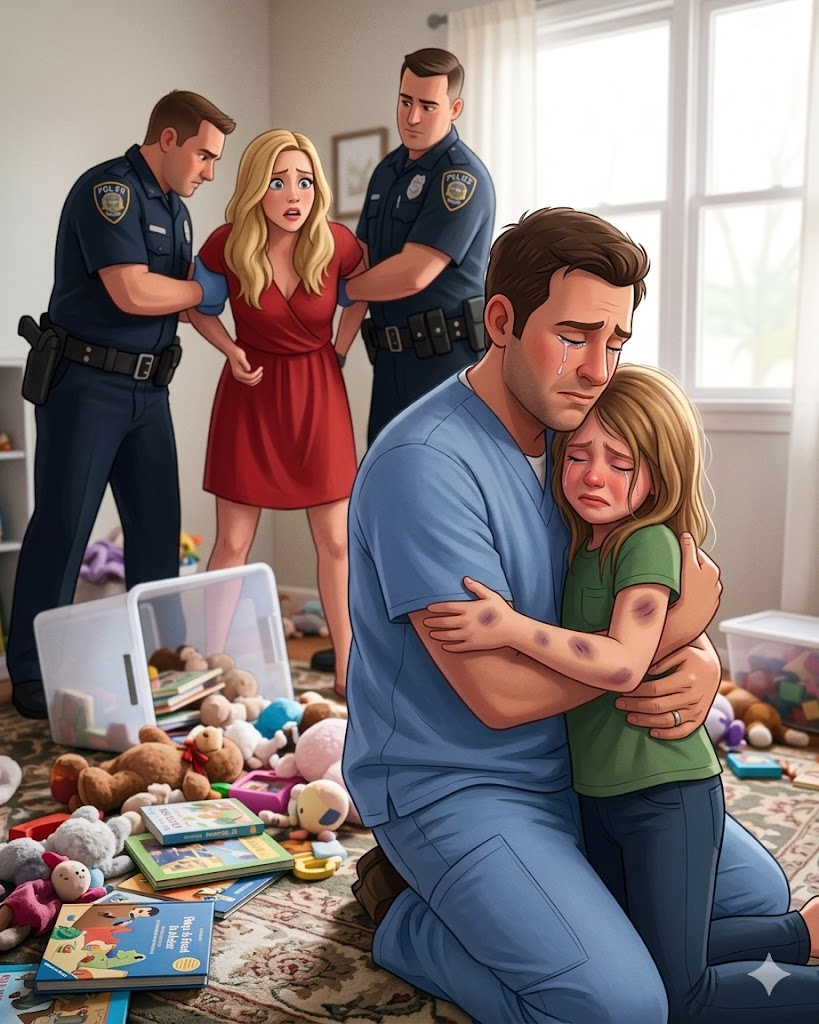
The first time Harper cried when we were alone, I told myself she was only trying to survive the shock of a new life.
That is the gentle lie adults reach for when a child stands in front of them with glassy eyes, stiff shoulders, and a face too calm for her age. I had married her mother only three weeks earlier. At seven, a child can understand that her world has shifted, but she is still too small to control any part of it.

A new man in the hallway. A new last name written on school forms. A new adult making promises when other adults may have already taught her that promises disappear.
I was an ER nurse at the University of Colorado Hospital trauma unit. I had spent years reading pain before patients could explain it. I knew the sharp panic of accident victims, the hollow quiet of domestic survivors, the way fear settles into the body. I thought I could not be fooled.
I knelt in front of Harper and kept my voice soft. “What’s wrong, sweetheart?”
She shook her head quickly. Not like a child denying sadness, but like someone afraid of what might happen if she admitted it. Her eyes flicked toward the hallway, searching for something I had not learned to see yet.
Before Clara Monroe entered my life, I lived alone in a life made of double shifts, bitter coffee, and laundry running after midnight. Then Clara appeared—a medical technology representative with auburn hair, bright hazel eyes, and a way of speaking that made the future sound warm and certain. She talked about holidays, quiet Sundays, and a home where I would finally belong.
I wanted to believe her.
Our wedding at the Denver courthouse was small and polished. My brother Noah stood beside me, smiling, though doubt still sat in his eyes.
“Six months, Ethan,” he murmured. “You’re sure?”
“When you know, you know,” I said.
It sounded confident. Later, I would understand that confidence can be only another costume.
Clara wore cream silk and looked flawless, but Harper was the one who caught my heart. She walked behind her mother with a small bouquet of daisies, wearing a blue dress with pearl buttons, her dark eyes too old for her small face. She looked less like a flower girl and more like a witness.
“Welcome to the family,” Clara whispered after we were declared husband and wife.
Two hours later, we stood outside 219 Hawthorne Avenue, a Victorian house with steep roofs, narrow windows, and the cold elegance of something meant to be admired, not lived in. Inside, everything gleamed: polished wood floors, crystal chandeliers, expensive abstract paintings. It was a house where even silence seemed arranged.
“Harper,” Clara said, already sounding distant and businesslike, “show Ethan where he can put his things. I have emails to answer.”
Harper led me upstairs. At the door of the master bedroom, she looked at my suitcase and two boxes, the small remains of my old life.
“Are you staying?” she asked. “Or just visiting?”
“I’m staying,” I said, crouching beside her. “I’m your stepdad now. I’m not going anywhere.”
She nodded, but her face went blank in that careful way children learn when they do not trust good news.
Three weeks later, Clara left for a business trip to Salt Lake City. She stood at the door in a black suit, her perfume sharp and expensive.
“Be good for Ethan,” she told Harper. Her eyes held the child in place. “Remember what we talked about.”
Harper nodded, clutching a stuffed fox with one worn ear.
The moment the front door closed, the house seemed to breathe. The tension that always tightened the rooms when Clara was home vanished so completely it felt physical.
“Cereal?” I asked.
“Whatever you’re having,” Harper said.
We ate at the marble kitchen island, sunlight spilling across the counter. She kept glancing at me from behind her bowl.
“I heard there’s a new animated movie streaming,” I said. “Want to waste a few hours and rot our brains?”
For the first time since I had met her, Harper smiled for real. “Mom says TV makes your thoughts weak. But… okay.”
We spent the morning on the sofa beneath a knitted blanket. Slowly, Harper relaxed. She laughed. She asked questions. She told me the fox’s name was Scout. For a few hours, she was simply seven years old, and I let myself believe the family Clara had promised me might still become real.
Then, near noon, I noticed the tears.
The movie was still playing, bright animals dancing across the screen, but Harper had gone completely still. Tears ran silently down her cheeks while she squeezed Scout against her chest.
I paused the movie. “Hey. What happened?”
“Nothing,” she whispered, wiping her face too fast.
“Harper, talk to me. We’re a team, remember?”
She stared at the floor for a long time. Then she said, so softly I almost missed it, “Mom says you’ll get tired of us. She says men always get tired because I’m too much work. She says when you see the real me, you’ll leave.”
My chest tightened like a fist had closed around it. To tell a child she is responsible for being abandoned is a cruelty that leaves no visible wound.
“Look at me,” I said gently but firmly. “I’m an ER nurse. I know what ‘too much work’ looks like. I’ve seen people at their worst, and I don’t walk away. I married your mom, but I joined your life too. I’m here, Harper. I promise.”
She leaned into me, small and exhausted. We finished the movie in silence, but my mind was already moving. Abandonment was not the only fear living in that house. It was simply the only one she had dared to name.
That night, I heard crying.
Not loud sobs. Not a child calling for help. It was soft, muffled, rhythmic—crying designed not to be heard.
I slipped from bed and followed the sound to Harper’s room. She sat on the floor by the window, moonlight catching the tears falling onto Scout.
“Bad dream?” I whispered.
She shook her head.
“Can’t sleep?”
Another shake.
I sat on the edge of her bed, leaving space between us. “Sometimes secrets get heavy. You can tell me if something is hurting you.”
“I can’t,” she gasped, gripping the fox. “Mom says it isn’t true anymore. She says that was the old Harper. If I talk about it, the old Harper will come back and you’ll hate her.”
Cold dread settled in my stomach.
“What happened to the old Harper?”
Her eyes lifted to mine, huge with terror. “I’m not supposed to tell. She said the fire would come if I told.”
Before I could ask more, headlights swept across the wall from outside. Harper scrambled into bed and pulled the blanket to her chin.
“I’m tired now, Ethan,” she whispered.
I stood in the doorway until her breathing evened out. But I did not sleep. Something inside 219 Hawthorne Avenue was broken, and the cracks were starting to show.
Clara returned two days later with designer luggage, silk blouses, and a perfect smile. She gave me a watch and Harper a stiff pink dress that looked more like a costume than a gift. She looked like a successful, loving mother, but I had begun watching her differently.
I saw how Harper’s shoulders curled the second Clara stepped inside. I saw how Clara’s smile never reached her eyes.