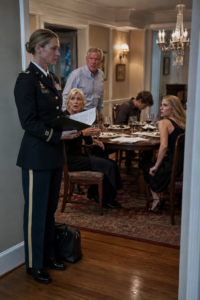
My father texted me overseas: “Your card was declined. What did you do to our money?” He forgot I was an Army logistics officer trained to trace every missing dollar—so while my brother stood in a jewelry store trying to buy an engagement ring with my pay, I froze the card, opened three years of bank records, flew home in uniform, and placed one folder on the dinner table that made my whole family go silent

The first thing my father said was not, “Are you safe?”

It was not, “How are you holding up over there?” or “We miss you,” or even the bare minimum a parent should say when his daughter is standing on a military airstrip halfway across the world with dust in her teeth and jet fuel in her lungs.

It was a text message.

Your card was declined. Call me now.

Then, ten seconds later:

What did you do to our money?

I stood on a cracked strip of tarmac in the Middle East with my gear strap cutting into my shoulder, the sun pressing down hard enough to make every breath feel borrowed. Engines roared behind me. A transport crew was shouting over the noise. The air smelled like diesel, metal, sweat, and the kind of dry heat that made you understand why shade had once been considered a blessing.

I read my father’s message twice.

Our money.

That was the phrase that stopped everything.

For three years, I had been deployed off and on, moving through bases, temporary housing, supply yards, hangars, and brief stretches of sleep that never felt long enough. I was Captain Clara Mitchell, U.S. Army logistics officer, the woman people trusted to make impossible routes work, to get equipment where it needed to be, to keep records clean and shipments moving across borders that did not care about anyone’s personal problems. My job rewarded order. It punished assumption. If a number didn’t match, I checked it. If a vehicle didn’t arrive, I traced it. If a system failed, I did not cry about betrayal. I found the point of failure and fixed it.

Except with my family.

With them, I had been careless in exactly the way I knew better than to be.

My phone buzzed again in my hand. Dad calling. Again. His name filled the screen like a command. Arthur Mitchell had always believed urgency was something he could manufacture through repetition. If he called enough, raised his voice enough, paced enough, slammed enough drawers, the world eventually shaped itself around his need. In our house, people answered when my father called. My mother, Evelyn, answered. My brother, Preston, answered. I answered, even from war zones and briefing rooms and supply depots where reception came and went like a bad mood.

This time, I let it ring.

The call went to voicemail.

I opened my banking app.

It took a few seconds to load because the network was weak, and those few seconds stretched long enough for three years of phone calls to line up in my head. The furnace emergency. The roof leak. The medical bill. The car repair. Preston’s job gap. Mom’s prescription issue. Dad’s property tax panic. Every call had been framed the same way. We hate to ask, Clara. We know you’re busy. We wouldn’t bother you if it wasn’t serious. You’re the strong one. You know how to handle things.

Strong one.

I used to think that was praise.

The app loaded.

No fraud warning. No security alert. No overdraft. Just one declined attempt on the shared card linked to my account.

Amount: $1,200.

Merchant: Whitcomb & Vale Fine Jewelry.

Location: Columbus, Ohio.

I stared at the transaction until the tarmac blurred around the edges.

A jewelry store.

Not a hospital. Not a pharmacy. Not a mechanic. Not a contractor. Not a utility company threatening shutoff. A jewelry store in Columbus.

Another call came in.

Dad.

I rejected it.

A second later, another text appeared.

Clara, this is serious. Call me before you make this worse.

Before I made this worse.

I could almost hear his voice, the old courtroom authority he used at the dinner table when I was fifteen and had asked why Preston got new cleats while I needed to wait another year for track shoes. Your brother’s team is competitive, Clara. Don’t be selfish. I could hear my mother smoothing the air after him. You know how your father gets. Don’t take it personally. I could hear Preston, eight years old and already fluent in being protected, chewing with his mouth open while I stared at my plate and learned the family math.

Preston needed.

Clara handled.

That was the equation.

A gust of hot air blew dust against my face. I blinked once, not from emotion but because grit had gotten into my eyes. Somewhere behind me, a crew chief yelled my name, then pointed toward the loading area. We were moving soon. I had work to do. Real work. The kind that did not require me to pretend theft was love.

I tapped into the card controls.

There it was. Clean. Direct.

Freeze card.

No family meeting. No argument. No childhood memories leaning over my shoulder asking me to be reasonable. Just one button.

I pressed it.

The screen changed instantly.

Card status: frozen.

The supply line was cut.

For the first time in three years, my phone went silent.

I slid it into my pocket and walked toward the aircraft with the rest of my unit, boots hitting the hot concrete in rhythm. Around me, everything was noise and motion. Pallets being loaded. Engines whining. Men and women moving with practiced efficiency. Orders passing from one person to another. Systems doing what systems were designed to do.

Back home, another system had just failed.

And this time, I was going to audit it properly.

That night, after the transport mission ended and the base settled into its restless version of quiet, I sat in my quarters and opened my laptop. The room was small, metal-framed, functional in the military way. A narrow bed. A desk. A locker. No wasted space. No soft edges. I liked that about it. Everything had a purpose. Everything could be inventoried.

I logged into my bank through the full desktop portal.

The first thing I did was export thirty-six months of statements.

Three years of my life became rows of numbers.

Date. Description. Amount. Balance.

At first glance, it looked ordinary. That is the dangerous thing about financial betrayal. It rarely announces itself in one dramatic withdrawal. It hides in patterns small enough to ignore until ignoring them becomes your second job.

I opened a spreadsheet and created a new column.

Dad contact.

Then I pulled up my phone history.

It took less than ten minutes for the first pattern to appear.

April 15th: military pay deposit, $3,842.17.

April 16th: three missed calls from Dad.

April 16th: transfer out, $600.

May 1st: deposit, $3,842.17.

May 2nd: text from Dad: Emergency. Call when awake.

May 2nd: transfer out, $850.

May 15th: deposit, $3,842.17.

Continue to Part 2 Part 1 of 5

Leave a Reply

Your email address will not be published. Required fields are marked *