PART 1
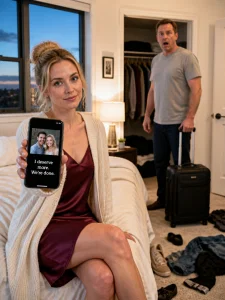
At 2:00 a.m., the zipper of a suitcase broke the silence of the bedroom.
I lay still on my side of the bed, eyes half closed, listening to my husband, Arthur Vance, move around our walk-in closet with the careful panic of a thief. He thought the tea he had prepared would keep me asleep.
They had not.
I had switched our cups.
For twenty minutes, I watched him through the reflection in the black window. Designer shirts. Passport. Cash. The blue velvet box where he kept his cufflinks. He packed everything except guilt.
At 2:18 a.m., he stepped beside the bed and stared down at me.
“Poor Eleanor,” he murmured. “You never even saw it coming.”
I kept my breathing slow.
He leaned close, and I smelled his expensive cologne, the one his mistress had bought him because I had seen the receipt in his coat pocket three weeks ago.
Then he walked out.
I waited until his car left the driveway before I sat up.
My phone lit at 2:37 a.m.
It was a photo.
Arthur stood at Boston Logan Airport with Sienna Brooks, his twenty-nine-year-old mistress, pressed against his chest. She wore sunglasses indoors and my diamond tennis bracelet on her wrist.
Below the picture was a message:
“Goodbye, useless woman! I’ve stripped you of all your assets!”
I stared at it.
Then I chuckled.
Not because it didn’t hurt. It did. Eleven years of marriage can still hurt, even when betrayal is no longer a surprise.
I chuckled because Arthur had always mistaken silence for weakness.
He believed the house was his because his name appeared on the mailbox. He believed the company accounts were his because I let him sit in the biggest chair during investor dinners. He believed I was useless because I allowed him to speak first.
What he never knew was that six months earlier, after discovering his affair, forged signatures, hidden loans, and the shell company he had built under Sienna’s brother’s name, I had stopped being a wife and became evidence.
Every bank statement. Every email. Every hotel receipt. Every drunken voice message where he bragged about “emptying Eleanor out before the divorce.” All of it had been delivered to my attorney, forensic accountant, and the FBI financial crimes unit by 10:00 p.m. the previous night.
At 2:45 a.m., I replied with only one line.
“Enjoy the airport.”
At 3:06 a.m., Arthur called.
I did not answer.
At 3:09, Sienna called.
I smiled, poured his drugged tea down the sink, and watched the first snow of December fall over our front lawn.
By sunrise, Arthur would learn that the passport in his pocket was worthless, the accounts he had stolen from were frozen, and the woman he called useless had already signed the warrant…
Part 2
At 6:12 a.m., the first call came from Detective Thomas Cole.
“Mrs. Vance,” he said, his voice calm and professional, “your husband attempted to board Flight 418 to Zurich with Ms. Sienna Brooks. Homeland Security flagged both passports before boarding. They are currently being held for questioning.”
I stood in my kitchen in a robe, watching coffee drip into the pot Arthur had once insisted was “too cheap” for our lifestyle.
“Did he say anything?” I asked.
There was a pause. I could hear airport noise behind him, muffled announcements, rolling luggage, people moving toward lives that still belonged to them.
“He claimed you were emotionally unstable,” Detective Cole said. “Then he said you had given him full authority over all marital and business assets.”
I laughed softly. “Of course he did.”
“We also found one hundred and eighty thousand dollars in cash inside Ms. Brooks’s carry-on. Along with several certified checks made out from accounts linked to Vance Medical Logistics.”
That name still tasted strange to me.
Vance Medical Logistics had started in my father’s garage in Ohio before Arthur ever knew what freight compliance meant. My father, Harold Sterling, had built relationships with hospitals across the Midwest. I had expanded the company to the East Coast. Arthur joined later, after our marriage, with charm, confidence, and no real experience.
Over time, I let people assume he was the force behind the company. It was easier. Investors liked his booming speeches. Clients liked my quiet efficiency. Behind closed doors, I corrected his numbers, cleaned his mistakes, and saved deals he nearly ruined.
Then came Sienna.
She was not just beautiful. She was ambitious in a reckless way. She told Arthur he deserved more. She called me plain, boring, “a spreadsheet in human form.” The phrase had appeared in one of their messages.
A spreadsheet remembers everything.
By 8:00 a.m., my attorney, Victoria Thorne, arrived at the house with two associates and a sealed folder.
“You look rested,” she said, removing her gloves.
“I slept before the storm.”
Victoria smiled. “Good. Because Arthur’s attorney is already demanding an emergency hearing. He claims you froze the accounts out of revenge.”
I took the folder from her. “Can he prove legal access?”
“No. That is the beautiful part. The company restructuring you approved last month placed operational control under the Sterling Family Trust. Arthur signed it himself.”
“He thought it was tax planning,” I said.
“He never read page seven.”
Arthur never read anything longer than a menu.
By noon, the news had reached our board members. Three called me privately. One apologized. One pretended he had always suspected Arthur was unstable. The last, Charles Boyd, asked if this would affect quarterly deliveries.
“No,” I told him. “The company will run better by Monday.”
At 2:30 p.m., I finally listened to Arthur’s first voicemail.
“Eleanor, listen to me. This is a misunderstanding. Sienna panicked. I didn’t mean that message. You know how I get when I’m angry. Call Victoria off. We can fix this.”
The second message was louder.
“You think you’re clever? You think paperwork makes you powerful? I made you relevant!”
The third message came from Sienna.
“Eleanor, please. Arthur told me you two were separated. I didn’t know about the money. I didn’t know any of this was illegal.”
I replayed that one twice.
Not because I believed her.
Because her voice shook in exactly the way mine had five months earlier, when I stood in my bathroom reading her texts on Arthur’s phone, realizing my marriage had not collapsed suddenly. It had been dismantled piece by piece while I was busy saving the life we shared.
That evening, Victoria and I sat across from Arthur in a conference room at the federal building.
He looked smaller without his tailored coat.
His eyes locked onto mine. “Eleanor,” he said, softening his voice, “baby, please.”
I folded my hands.
“You called me useless at 2:37 this morning.”
Sienna, seated beside her public defender, looked down.
Arthur swallowed. “I was angry.”
“No,” I said. “You were honest. That was your mistake.”
Victoria opened the sealed folder and slid a copy across the table.
Arthur’s face drained as he read the first page.
It was not a divorce filing.
It was a civil complaint for fraud, breach of fiduciary duty, conversion of company funds, identity theft, and conspiracy.
I stood.
“Enjoy the hearing, Arthur.”
He grabbed the edge of the table. “Eleanor, you can’t destroy me.”
I looked at the man I had once loved, the man who had mistaken my patience for permission.
“I’m not destroying you,” I said. “I’m returning everything you built.”
Part 3
The heavy oak door of the federal conference room clicked shut behind me, cutting off Arthur’s desperate shouts. Victoria followed me out into the brightly lit hallway, her heels clicking rhythmically against the polished terrazzo floor.
“His public defender is already advising him to look into a plea deal,” Victoria said, slipping her glasses into her pocket. “He knows the federal government doesn’t lose wire fraud cases when the paper trail is this clean. But what about Sienna?”
I paused by the tall windows overlooking the city. Below us, the evening traffic crawled through the slush of the first winter snow. “Sienna is a symptom, Victoria. Not the disease. Let her public defender argue that she was an unwitting accomplice. The FBI will decide how much of that one hundred and eighty thousand dollars she knew was stolen.”
“And the board?”
“Tell Charles Boyd to convene an emergency meeting for nine o’clock tomorrow morning,” I said, turning to look at her. “I want Arthur’s formal removal from the corporate bylaws finalized before the markets open.”
Victoria smiled—a sharp, professional expression that meant a victory was secure. “Consider it done. Go home, Eleanor. You’ve earned a night of actual sleep.”
I didn’t go home immediately. Instead, I drove down to the old industrial district near the docks, pulling up outside the brick warehouse that bore the faded, painted sign: Sterling Logistics. It was the original building my father had bought in the late eighties.
I unlocked the side door and walked into the quiet, echoing space. It smelled of old pallets, motor oil, and history. Arthur had hated this building; he had forced the board to buy a glass-and-steel high-rise downtown the second we crossed thirty million in revenue, calling this place an “embarrassing monument to a garage operation.”
But it was here that I learned how a supply chain worked. It was here that my father taught me that a company’s strength isn’t in its stock price, but in its compliance and its contracts.
My phone vibrated in my coat pocket. It was an alert from our primary corporate banking portal.
Notification: Attempted wire transfer of $2.4M from Vance Medical Logistics Operating Acct to Swiss Commerce Bank blocked by Administrator (E. Sterling).
I stared at the screen. The timestamp on the attempted transfer was 2:32 a.m. the previous night—exactly five minutes before Arthur had sent me that smug airport selfie. He hadn’t just been trying to leave me; he had tried to completely drain the business’s capital reserves, leaving thousands of suppliers unpaid and the company crippled.
He hadn’t just wanted to start a new life with his mistress. He had actively wanted to destroy mine.
I tucked the phone away, a cold, absolute clarity settling into my chest. Eleven years of marriage hadn’t just been dissolved by a betrayal; they had been revealed as an extended con. Arthur had never loved the business, and he had never loved me. He had loved the proximity to wealth, and he had spent over a decade waiting for the right moment to steal it all.
By the time I returned to our empty mansion, the house felt entirely different. The suffocating weight of Arthur’s loud, performance-heavy presence was entirely gone. His expensive shoes were missing from the mudroom, his loud laughter no longer echoed from the home theater, and his tailored suits had been cleared out of the closet.
I went into the kitchen, poured myself a glass of water, and sat down at the marble island with my laptop. I had a board meeting to prepare for, and I had no intention of arriving without a strategy.
Final Part
The board room on the twentieth floor of the downtown high-rise was dead silent at 9:00 a.m.
Charles Boyd sat at the head of the long glass table, flanked by the seven other principal shareholders of Vance Medical Logistics. When I walked in, wearing a sharp, tailored navy suit that belonged entirely to me, every man in the room stood up.
There was a profound, nervous tension in the air. These were men who had spent years golfing with Arthur, men who had toasted his “visionary leadership” at annual galas while I quietly sat three chairs down, managing the logistical frameworks that kept the company compliant.
“Eleanor,” Charles Boyd began, his voice laced with an uncomfortable, placating warmth. “Thank you for coming. We are all deeply, deeply shocked by the news of Arthur’s… legal complications. The press has been hounding our media relations team since dawn.”
“It’s not a legal complication, Charles,” I said, taking my seat at the center of the table. I didn’t wait for them to sit. “It is a federal indictment. Arthur Vance attempted to embezzle two point four million dollars of corporate capital, forged my father’s estate signatures, and used a shell company to siphon freight compliance fees.”
A few of the board members shifted their weight, looking down at their tablets.
“We understand that this is a highly emotional time for you,” another board member, a logistics director named Harrison, chimed in. “A marital dispute of this magnitude is tragic. But we must think of the shareholders. The stock dropped four percent at the opening bell. There is a sentiment that without Arthur’s public face, the Vance brand may suffer.”
I opened my laptop, linking it directly to the massive projection screen at the front of the room.
“First of all,” I said, my voice echoing with an icy authority that made Harrison instantly close his mouth, “the brand is not Vance. The legal corporate entity, as of thirty days ago, has reverted entirely to its original registration: Sterling Medical Systems.”
On the projection screen, a massive, undeniably clean legal document appeared.
“Arthur signed the restructuring paperwork under the impression that he was finalizing a tax shield for his own shell companies,” I explained, scrolling down to the signature lines. “He didn’t read page seven, which carried a stipulation that any unauthorized attempt to liquidate or transfer corporate funds over fifty thousand dollars without the express, dual-signature approval of the Sterling Family Trust would result in an immediate, automatic forfeiture of all voting shares and an instant termination of executive employment.”
Charles Boyd leaned forward, his reading glasses slipping down his nose. “He… he signed his own termination?”
“He did,” I said. “And because his voting shares have been legally revoked by the trust due to his fraudulent behavior, I currently hold seventy-four percent of the company’s voting power. The Vance brand doesn’t exist anymore, gentlemen. And neither does Arthur’s position.”
The board members looked at each other, the reality of the situation finally crashing down on them. The quiet woman who had managed the spreadsheets had just executed a flawless corporate coup without firing a single shot.
“So,” I continued, closing the slide and bringing up the current operational queue, “here is how we are going to handle the Monday morning deliveries. I have already contacted our regional managers in Boston, New York, and Philadelphia. The frozen operating accounts have been cleared by the federal authorities because I provided them with the independent, clean capital from the Sterling Trust to cover this week’s payroll.”
I looked at Charles Boyd. “Do you have any questions regarding the leadership transition, Charles?”
Charles swallowed hard, then slowly offered a nod of genuine respect. “No, Eleanor. I think the company is in the exact hands it should have been in from the start.”
By 3:00 p.m., the press release had been issued. The market responded to the swift, decisive change in leadership with a five percent rally, completely erasing the morning’s losses. The “spreadsheet in human form” had stabilized the empire before the end of the trading day.
Two weeks later, I received a request from the federal holding facility. Arthur wanted to see me before his formal arraignment. Victoria Thorne advised against it, but I told her I wanted the closure. I wanted him to see me standing in the light of the truth.
The visitor room was cold and smelled of industrial disinfectant. When Arthur was led in, wearing a standard-issue orange jumpsuit, the contrast was staggering. The man who had strutted through our mansion in four-thousand-dollar Italian suits looked small, weathered, and entirely broken.
He sat down across from the glass partition, slowly lifting the heavy black phone receiver. I picked up mine.
“Eleanor,” he said, his voice entirely devoid of its usual booming, theatrical resonance. “You actually came.”
“I came to deliver the final divorce decree, Arthur,” I said, sliding the document against the secure transfer slot at the side of the table. “Victoria has already finalized the asset division. Or rather, the lack thereof. Since you used marital funds to finance Sienna’s apartment and your own offshore accounts, the court has ruled it a dissipation of marital assets. You have no claim to the house, the cars, or the business.”
Arthur looked at the paperwork, his eyes vacant. “You completely destroyed me. You sat there for months, watching me pack, watching me plan, and you just waited to pull the rug out.”
“You pulled the rug out yourself, Arthur,” I said, my voice level and calm. “You chose to pack that suitcase at two in the morning. You chose to take a photo at the airport with a stolen diamond bracelet on your mistress’s wrist. You chose to send a message calling me useless.”
He looked up, a flicker of his old, desperate anger visible in his eyes. “I gave you eleven years, Eleanor! I built that company’s public image! I made people believe we were a power couple!”
“No,” I corrected him. “You made people believe you were the power, while I did the work. You mistook my patience for ignorance, and you mistook my silence for weakness. A spreadsheet doesn’t react, Arthur. It just records. And when the math doesn’t add up, it corrects the error.”
He lowered his head against the glass, his shoulders trembling as the reality of his twenty-year prison sentence finally began to settle into his bones. “What about Sienna? She won’t even take my calls.”
“Sienna turned over the remaining cash and the tennis bracelet in exchange for immunity,” I said. “She’s already moved back to Ohio. She was an investment that failed you, Arthur. Just like all the others.”
I stood up, adjusting the lapels of my coat. I looked at the man who had thought he could empty me out, the man who had sneered at my existence while sneaking out like a thief in the night.
“Goodbye, Arthur,” I said, placing the receiver back on its cradle.
He reached out, his hand slamming against the glass partition, but I didn’t flinch. I didn’t even look back as the heavy steel door opened to let me out into the crisp, clean winter air.
The snow was still falling when I drove back into the driveway of my home. The house was quiet, but it was no longer empty. It was filled with the legacy of my father, the security of a business that belonged fully to the people who built it, and the absolute peace of a woman who had finally stepped into her own power.
Arthur Vance had left at two in the morning, convinced he had stripped me of everything. But as I walked through my front door, locking it behind me, I knew that the only thing he had actually taken with him was the trash.