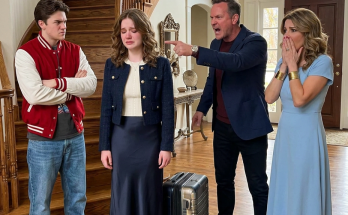
My father reacted first. He walked closer with the smile he reserved for the smell of money.
“Nathan, there must be some kind of misunderstanding.
Nathan didn’t blink.
“She enjoys it?”
My mother gave a fake laugh.
“Oh, please. Emily exaggerates. Besides, she never told us she was engaged. How were we supposed to know?”
I looked straight at her.
“You didn’t need to know I was engaged to let me sit down and eat.”
The silence that followed felt different.
It was no longer surprise.
It was shame trying to hide beneath the tablecloth.
Claire crossed her arms.
“Don’t act like a victim. Mom just wanted everything to be perfect.”
“Perfect for
My father lowered his voice.
“Emily, watch your tone. This is not the time for family drama.”
Nathan stepped closer to me.
“Put on your coat.”
My mother lifted her chin.
“Excuse me?”
“I said Emily should put on her coat.”
“This is a family dinner,” my mother said.
Nathan looked around at the carved turkey, the full wine glasses, and the occupied chairs filled with people who had spent years treating me like a servant who happened to share their name.
“No,” he replied. “This is a performance. And she’s done playing her role.”
My father clenched his jaw.
“Nathan, let’s speak like adults. It isn’t wise to mix personal matters with business.”
That was when I understood everything.
It didn’t hurt him to see me leave.
It hurt him to see me leave with Nathan.
I slowly untied the apron and placed it on the counter.
My mother grabbed my arm.
“If you walk out that door, don’t come back expecting us to beg you.”
I looked at her without anger.
That surprised me most of all.
I simply no longer had the strength to keep fighting for a seat in a place
“I’m not coming back to beg for anything.”
Claire whispered,
“You’ll regret this.”
Nathan answered for me.
“No. She’ll remember it.”
I walked toward the front door.
As I passed the table, everyone suddenly seemed to remember my name. One aunt tried to touch my shoulder. Logan muttered something about “not burning bridges.” My father followed me into the foyer.
“Emily, think carefully. That contract supports a lot of people.”
I stopped with my hand on the doorknob.
“How interesting, Dad. When I gave up my future to support all of you, nobody asked me to think carefully.”
Outside, rain fell over the trees of River Oaks.
Nathan opened the door of his black SUV.
Before getting in, I looked back at the brightly lit house.
For years, I believed I was the one left out of the family table.
That night, I realized they were the ones left out of my life.
And the worst part for my family wasn’t watching me leave.
It was realizing I knew exactly which secret could destroy them.
The SUV drove through downtown Houston in the light rain, the kind that blurs city lights and makes everything look like a sad movie through wet glass.
I sat quietly with my hands in my lap, still smelling the cheap dish soap from the kitchen. Nathan drove without speaking. He wasn’t calm. I knew him well enough to notice the tension in his jaw, the way his fingers held the steering wheel.
“I should have gotten there sooner,” he finally said.
I shook my head.
“You arrived when I was finally ready to leave.”
“I didn’t know they were that cruel.”
I stared out the window.
We passed crowded restaurants, couples sharing umbrellas, families leaving dinner together.
For some people, belonging somewhere looked so easy.
“I didn’t want to know either,” I said.
The truth was, for years I had decorated my wounds until they sounded like harmless little stories.
I told Nathan my family was difficult, not that my mother had made me serve food at Claire’s engagement party because, “You don’t have a boyfriend, so at least make yourself useful.”
I told him my father was demanding, not that he had asked me to sell my car to cover one of Logan’s debts, only to later announce at lunch that his son was “a fearless entrepreneur.”
I told him about teasing, not about the day my mother said in front of twelve people,
“Emily doesn’t need a new dress. She’s not someone people notice.”
You learn to shorten your pain so you don’t scare the people who love you.
We reached Nathan’s apartment in Uptown shortly after ten.
It was spacious, quiet, warmly lit, and smelled like fresh coffee.
His housekeeper, Mrs. Miller, stepped out of the kitchen, took one look at my face, and asked no questions.
“I’m warming up some soup for you, sweetheart,” she said. “A face like that needs more than pride.”
For the first time all night, I almost laughed.
Nathan helped me take off my coat.
Underneath, I was wearing the navy-blue dress I had carefully chosen before my mother covered it with an apron.
He looked at me as if I were the only person in the room.
“You look beautiful.”
“I smell like turkey.”
“Then the turkey was lucky.”
I smiled.
Then my smile fell apart.
I covered my face with my hands and cried.
It wasn’t graceful crying.
It was tired.
Ancient.
The kind of crying that seemed to come from the little girl who once waited for her mother to brush her hair with tenderness, from the teenager who handed over her savings without ever hearing thank you, from the woman who kept accepting crumbs because she had mistaken crumbs for family love.
Nathan didn’t tell me to calm down.
He didn’t say, “It’s over now.”
He simply held me, as if he understood that some grief doesn’t need an immediate solution.
It only needs a safe place to land.
Later that night, sitting in his kitchen with a bowl of noodle soup and a sandwich Mrs. Miller had made because “nobody thinks clearly on an empty stomach,” my phone began vibrating.
Mom.
Dad.
Claire.
Logan.
Aunt Diane.
Even a cousin who never remembered my birthday.
I didn’t answer.
Then a message from my father appeared.
Emily, this has gotten out of control. Call me before you damage something important.
I read it three times.
Something important.
Not my pain.
Not my humiliation.