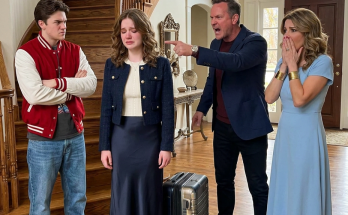
It was the kind of order that had followed me my entire life.
“Put on the apron, Emily. The family didn’t come here to watch
That was what my mother, Margaret, told me as she adjusted the silverware on the main dining table, as if each fork mattered more than my dignity.
My father, Harold, had invited the whole family to Thanksgiving dinner at his house in River Oaks, Houston. He said he wanted to “bring everyone together like the old days,” even though we had never truly been together in that house. We had only been polished, properly dressed, and perfectly trained to pretend.
By six that evening, the living room smelled of roasted turkey, expensive
And I was in the kitchen.
My mother had placed the apron in my hands as though she were handing me a
“You know this kitchen better than anyone. Don’t make a scene. Serve, help, and try to look grateful.”
Grateful.
Since I was seventeen, I had been trained to be exactly that. Grateful for sleeping under their roof. Grateful for working at the family company without a real salary. Grateful for leaving college when my father’s construction business got into trouble and “everyone had to sacrifice,” even though I was the only one who actually gave anything up.
Claire kept studying fashion in New York because, according to my mother, “she has presence.” Logan was given enough money to launch
“Emily is the strong one.”
The strong one was just the person everyone expected to carry everything without anyone asking whether her back was breaking.
So I cooked.
I checked the turkey, reheated the green bean casserole my mother insisted on “to keep things traditional,” served mashed potatoes, sliced bread, washed dishes, and refilled wine glasses. Every time I entered the dining room, I heard my mother praising Claire.
“My beautiful daughter has always known how to shine.”
Then she would gesture toward Logan.
“And him—even if he’s a little wild—he was born for business.”
No one asked about me.
No one noticed that my own plate was still empty beside the sink.
Around eight o’clock, while I scrubbed a burned serving tray, the doorbell rang.
The dining room went quiet at once.
First, I heard footsteps in the hallway. Then the nervous voice of the young housekeeper.
“Mr. Whitmore… someone is here to see you.”
I didn’t even look up. I thought it was another late guest or one of my father’s business contacts.
Then the kitchen fell silent.
A man appeared in the doorway.
He wore a black suit, a dark overcoat, and shoes still damp from the rain. He was tall, composed, carrying the effortless confidence of someone who never needed to raise his voice for people to move aside. His eyes moved across the dining room, then into the kitchen, until they landed on me.
My hands were still wet, my hair was quickly tied back, and there was a stain of gravy on my sleeve.
He walked straight toward me.
Before I could say anything, he gently took my soapy hand, lowered his head, and kissed my knuckles.
“I’m sorry, my love,” he said. “I’m late.”
The whole dining room forgot how to breathe.
My mother turned pale.
Claire stood up.
Logan whispered a curse.
Because this wasn’t just another guest.
This was Nathan Cole, owner of Cole Hospitality Group, the hotel magnate my father had spent the past six months trying to win the biggest contract of his career from.
And he had just called me my love.
My father slowly rose from his chair, his face drained of color.
“Emily… do you know Mr. Cole?”
Nathan looked at the apron tied around my waist. Then he looked at the dinner table that had been set for everyone except me.
His expression hardened.
“I know her very well,” he said. “She’s my fiancée. And I’d like to know why she’s washing dishes while the rest of you are eating dinner.”
The word fiancée hit the table like a wineglass shattering.
No one moved.
My mother opened her mouth, but for the first time, she had no cruel remark ready. Claire stared at my hand as if searching for a ring I had never dared wear around them. Logan gave a nervous laugh.
“No way, Emily,” he said. “Since when?”
I took a deep breath.
Nathan and I had been engaged for four months. We met two years earlier at a charity gala in Dallas where I was coordinating vendors. That night, the sound system failed, the chef threatened to quit, and a major donor threw a tantrum in front of three hundred guests. I solved every problem without shouting, crying, or asking permission.
Nathan noticed me.
He didn’t see “Harold Whitmore’s useful daughter.” He didn’t see Claire’s overlooked sister.
He saw me.
I kept our relationship secret because I knew my family. I knew that if they found out, my mother would suddenly start hugging me in public, my father would begin calling me “my little girl” in front of his business partners, Claire would ask me for advice through poisonous smiles, and Logan would start talking about “projects we could build together.”
To them, love wasn’t love unless it could be turned into an opportunity.