PART 1: The Takeover
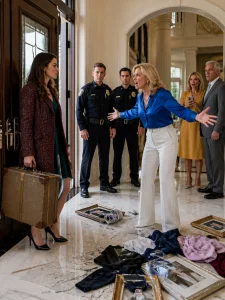
“Get out right now or I’m calling the police! My son bought this apartment for me!”
My mother-in-law screamed those words before I had even managed to drag my second suitcase across the threshold.
For one strange second, I thought exhaustion had rearranged reality. I had been on a delayed flight from Boston, my shoulder ached from sleeping upright in seat 22C, and the zipper on my garment bag had split somewhere between baggage claim and the parking garage. It was nearly eight o’clock on a gray Thursday evening in Atlanta, and all I wanted was to step into my own apartment, take off my shoes, drink water from a real glass, and sleep for twelve uninterrupted hours.
Instead, Fiona Vance was standing in my living room wearing a satin robe the color of spoiled champagne, hair rolled in hot curlers, holding a mug that had belonged to my grandmother.
My grandmother’s mug. White ceramic. Blue violets. A tiny chip on the handle where I had dropped it at twelve years old and cried because I thought I had ruined something sacred. Grandma Elise had laughed, dabbed glue on the crack, and told me, “Pretty things with chips still hold coffee, Maya. Don’t let anyone tell you different.”
Now Fiona had her red lipstick on the rim. She stood there like she owned the place.
Behind her, my home had been rearranged into a stranger’s idea of superiority. The framed photographs on the console table were gone: my parents at Lake Lanier, my sister Olivia laughing with powdered sugar on her nose, me standing in front of the apartment the day I closed, holding keys in one hand and a cheap grocery-store bouquet in the other. My cream throw pillows had been replaced with stiff embroidered monstrosities that read Bless This Home and Family Is Everything. A lace dust cover dangled from my dining room chandelier as if Fiona had looked up and decided even light fixtures needed modesty.
The air smelled like her perfume—old roses and entitlement.
I set down the handle of my suitcase. “Fiona,” I said.
“Do not Fiona me,” she snapped, tightening her grip on the mug. “You heard me. Get out. This is my home now.”
My name is Maya Sterling. I was thirty-one years old, recently separated from Fiona’s son, and standing in the foyer of the Atlanta apartment I had purchased three years before I ever met Arthur Vance. Bought with my own money. Titled in my own name. Renovated with bonuses from the consulting job Arthur liked to mock right up until those bonuses paid for the hardwood floors, the kitchen appliances, the built-in bookshelves, and the down payment he never contributed a single cent toward.
I had spent six weeks in Boston helping my younger sister recover from emergency surgery. Apparently, six weeks was all Arthur and Fiona needed to turn my absence into an invasion.
“This is my apartment,” I said.
Fiona laughed. It was a theatrical laugh, the kind women like her use when they think condescension counts as evidence. “Oh, honey,” she said, drawing the word out until it became an insult. “You really don’t understand what’s happening, do you?”
I looked past her into my own living room. My linen curtains had been tied back with tassels I had never seen before. A framed needlepoint prayer hung where my abstract print used to be. On the coffee table sat a stack of gossip magazines, a half-eaten lemon cookie, and Arthur’s old law school mug—though he had dropped out after one semester and still spoke about it like a sabbatical from destiny.
“Where are my things?” I asked.
Fiona waved one manicured hand. “Stored.”
“Where?”
“Somewhere safe.”
“Fiona.”
Her eyes narrowed. “You abandoned the place, Maya. You left my son alone, ran off to Boston, and expected everyone to wait around while you played nursemaid for your sister. Arthur made a decision. He decided it was time someone stable lived here.”
Stable. That almost made me smile. Fiona Vance calling herself stable was like a match calling itself a fire safety expert.
“Arthur made a decision about property he does not own,” I said.
Her face tightened, but only for a second. “My son bought this apartment for me,” she said again, louder now. “He signed papers. You have no right to come in here dragging luggage like some cheap tenant. This is a family residence now, and you are not part of this family anymore.”
I glanced at the hallway behind me. No neighbors yet. But someone had probably heard. Voices carried in high-rise corridors, especially on floors where everyone pretended not to listen while catching every word.
Fiona stepped closer. “You were never good enough for Arthur,” she said. “You know that, don’t you? All those spreadsheets and suits and little corporate trips. You thought making money made you a wife. It didn’t. A wife supports her husband. A wife doesn’t humiliate him by acting like she’s the man.”
There it was. The old wound dressed in fresh lipstick.
Arthur had said softer versions of that sentence for years. Jokes at first. “Maya’s the CFO of our marriage,” he would say when I paid the mortgage. “She loves her little reports.” Then resentment. “Not everything is a client presentation, Maya.” Then mockery when his investment ideas failed and my work kept the lights on. “Must be nice billing people six figures to tell them what color their charts should be.”