He even texted me that he hated old things and deserved a new life, as if twenty years of marriage, motherhood, and the home built on my father’s land were just clutter he could order removed. I let him believe I was broken. I let him enjoy every photo, toast, and beachside celebration while my attorney moved faster than he ever imagined I could. Then I parked down the road on the morning his plane landed, watched his car pull into the driveway, and saw his face turn white when he realized the house itself was gone…
Part 1: The Directive at 2:13 AM
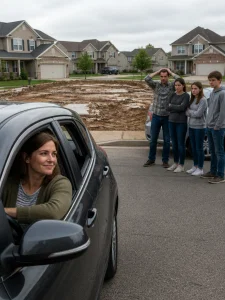
The text arrived at precisely 2:13 in the morning.
I know the exact time because I’d been lying awake anyway, staring at the rhythm of the ceiling fan and listening to the house settle around me—the way old houses do, creaking and sighing like they’re trying to warn you about the weather. My phone illuminated the nightstand. For one foolish, half-asleep second, I thought maybe Logan was checking in from his flight. Maybe something had gone wrong with the trip. Maybe he’d remembered I existed.
Be gone when we return. I hate old things. I work hard, so I deserve a new life.
I read it twice. Then a third time. Then the second message came through, almost cheerful in its delivery.
Don’t embarrass yourself. The kids will be with us.
I flipped the phone face-down and lay there in the dark for a long time. The ceiling fan kept turning. The house kept breathing. And somewhere over the Atlantic, my husband of nineteen years was probably sleeping just fine.
Logan Sterling had always had a particular talent for dressing up cruelty as corporate efficiency. Short sentences. No softening. No apology hiding between the lines. Just clear directives, delivered the way he handled everything at his logistics firm—like a man who’d already decided the outcome and was simply informing the other parties.
I used to think it was confidence. It took me years to understand the difference between a man who is sure of himself and a man who simply never considers the possibility that he might be wrong.
Three weeks before that text, he’d broken the news about Sienna at our kitchen island on a Tuesday morning while my coffee went cold. He didn’t ease into it. He sat down across from me, laced his fingers together on the counter like he was about to present quarterly earnings, and explained that he was “starting over.”
Her name was Sienna. She was twenty-six. She worked in his marketing department. He said she made him feel alive in a way he hadn’t felt in years, delivering the line with the rehearsed conviction of a bad actor.
I remember staring at my coffee mug. It was the one our daughter had painted for me in the sixth grade—uneven glazed letters, a chipped handle, an attempted flower on the side that looked more like an exploding sun. I just kept looking at it while he talked. He said he’d “handled everything.” That was his phrase. Handled everything. As if a nineteen-year-old marriage was a logistical hiccup he’d crossed off between conference calls.
The destination wedding in Europe was his grand idea, of course. A luxury resort in Amalfi—turquoise water, imported orchids, an open bar, and everyone Logan had ever wanted to impress. He invited his parents. He invited our mutual friends—people who’d sat at my dinner table, drunk my wine, and held my hand at my father’s funeral. He invited our teenagers: Marcus, who was seventeen and already moving through the world with his father’s sharp jawline and absolute certainty, and Lily, who was fifteen and had spent the last three weeks barely speaking to me, as if I were somehow responsible for the inconvenience of the divorce.
He did not invite me. He simply booked the flights and sent a shared calendar invitation to the family, complete with notes about luggage weight limits and appropriate black-tie attire.
Part 2: The Open Door
The night after he sent that 2:00 AM text, I didn’t sleep. I sat in the living room in the dark and thought about my father.
He’d died six years ago, quietly, the way he’d lived—without making a fuss. But before he went, when his mind was still sharp and his hands still steady, he’d sat across from a notary and signed the deed to our property over to me alone. It was a sprawling five-acre lot in the Virginia countryside. Not to Logan and Brooke. Not to the Sterling family. Just to me. It was land that had been in my family for three generations.
Logan had found out afterward and laughed. “Your dad’s little paranoia,” he called it at dinner parties, treating it as a quirky anecdote about his eccentric father-in-law who apparently didn’t fully trust his son-in-law even after fifteen years of marriage. Everyone would smile politely. I would smile too, and move on to the next course.
My father never said it out loud. But sitting there in the dark, I finally understood what he’d been doing. He’d been leaving me a door.
The next morning, I drove to a modest legal office on the edge of town. The attorney’s name was Dana Caldwell. She was somewhere in her fifties, gray-streaked hair pulled back tight, reading glasses on a silver chain around her neck. She looked like someone who had heard every version of human betrayal and was entirely unimpressed by all of them.
I handed her my phone and let her read the texts. She read them slowly, set the phone down, and looked at me over her frames.
“You want him out,” she said. It wasn’t a question.
“I want him to feel it,” I replied.
She nodded once. “Then we do it clean. Paperwork. Timing. No drama from you—he’ll provide enough of his own.”
We moved faster than Logan would have ever believed I was capable of moving. He’d spent two decades operating under the assumption that I was the slow one, the cautious one, the housewife who needed corporate concepts explained twice. It never occurred to him that I’d simply been waiting for a reason to run.
Dana filed an emergency motion for temporary exclusive use of the property, citing marital abandonment and documented harassment. Logan, who had proudly signed his contempt with his own name and sent it at 2:13 in the morning, had legally handed us the match.