At nineteen, Hannah returned home with a pregnancy test hidden at the very bottom of her jacket pocket.
They lived in a quiet Albany neighborhood, inside a small but well-maintained house—the sort of street where people noticed when you got home and who came walking beside you.
Her mother, Diane, was in the living room folding freshly washed clothes.
Her father, Frank, sat in his recliner with the evening news on, still wearing his gray warehouse uniform, grease stains marking his hands.
Hannah didn’t know how to make herself say it.
So she pulled the test from her pocket and placed it on the coffee table.
Diane froze.
Frank switched off the television.
“Who’s the father?” he asked, his voice sharp and hard.
Hannah felt her chest tighten.
“I can’t tell you.”
Silence fell between them like a heavy stone.
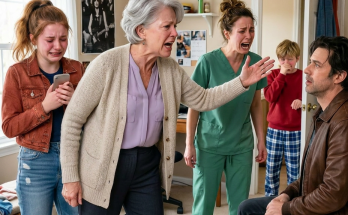
“What do you mean, you can’t?” Diane cried. “Is he married? Is he older? Did he hurt you?”
“It’s not like that,” Hannah whispered. “But I can’t lose this baby. If I do… all of us will regret it.”
Frank rose so fast the recliner slammed back into the wall.
“Don’t you dare threaten me, young lady.”
“Dad, please. One day you’ll understand.”
“You are not bringing a nameless shame into this house,” he shouted. “Either you end the pregnancy, or you leave.”
Diane started crying.
But she stayed silent.
Hannah pleaded with them.
She tried to explain that she couldn’t talk about it yet.
She told them it wasn’t because she was being difficult, that something much larger was buried beneath everything.
Frank refused to listen to one more sentence.
Less than an hour later, Hannah stood on the sidewalk with one suitcase, forty dollars in her pocket, and an old jacket wrapped around her shoulders.
Her mother watched from the window, one hand pressed against her mouth.
But she never opened the door.
That night, Hannah slept in the bus station.
The next morning, she left for Chicago, where an old friend from high school helped her rent a tiny room behind a hair salon.
That was where she started over with nothing.
She sold sandwiches in the morning.
Washed dishes in the afternoon.
Studied bookkeeping online at night, after her body was already drained.
Then she gave birth to her son.
She named him Owen.
Owen was born with deep, serious eyes, the kind that made him seem like he understood far too much for a newborn baby.
He grew up slim, gentle, and endlessly curious.
He asked questions about everything.
Why the sky became orange at sunset.
Why his mother never talked about his grandparents.
Why there were no photographs of his father.
Hannah always gave him only the answers she could.
“Your father was a good man.”
“And my grandparents?”
“Someday, sweetheart.”
But that “someday” arrived when Owen turned ten.
That night, while they cut into a cheap chocolate cake, he looked at her with a seriousness that broke something inside her.
“Mom, I want to meet them. Just once.”
Fear rose through Hannah.
Not fear of her parents.
Fear of everything she had spent years burying.
But Owen deserved the truth.
So three days later, they boarded a bus bound for Albany.
Hannah carried a backpack, a yellow folder, and a USB drive wrapped inside a napkin.
They arrived on a Saturday afternoon.
The house looked exactly as it always had.
The same brown front door.
The same bougainvillea near the wall.
The same front step where she had cried ten years earlier, pregnant and alone.
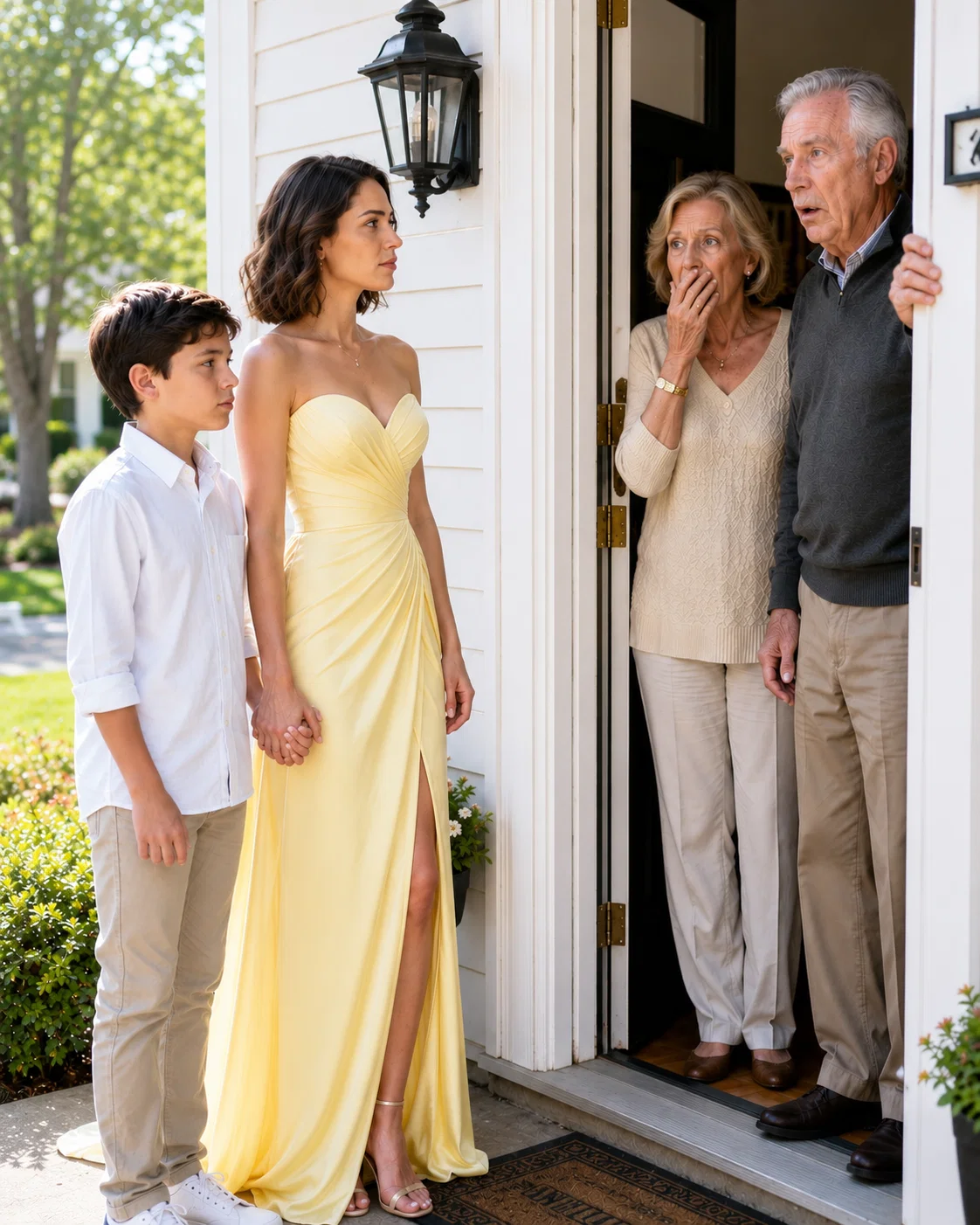
Hannah knocked.
Frank opened the door.
When he saw her, the color left his face.
“Hannah?”
Diane appeared behind him.
And when her eyes landed on Owen, she gasped.
Nobody spoke.
Owen stepped a little behind his mother.
Hannah took a slow breath.
“I came to tell you the truth.”
Frank tightened his jaw.
“After ten years?”
Hannah took an old photograph from the folder.
It showed a smiling young man in an engineer’s hard hat, standing beside Frank in front of the factory where Frank had worked his entire life.
Diane covered her mouth.
Frank stumbled backward.
Hannah laid the photograph on the table.
On the back, written in shaky handwriting, was one sentence:
“Your father tried to save us.”
Frank began to shake.
And Owen, unable to understand any of it, asked:
“Mom… is that man my dad?”
Hannah felt her knees weaken.
For ten years, she had pictured that moment.
She had rehearsed it while crying silently, washing dishes, waiting for buses, and counting coins for diapers.
But nothing could have prepared her for hearing Owen ask that question in front of his grandparents.