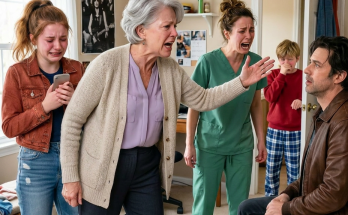
A younger cousin quietly began unzipping the suitcase he had packed, as if invisibility might return and save him.
Melanie opened the black folder and pulled out a second tab.
“Before anyone says another careless thing,” she said, “you should know Simon anticipated a challenge.”
She explained that he had left signed copies of prior demand letters regarding unauthorized use of his name, evidence of attempted access to his accounts, and surveillance stills from an earlier visit to this property during his hospitalization.
Knox went pale, and that was when I knew Simon hadn’t just expected them to come.
He had anticipated exactly who would touch what.
Melanie placed three still images on the dining table, showing Knox, Kaylin, and Dorothy in the act of trespassing during the week Simon was in the hospital.
No one spoke.
Even Deputy Collins seemed impressed by the level of detail.
“He installed interior cameras after a prior incident,” Melanie explained, “and those files are backed up offsite.”
Dorothy’s mouth opened, then closed, and she stared at the floor.
“He wouldn’t do this to family,” she whispered.
I almost answered, but Melanie spoke first.
“He did exactly this to family because of what family repeatedly did to him,” she said.
From the folder, she withdrew one last item, a sealed envelope in Simon’s handwriting with my name on the front.
I opened it with trembling hands.
The note was brief.
It apologized for leaving me to handle this ugliness while grieving.
He told me he loved me and reminded me not to negotiate with people who treated loss as an opportunity.
He said the documents Melanie held were more than sufficient to remove them, and that if his family chose humiliation over grace, he had left them exactly what they had earned.
That caught Dorothy’s attention.
“What does that mean?” she asked sharply.
Melanie answered without a hint of sympathy.
“It means Simon made one probate provision.
Each named relative receives one dollar and a formal no-contest warning.”
She added, “In addition, any continued interference triggers the release of supporting records to the appropriate counsel regarding prior fraudulent activity.”
Kaylin sank heavily into one of my dining chairs.
Knox cursed under his breath.
Dorothy stared at Melanie as if language itself had turned against her.
“He left me one dollar?” she asked.
“Yes,” Melanie said, “And it was his decision.”
Dorothy turned to me, and what flashed in her eyes then was not grief.
It was pure exposure.
The shock of realizing the quiet one had kept records for years hit them hard.
She had treated Simon as if he existed to absorb the consequences of her appetites, but his final act was an absolute refusal.
Deputy Collins cleared his throat and instructed everyone to gather only their own personal belongings.
No documents, no electronics, no boxes.
Luis supervised as bags were reopened and Simon’s possessions were returned piece by piece.
Shirts went back into closets, cables back into drawers, and the watches were returned to the valet tray on the dresser.
The process took nearly an hour, and no one dared to look at the urn.
Before leaving, Dorothy paused in the doorway and turned toward me.
“You think this makes you safe?” she asked, her voice dripping with venom.
I stood beside the entry table, one hand near Simon’s flowers.
“No,” I said, “Simon made me safe.
This only makes you visible.”
She left without another word, and the door shut behind her.
Finally, the apartment fell quiet.
It was not peaceful yet, but it was honest.
I stood there for a long time, looking at the room they had almost stripped bare.
The closet was half-open, the dining table was scattered with legal papers, and the couch still held the impression where Simon used to fall asleep.
Melanie placed a light hand on my arm.
“There is one more thing,” she said gently.
We sat at the dining table after Luis and the deputy left.
Melanie opened the final section of the black folder and slid a small flash drive toward me.
“Simon recorded a message the morning after he signed everything,” she said, “It is for you, and for the record if the family ever contested the trust.”
I plugged it into Simon’s laptop with hands that still didn’t feel like my own.
His face appeared on the screen, illuminated by the harsh hospital light.
He smiled at the camera, that same crooked smile he used whenever he knew he was being more sentimental than usual.
“Vera,” he said, “If you are seeing this, then first, I am sorry.
Second, if my family is in the condo while you watch it, I hope you laughed.”
I laughed again then, and the sound finally broke the tension in my chest.
He continued, saying he had spent too many years confusing loyalty with surrender.
He said loving me had taught him that peace requires boundaries, not just patience.
He explained he arranged everything to protect the one person who never reached for his wallet before his hand.
Then his expression shifted.
“For the record,” he said, his voice losing its softness, “my mother, Dorothy Hale, and my cousins have no authority over any property, account, or file associated with me.
Any claim otherwise is false, and any use of old keys or old family stories should be treated as what it is: trespass dressed as grief.”
The screen went dark a moment later.
I sat there with tears on my face, not because I was surprised, but because even in death, Simon sounded exactly like himself: precise, careful, and quietly devastating.
The formal challenges never came.
Maybe Dorothy understood that Simon had built the kind of case you don’t challenge unless you are willing to lose publicly.
Maybe Knox remembered the surveillance stills.
Maybe Kaylin realized probate is a terrible place to try to improvise innocence.
Within three weeks, the trust transfers were complete.
The condo remained mine, the investment accounts settled, and Simon’s private donations continued through instructions he had already signed.
I learned more about his work in those weeks than in the ten years we had spent together.
That was the irony of it all.
The people who wanted Simon’s assets had never cared enough to understand Simon himself.
A month later, I walked alone through the historic district at sunset.
The old city began to sound like itself again as the tourists thinned out.
I stopped in front of the place where we once shared coffee and debated whether private people are born that way or made.
Simon had said they were made, usually by surviving the wrong kind of attention.
He had been right about that, too.
When I returned home, the condo was finally quiet.
My quiet.
I placed fresh flowers beside his urn and opened the windows to let the humid air drift through the rooms.
Nothing had been taken, and nothing had been lost except the illusion that blood guarantees decency.
I stood in the doorway for a while before turning on the lights.
Then I laughed once more, softly this time, and whispered into the apartment he had protected until the very end, “They never knew who you really were, but I did.”
THE END.