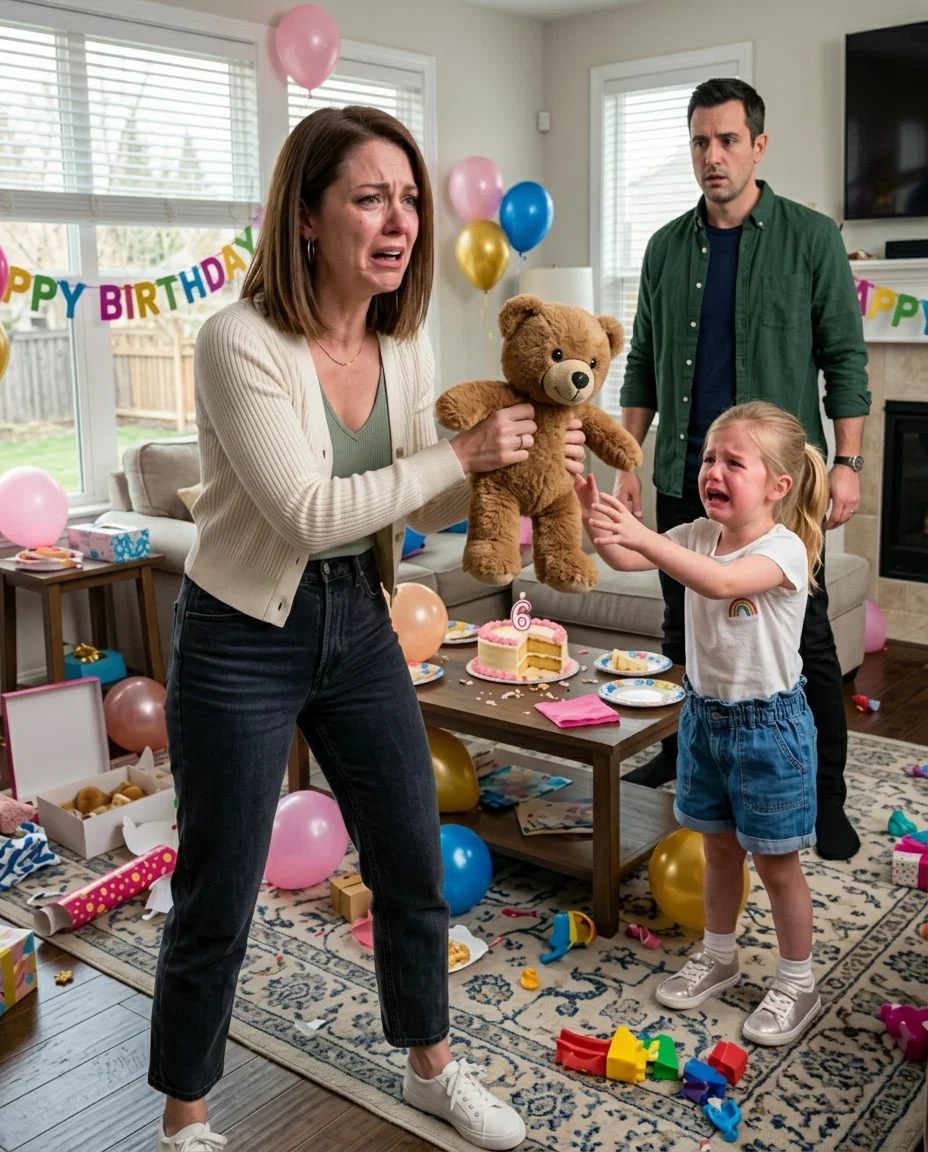
My in-laws mailed my 6-year-old daughter an adorable brown teddy bear for her birthday. She smiled for a moment, then suddenly went still and asked, “Mommy, what is it?” When I leaned in and looked closer, my face drained of color. I did not scream. I took action—and three days later, police were standing at their door.
For my daughter’s sixth birthday, my in-laws sent her a sweet brown teddy bear wrapped in gold paper and finished with a satin pink ribbon.
Lily squealed the second she saw the box waiting on our porch.
“Grandma and Grandpa remembered!” she said, bouncing barefoot across the living room carpet.
I smiled, even though my stomach tightened slightly. My husband, Daniel, had not spoken to his parents in almost eight months. Not since the fight about boundaries, unexpected visits, and the way his mother, Margaret, kept telling Lily that “Mommy was too strict” every time I refused something.
Still, it was Lily’s birthday. I did not want to darken the day.
“Go ahead,” I said. “Open it.”
She ripped through the wrapping paper, lifted out the bear, and hugged it right away. It was soft, brown, and almost ridiculously cute, with shiny black eyes, a stitched smile, and a small red bow around its neck.
For three seconds, Lily looked delighted.
Then she went rigid.
Her arms loosened around the bear. Her smile vanished.
“Mommy,” she whispered, holding it away from herself. “What is it?”
I moved closer.
At first, I thought she meant the tag. A small white gift tag was tucked under the bow. But then I saw the bear’s left eye. It did not match the right one. The right eye was glossy and flat. The left eye had a tiny dark circle at the center, too deep, too exact, like a pinhole.
My mouth went dry.
I carefully took the bear from Lily.
“Sweetheart,” I said, keeping my voice steady, “go help Daddy put candles on the cake.”
She frowned. “Is it broken?”
“Maybe,” I said. “I’ll check it.”
Daniel looked over from the kitchen, saw my face, and immediately walked toward me. I turned the bear over in my hands. There was a seam along the back, but near the battery compartment, I felt something solid. Not a music box. Not stuffing. A square.
Daniel whispered, “Claire?”
I did not answer.
I carried the bear into our bedroom, closed the door, and set it on the dresser. Then I switched off the lights. The left eye faintly glimmered.
Daniel’s face changed.
“No,” he breathed.
I searched the bear carefully and found a hidden switch under the stitched fabric near its leg. My fingers trembled, but I did not scream. I did not call Margaret. I did not accuse anyone.
I took pictures. I put the bear in a drawer. Then I called my brother, Aaron, a detective in another county.
He listened without cutting me off.
Then he said, “Claire, do not open it yourself. Do not destroy it. Put it in a paper bag, not plastic. I’m calling someone.”
Three days later, police were at my in-laws’ door.
PART 2
By the time police reached Margaret and Richard Whitmore’s white colonial house in West Hartford, I already understood the bear was not some innocent toy with a faulty part.
A technician had come to our house the morning after Lily’s birthday. He wore plain clothes, carried a black case, and introduced himself only as “Evan from digital forensics.” Aaron stayed beside him the entire time, not as a detective on the case, he reminded me, but as my brother.
Evan placed the teddy bear on our dining table as though it belonged in an evidence room. Because, apparently, it did.
Lily was at school. Daniel had called out of work and sat beside me, pale and silent, one hand wrapped around a mug of coffee he never touched.
Evan used a small blade to cut open the seam along the bear’s back. Inside, hidden behind the stuffing, was a compact wireless camera module with a microphone, battery pack, and microSD card. The lens had been positioned perfectly behind the bear’s left eye.
Daniel stood so quickly his chair scraped against the floor.
“My parents didn’t do this,” he said, but his voice carried no certainty.
Evan did not look up. “Someone did.”
He removed the card, slid it into a reader, and opened the files on his laptop. There were short recordings, each marked with dates and times. The first file had been created two weeks earlier, long before the bear ever reached our home.
That was when Daniel stopped trying to defend them.
The footage showed Margaret’s kitchen table. Her hands appeared in the frame, thin and manicured, turning the bear’s head toward herself.
Then Richard’s voice came from somewhere off camera.
“Are you sure this is legal?”
Margaret answered, “It’s our granddaughter. We have a right to know what goes on in that house.”
Daniel covered his mouth.
I felt something icy slide down my spine.
There were more clips. Margaret testing the sound. Richard complaining that the battery would not last long. Margaret saying, “Claire has poisoned him against us. If we can prove she screams at Lily, or neglects her, or says something unstable, we’ll have what we need.”
“What she needs for what?” I asked.
Evan’s face stayed professional, but his eyes softened. “Custody pressure. Family court. Maybe blackmail. That’s for investigators to determine.”
Police did not storm in that same day. They documented everything first. They took the bear. They interviewed Daniel and me separately. They asked about the history with his parents, whether they had keys to our house, whether they had ever threatened us.