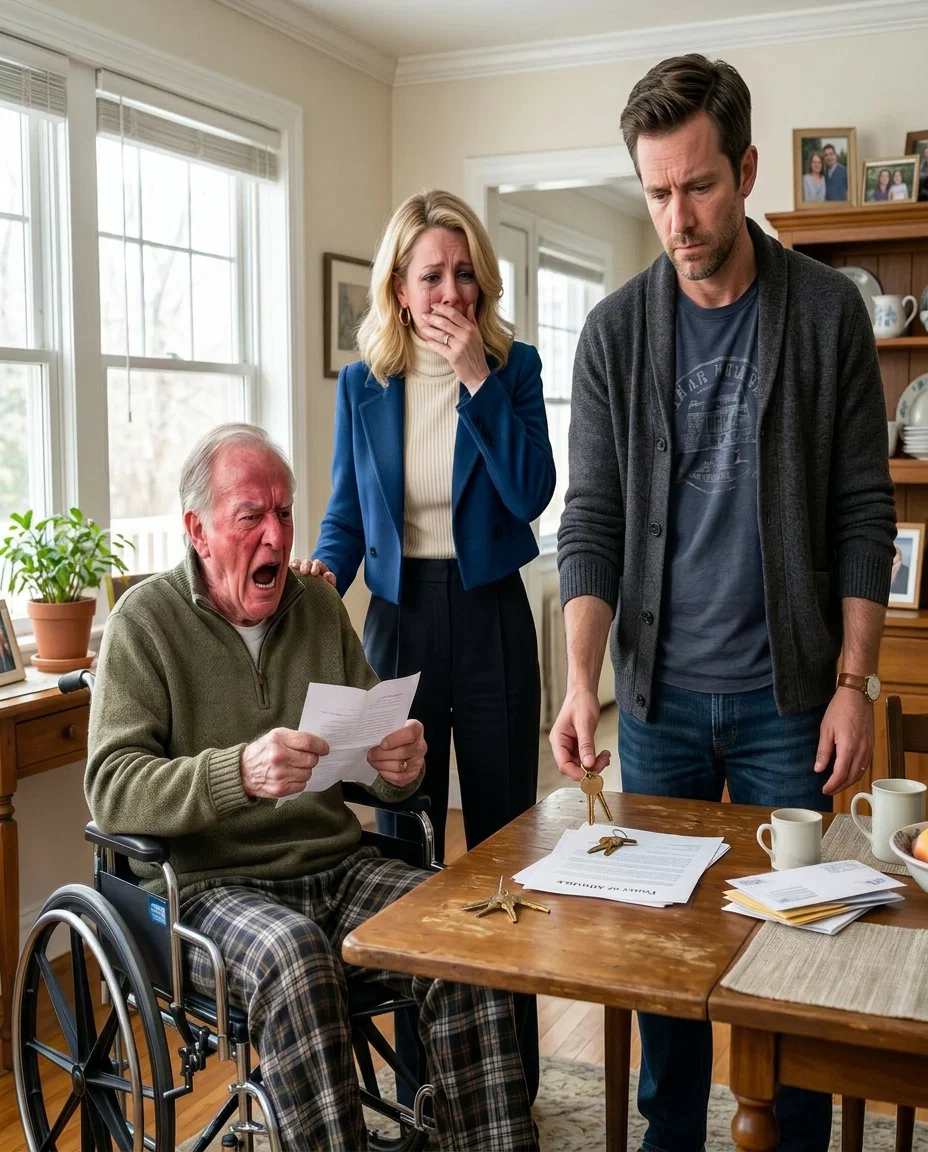
After five years of giving up my own life to look after Dad, he left the full inheritance to my golden-child sister, who had only returned eight weeks earlier. I calmly placed the power-of-attorney papers and house keys in front of them, smiled, and said, “Congrats.” Then Dad read my letter and erupted.
For five years, I surrendered my life to my father’s home.
I was thirty-four when Dad’s stroke changed everything. One minute, Walter Bennett was the loudest man in any room, the retired contractor who could still embarrass younger men with a hammer in his hand. The next, he was half-paralyzed, angry, and frightened in a hospital bed in Cleveland, Ohio, gripping my hand as if I were the only thing stopping him from sinking through the floor.
My sister, Claire, called twice during that first week.
Then she vanished.
I became the person who memorized medication schedules, insurance codes, physical therapy routines, and the careful way to lift a grown man without damaging his pride. I left my marketing job and picked up freelance projects at night. I sold my car to keep the property taxes paid. I gave Dad sponge baths while he criticized my cooking. I slept on the worn leather couch outside his bedroom because he panicked whenever he woke up alone.
Claire was the golden child. She always had been. Beautiful Claire. Charming Claire. The daughter who mailed glossy Christmas cards from Los Angeles and forgot Dad’s birthday three years straight.
Eight weeks before the will was read, she returned.
She showed up in a cream coat, holding tulips and wrapped in a cloud of perfume, calling Dad “Daddy” in a gentle voice I had not heard since we were teenagers. Suddenly, he was laughing again. Suddenly, he wanted his hair combed before breakfast. Suddenly, Claire was taking photos with him on the porch and posting captions about “family healing.”
I realized something was wrong when Dad’s attorney, Mr. Whitcomb, stopped returning my calls.
The meeting took place on a gray Monday morning in Dad’s dining room. Dad sat at the head of the table in his wheelchair. Claire sat beside him, one manicured hand resting on his shoulder. Mr. Whitcomb opened a folder and read the revised will.
The house, the retirement accounts, the lake cabin, and almost everything else went to Claire.
I was given Dad’s watch, his old pickup truck, and “gratitude for years of assistance.”
Claire lowered her eyes, acting surprised.
Dad would not look at me.
I rose slowly. I set the power-of-attorney documents on the table, then the house keys, then the medication binder I had built page by page over five years.
“Congrats,” I said calmly.
Claire blinked. “Evan, don’t be dramatic.”
I smiled at her, then at Dad. “I’m not.”
I handed Mr. Whitcomb a sealed envelope. “Please make sure he reads this today.”
Dad frowned. “What is that?”
“My resignation,” I said.
Then I walked out.
An hour later, my phone rang twelve times. I let every call go to voicemail.
The thirteenth call came from Claire.
“He read your letter,” she hissed. “Dad’s screaming. What did you do?”
In the background, Dad shouted, “You can’t be serious!” His voice cracked with anger. “Evan!”
I looked at the empty passenger seat of my rental car and kept driving west.
Part 2
By the time I crossed into Indiana, Claire had left seven voicemails.
The first was furious. The second was panicked. By the fourth, her voice had thinned into something anxious and brittle.
“Evan, Dad needs his evening pills. The blue one, the white one, and the little half tablet. I can’t find the cutter. Where do you keep the cutter?”
I deleted it.
Not because I wanted Dad harmed. Before I left, I had arranged two weeks of professional home care. I had contacted his primary doctor, emailed his medication list, paid the first deposit from my own savings, and left every document in labeled folders on the kitchen counter. My letter explained all of that clearly.
It also explained that I was finished being unpaid staff while Claire performed daughterhood for applause.
I drove to Columbus and checked into a cheap motel near the freeway. The room smelled of bleach and old carpet, but when I shut the door, no one called my name. No monitor beeped. No television blasted from Dad’s bedroom. No one accused me of buying the wrong soup.
I slept for eleven hours.
The next morning, I turned my phone back on.
There were twenty-nine missed calls.
One was from Mr. Whitcomb.
I called him back first.
“Evan,” he said carefully, “your father wants to discuss the situation.”
“There’s no situation.”
“He feels the letter was… severe.”
I sat on the edge of the bed. “Did he understand it?”
Silence.
Then Mr. Whitcomb sighed. “Yes.”
Good.
The letter was not emotional. I had learned a long time ago that emotion only gave Dad something to attack. So I wrote it like a formal business notice.
As of Monday, I resigned as caregiver, household manager, medical coordinator, financial assistant, driver, emergency contact, and power-of-attorney agent.
I listed every task I handled each day.
I listed every bill I had paid using my own money.
I listed the dates Claire promised to visit and failed to show up.
I attached copies of emails where Dad called me “the only reliable one,” followed by copies of the revised will naming Claire as his primary beneficiary because she “needed a fresh start.”
At the end, I wrote: “Since Claire is now trusted with your legacy, I trust she can also manage the responsibility attached to it.”
By noon, Claire called again.
This time, I answered.
“You need to come home,” she snapped.
“No.”
“You can’t just abandon him.”
“I didn’t. I arranged care.”
“For two weeks!” she shouted. “What happens after that?”
“You inherit the house. Sell it. Hire help. Move in. Choose one.”
She went silent.
That silence told me everything. Claire had expected the money, not the work. She wanted the keys, not the alarms. The lake cabin, not the bathroom rails. The praise, not the pill organizer.
At last, she whispered, “You’re punishing us.”
“No,” I said. “I’m believing you.”
That evening, Dad called.
I almost let it ring. But a part of me wanted to hear his voice without immediately rushing to repair something.