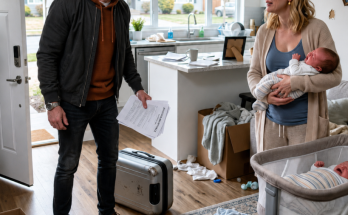
The Papers on the Coffee Table
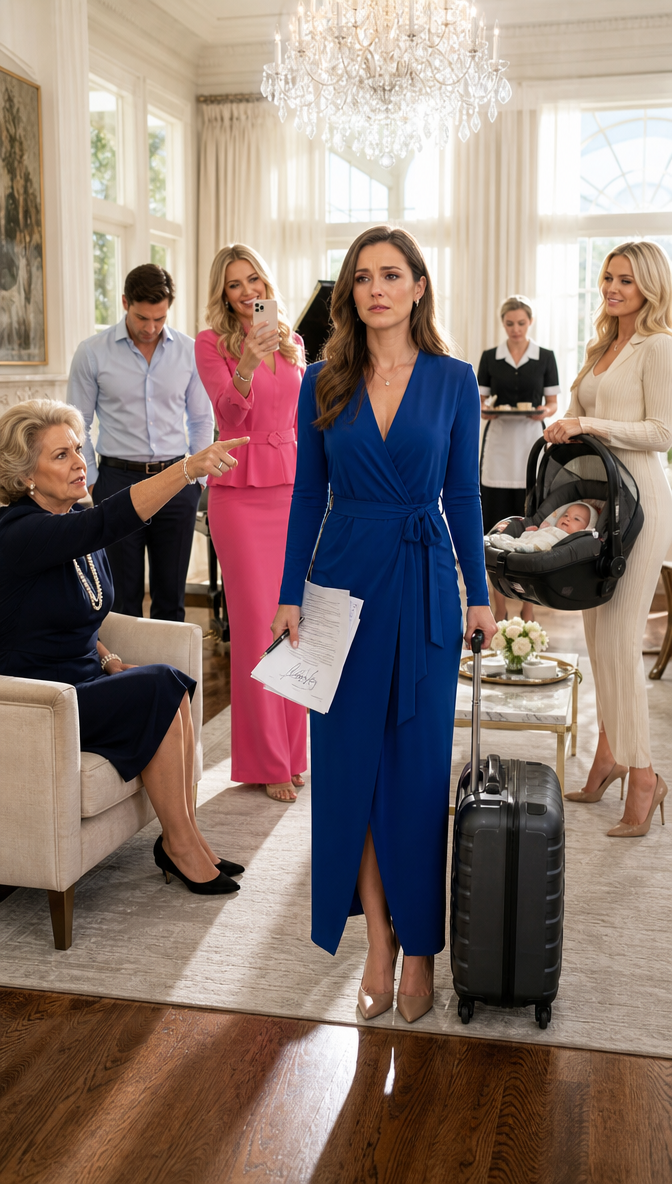
“Sign it, Evelyn, and stop dragging this out. This house finally needs a woman who can give my brother a child.”
Brooke Kessler said it while standing beside the marble fireplace in our living room, one hand resting on her narrow waist, her pale blond hair swept back as if she had prepared herself for a photograph rather than a family disgrace. Her voice moved through the room with the confidence of someone who had never once considered that cruelty might sound ugly when spoken out loud.
The housekeeper, Mrs. Palmer, had been gathering water glasses from the sideboard, and when Brooke spoke, she froze for the smallest moment, her fingers still around a crystal tumbler, her eyes lowered in that polite way working people learn when wealthy families begin tearing each other apart in front of them.
My mother-in-law, Marjorie Kessler, sat in the largest chair in the room, a high-backed cream linen armchair she had claimed as hers three weeks after I married her son. She wore pearls, a navy dress, and the expression of a woman presiding over a verdict. A manila folder rested on her lap, and my husband, Parker, sat beside her, quiet as a boy waiting for someone else to explain what he had done.
For six years, I had been Parker’s wife. For six years, I had taken his family’s comments with a smile that grew thinner every season. They called me cold when I asked for privacy. They called me selfish when I said adoption should be a conversation between husband and wife. They called me unlucky when another appointment ended with me sitting in the parking lot of a clinic outside Atlanta, holding medical papers in one hand and my dignity in the other.
No one in that family ever asked what the doctors had found. No one asked why Parker always changed the subject when results came back. No one asked why I was the only one expected to carry the blame like a purse I had chosen myself.
Marjorie tapped the folder with one manicured finger.
“You have embarrassed this family long enough,” she said. “My grandson should not have to grow up in whispers because you refuse to let go.”
I looked up from the pen in my hand.
“Your grandson?”
Parker closed his eyes.
And in that one small gesture, everything I had tried not to understand finally arranged itself into the truth. The unfamiliar perfume on his shirts. The phone calls he ended when I came into the kitchen. The weekend trips to Jacksonville that he said were for client meetings. The hotel charges he insisted were billing mistakes. The nervous kindness that came and went from him in short, guilty flashes.
There was another woman.
And there was a baby.
Brooke gave a little laugh, soft and sharp around the edges.
“Don’t look so surprised. Tessa is already staying outside Savannah, waiting for Parker to bring her home. She is a real woman, Evelyn. She gave this family what you never could.”
A real woman.
For a moment, those words pressed against my ribs harder than I expected, not because I believed them, but because I had spent too many years trying to be gentle with people who had mistaken my kindness for permission.
I did not cry. That disappointed them, I think. They had prepared for tears, for pleading, for the satisfaction of watching me fall apart in the same room where I had once hosted Thanksgiving dinners and Christmas breakfasts and Sunday suppers with too many candles and too much hope.
Instead, I signed.
The pen moved across the paper with a sound so small no one else could have heard it, but to me, it felt like the closing of a door I should have shut years earlier.
Marjorie took the papers from me before the ink had fully settled, smiling as if she had won something precious.
“Finally,” she said. “Go upstairs and get your things. And do not take anything my son paid for.”
I looked around the room at the wide oak floors, the antique mirror over the fireplace, the blue-and-white china I had collected one piece at a time, the piano I had tuned every spring though Parker never learned to play, and the kitchen beyond the archway where I had spent evenings making dinner for a man who came home smelling like another life.
None of it belonged to Parker.
The house had been mine before the wedding. I had bought it with the inheritance my father left me and the money I earned from my historic-home design firm, long before Parker Kessler arrived in my life with student loans, a repossession notice he begged me to help with, and a family that spoke endlessly about values while making themselves comfortable in rooms they had not earned.
But I had never said that out loud.
I had protected Parker’s pride because I thought that was what love did. I had let his mother believe what she wanted because correcting her felt petty. I had let Brooke call me spoiled, useless, difficult, and empty because some part of me believed that keeping peace was more noble than keeping record.
That was the mistake that cost me the most.
I went upstairs and packed one suitcase. I took clothes, legal documents, my laptop, my grandmother’s watch, and a small cedar box filled with photographs of my father standing beside houses he had restored with his own hands. I left behind the furniture, the dishes, the rugs, the framed wedding portrait in which Parker looked proud and I looked young enough to believe pride was the same thing as love.
When I came back down, Brooke had her phone raised.
“Look at this,” she said, her voice bright for the camera. “This is what it looks like when a kept woman finally runs out of luck.”
Parker did not tell her to stop.
That, more than anything, settled the last restless thing inside me.
Marjorie stepped close enough that I could smell her gardenia perfume.
“Tomorrow, Tessa and the baby are coming home,” she said. “This house needs joy, not a bitter woman wandering through it like a cloud.”
I picked up my purse, adjusted the strap on my shoulder, and walked to the front door. Before I stepped outside, I turned back one last time.
“Enjoy tonight,” I said.
Brooke lowered the phone just enough to smirk.
“What are you going to do, Evelyn? Cry in some guest room until Parker feels sorry for you?”
I smiled, but only a little.
“No,” I said. “I am going to let you finish what you started.”
I closed the door behind me while they were still laughing, and none of them understood that it would be their last night sleeping under my roof.
The Riverfront Hotel
I did not go to a friend’s house. I did not call my mother. I did not sit in my car and ask the sky why people who knew your softest places were often the ones most willing to press their thumbs against them.
I checked into a quiet hotel near the Savannah riverfront, the kind with brass lamps, dark wood, and a front desk clerk who did not ask why a woman arrived alone with one suitcase and eyes that looked too calm for midnight. I ordered black coffee, opened my laptop, and watched the living room of my own house appear on the screen.
Before I left, I had turned on two small security cameras, both of them legal, both of them installed months earlier after a series of package thefts in the neighborhood. One faced the living room. The other captured the dining room and part of the kitchen. I had not left them on out of curiosity. I had left them on because by then I understood that people who rewrite the truth in private often perform it beautifully in public.
On my screen, Marjorie poured champagne into the crystal flutes I had bought in Charleston. Brooke raised her glass and said something about removing bad energy from the house. Parker smiled, though not fully. Even from a hotel room miles away, I could see the tension in his jaw.
He knew me well enough to be uneasy.
That was one small comfort.
Marjorie leaned back in the chair she had always treated like a throne.
“She signed,” she said. “She will not fight. Women like Evelyn crumble when they are left alone.”
I turned off the audio.
There was nothing more I needed to hear that night.
The next morning, I called Nathaniel Brooks, the real estate attorney who had handled the closing when I bought the house seven years earlier. He was an older white gentleman with a dry voice, careful manners, and a memory sharp enough to make careless people nervous.
“Nathaniel,” I said when he answered. “I want to sell the house.”
There was a pause.
“Today?”
“Today.”
“Are you certain?”
I looked out the hotel window at the river, where early sunlight was touching the water in pale strips.
“More certain than I have been in years.”
By eleven o’clock, I was sitting in his office in a gray dress, my hair pulled back, my hands folded neatly on a polished conference table. Across from me sat Harold Waverly, a soft-spoken developer from Asheville who specialized in turning historic houses into small luxury inns. He had admired my property for years. He knew the neighborhood. He knew the bones of the house. Most importantly, he had the money ready and attorneys who did not waste time.
They reviewed everything: the deed, the property tax history, the date of purchase, the source of funds, and the prenuptial agreement Parker had insisted on because his mother had convinced him I might come after his “future success.” The irony was almost elegant.
The house was mine. Only mine. Purchased before the marriage. Protected by paperwork Parker had never bothered to read because he had assumed documents mattered only when they favored him.
By early afternoon, the sale was complete, the funds were confirmed, and Harold Waverly was the legal owner of the house Parker’s family had spent the previous night celebrating as their prize.
I expected to feel victorious.
I did not.
What I felt was quieter than that. Cleaner. Like opening a window in a room where smoke had lingered too long.
I asked Harold for forty-eight hours before formal turnover, not because I wanted drama, but because I knew the Kesslers would reveal more about themselves if they believed no one could stop them.
And they did.
The Woman at the Doctor

The next afternoon, Tessa arrived at the house.
I saw her on the camera feed as she stepped through the front door wearing oversized sunglasses, a cream coat, and the kind of expensive confidence people mistake for class. She carried a designer diaper bag on one shoulder and held a baby carrier in the other hand. Marjorie rushed toward her with both arms open, her face softening in a way I had once wished it would soften for me.
Parker kissed Tessa in the kitchen.
Not near the kitchen. Not just inside the doorway. In the kitchen where I had made him chicken soup when he had the flu, where I had packed his lunches during the first year of our marriage because money was tight and he was too proud to admit it, where I had stood barefoot at midnight making tea while he told me he felt like a failure and I promised him we were a team.
He kissed her there.
“All of this will be yours,” he told her. “Evelyn left with nothing.”
Tessa slowly looked around the living room, taking in the built-in bookshelves, the crown molding, the tall windows, the piano, the long dining table under the chandelier.
“We need to change the furniture,” she said. “It feels like a sad older woman lives here.”
Brooke clapped her hands once.
“Exactly. We should clear everything out. I do not want one trace of her left.”
I saved the recording.
That evening, they hosted a family dinner. Not a quiet meal. A celebration. Blue balloons were tied to the porch railing. Parker’s cousins arrived with covered dishes. Marjorie wore a pale pink dress and carried the baby around as if presenting a royal heir. Brooke filmed everything, narrating into her phone about blessings, fresh starts, and the joy that enters a home once bitterness leaves.
Twenty-five people gathered in my dining room and ate from my serving platters while Parker stood beside Tessa with his arm around her waist.
At four o’clock exactly, the doorbell rang.
Brooke turned with her phone still recording.
“Maybe that is another gift for the baby,” she said.
It was not.
Harold Waverly stood on the porch in a charcoal suit, flanked by two attorneys and a small private security team. He looked calm, almost apologetic, the way professional men do when they are about to deliver a truth that requires no raised voice.
Parker stormed to the entrance, his face red with anger.
“Who gave you permission to come onto this property?”
One of the attorneys opened a folder.
“The current owner,” he said. “This house was legally sold yesterday. Mr. Waverly is here to begin the possession process.”
Marjorie appeared behind Parker, still holding the baby blanket over one arm.
“That is impossible,” she said. “This is my son’s house.”
The attorney looked at her with the patience of a man who had heard many confident wrong answers in his career.
“It never belonged to your son.”
The room changed.
Not loudly at first. It changed in small movements: a cousin lowering his fork, an aunt turning toward Parker, Brooke’s phone dipping halfway toward her chest, Marjorie reaching for the back of a chair as if the floor had shifted beneath her expensive shoes.
Parker snatched the papers from the attorney’s hand and began reading. His eyes moved quickly at first, then slower, then hardly at all.
He found my name.
He found the purchase date.
He found the truth he should have cared enough to know years earlier.
“No,” he whispered.
Brooke stopped recording, but she had waited too long. Her own live video had already carried the moment beyond the room. Dozens of relatives, friends, and acquaintances had watched her celebrate my removal, only to witness the house slip out from under them like a rug they had been dancing on.
Marjorie’s face lost all its authority.
“Parker,” she said, her voice thin. “Tell them.”
But Parker had nothing to tell.
Tessa stepped out from the kitchen with the baby carrier in one hand. She looked from Parker to the papers, then to the attorneys at the door. Her expression changed in a way I recognized immediately: calculation turning into disgust.
“Are you telling me,” she said slowly, “that you do not own this house?”
Parker turned toward her.
“Tessa, we can work this out.”
“Do you have money?”
He swallowed.
“It is complicated.”
“It sounds simple to me.”
Marjorie stepped forward.
“Young lady, this is still a family matter.”
Tessa gave a small, humorless laugh.
“Family?” she said. “That is interesting, because there is something I never told any of you.”
Even through the camera, I saw Parker go still.
The whole room waited.
Tessa adjusted the strap of the diaper bag on her shoulder and looked straight at him, no softness left in her face.
“You were useful when I thought you had a house, Parker. But if the house, the money, and the life all belonged to your wife, then maybe you should have been kinder to the only woman in this story who actually had something.”
No one spoke.
I closed my laptop before she said anything more.
For the first time in six years, I did not need to hear the rest.
What I Took With Me

Two days later, I met Harold Waverly at the house for the final walkthrough.
The balloons were gone. The dining room smelled faintly of lemon cleaner and panic. Most of Parker’s family had disappeared from the scene as quickly as they had arrived, leaving behind only folded chairs, half-empty soda bottles, and the uncomfortable silence people leave when celebration turns into consequence.
Parker was there, sitting on the bottom step with his elbows on his knees. He looked smaller than I remembered, not because he had changed, but because I no longer stood beneath the version of him I had built in my mind.
When he saw me, he stood.
“Evelyn,” he said. “Please. Can we talk?”
I looked at him, really looked at him, and felt something softer than anger. Not forgiveness. Not pity exactly. More like the tired tenderness you feel for a person you once loved before they taught you why distance can be holy.
“You had six years to talk to me,” I said.
His eyes filled, but I did not move toward him.
“My mother pushed too hard,” he said. “Brooke made it worse. I got trapped.”
That almost made me smile.
Not because it was funny, but because it was so familiar. Parker had always been trapped by whatever choice embarrassed him after he made it.
“No,” I said gently. “You chose. You chose when you stayed silent. You chose when you let them call me names. You chose when you brought another woman into a life I was still helping you hold together.”
He looked down.
“I did not think you would sell it.”
“That was the problem,” I said. “You never thought I would choose myself.”
I walked past him and went upstairs one last time. The bedroom was nearly empty now, stripped of warmth, stripped of the little signs of a marriage I had tried to save long after it had stopped saving me. In the closet, on the highest shelf, I found one thing I had forgotten: a framed photograph of my father standing in front of the house the day I bought it. He was smiling, one hand on the porch column, proud in the quiet way good men are proud when their daughters build something solid.
I held the frame against my chest for a moment.
Then I carried it downstairs.
Marjorie was waiting in the foyer. Her pearls were gone. Her dress was plain. She looked at me as if seeing me for the first time, not as an obstacle, not as a disappointment, but as the owner of every room she had mistaken for her son’s achievement.
“You should have told us,” she said.
I paused with my hand on the door.
“No,” I said. “You should have asked.”
Outside, the afternoon light was bright over the porch, and for a second, the house looked exactly as it had the first day I saw it: weathered, graceful, waiting for someone to love it honestly.
I left with one suitcase, a cedar box, and my father’s photograph.
That was all I needed.
By the end of the week, Parker had moved into a rented apartment. Brooke deleted her video, though not before enough people had saved it to make her careful at church for a while. Marjorie stopped calling. Tessa, from what I heard, left Savannah before the month ended.
As for me, I bought a smaller house near the coast, one with a porch facing the marsh and no room large enough for people who mistook kindness for weakness. In the mornings, I drank coffee barefoot in the kitchen, and in the evenings, I worked at the long wooden table by the window, designing homes for people who understood that a house is not truly yours because you stand inside it.
It is yours because you honor what built it.
For years, I thought losing a marriage would feel like being emptied out.
But when I finally walked away, I learned the truth.
Sometimes the life you leave behind was never holding you.
Sometimes it was only standing in the doorway, blocking the light.