The video looped. Again, he toasted. Again, they laughed. High-maintenance wives. Choose yourself. Happy birthday to me.
I lay face-down on the carpet, my blood pooling slowly beneath me, my baby wailing a foot away, and my husband was celebrating his freedom. The disconnect was so vast, so obscene, that it felt like a nightmare I couldn’t wake from. I tried to dial 911, but my fingers were too weak to swipe. The phone slipped from my grasp and skittered away.
The edges of my consciousness began to fray. The room dimmed. Ethan’s cries grew distant, echoing, as if he were already a memory. I thought of my mother, who had died when I was twenty. I thought of the first time I felt Ethan kick. I thought of how Ryan had danced with me at our wedding, promising to love me in sickness and in health. I closed my eyes. I couldn’t fight anymore.
But someone else was listening.
My neighbor, Helen Russo, lived in the bungalow next door. She was seventy-two, a widow, a retired OB nurse who had delivered over three thousand babies in her forty-year career. I’d only known her a few months, but she’d become a quiet, grandmotherly presence in my life—she brought over homemade soup after the birth, offered to walk our dog, and insisted I call her for anything. When we set up the nursery, Ryan had struggled with the Wi-Fi baby monitor, and Helen had come over to help. She’d written down the access code and tucked it in her kitchen drawer “for emergencies.” I’d laughed and said I hoped we’d never need it.
That morning, Helen was in her kitchen making Earl Grey tea when she heard a faint thud through our shared wall. It was just a bump, but years of instinct prickled at her. She waited, listening. Then came the cries—not just newborn fussing, but the distinct, frantic shriek of a baby in distress, the kind that made her heart race. She called my cell. No answer. She tried the house phone. No answer. She didn’t hesitate.
Pulling out the scrap of paper with the monitor code, she opened the app on her own phone. The camera in our nursery flickered to life, and what she saw ripped a gasp from her throat: me, crumpled in a heap on the floor, surrounded by a spreading dark stain. Ethan, purple-faced and flailing, not yet two weeks old and utterly alone.
Helen grabbed the spare key I’d given her months ago and burst through our front door. She found me with a weak, thready pulse, barely breathing. She called 911, applied pressure to my bleeding, and kept me alive until the ambulance screamed up our quiet block. Then she scooped up Ethan, wrapped him in a clean blanket, and held him against her chest, rocking and shushing and praying.
I woke up three days later in the ICU at Denver Health. Tubes threaded into my arms, wires monitoring the fragile rhythm of my heart. I had suffered a delayed postpartum hemorrhage caused by retained placental tissue, the doctors explained. I’d lost nearly two liters of blood. If Helen had found me ten minutes later, I would have been dead. Ethan would have been alone for hours, maybe a full day, his cries unheard until it was too late.
Helen was there. She sat in the plastic chair by my bed, her silver hair tucked behind her ears, her hands folded in her lap. She looked exhausted but resolute. She had been caring for Ethan as if he were her own grandson, feeding him donated breast milk from a milk bank, walking him through the nights, singing him lullabies in her cracked, gentle voice. And in those three days, she had learned a lot about my husband.
She showed me the call logs on my phone—the one she had retrieved from the nursery floor. Not a single missed call from Ryan. Not one text. Instead, his Instagram feed was a parade of birthday joy: champagne toasts, ski runs, a steak dinner that cost more than our baby’s stroller. The video, replayed a dozen times, had amassed hundreds of views and laughing emojis. I watched it over and over, the whiskey glass glinting like a knife.
“He hasn’t tried to contact you at all?” I asked, my voice a dry whisper.
Helen’s eyes hardened. “Not once, sweetheart. But I’ve been doing a little digging of my own. That ‘guys’ trip’ wasn’t just guys. A friend of mine works at the resort. She sent me a photo.” She turned her phone to show me a candid shot from the hotel bar: Ryan with his arm around a blonde woman I recognized—his former assistant, the one he’d talked about a little too often. They were kissing.
I stared at the image until the pixels blurred. The man I had married, the father of my child, had not only abandoned me in a medical crisis but had done so to celebrate with his mistress. The betrayal was so comprehensive, so surgical, that I felt a strange, hollow calm.
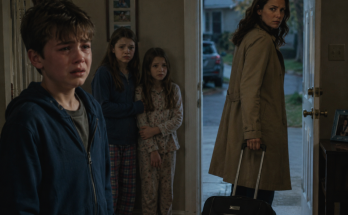
Three days after he left, Ryan returned home. He had no idea anything was wrong. He hummed as he unlocked the front door, a jaunty tune from the 80s. A silver souvenir watch from an Aspen boutique hung loose on his wrist. He stepped into the foyer expecting the ordinary chaos of new parenthood—the faint smell of diaper cream, the hum of a breast pump, maybe me passed out on the couch. Instead, the house was tomb-quiet.
The nursery door stood ajar. Light from the window fell on the empty bassinet, its sheets smoothed and pristine. A hospital identification bracelet lay on the dresser, alongside a crumpled package of sterile gauze. The mobile turned lazily, but there was no baby to watch it. No wife.
Ryan’s smile evaporated. He called my name. Nothing. He called Ethan’s name. Nothing. He dropped his suitcase, and the watch—unsecured—slipped from his wrist and shattered on the hardwood floor, a spray of silver fragments and broken glass. He ran from room to room, his panic rising, his face draining of color. In the kitchen, he found a handwritten note on the counter in neat, old-fashioned cursive: Ryan—Emma is at Denver Health. Room 437. You might want to explain yourself. —H.R.