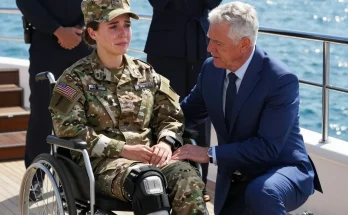
The air went out of me.
Gaslighting. The ultimate psychological kill shot. She had paved the road for this exact moment. Any word from my mouth would be written off as the paranoid rambling of a broken soldier. If I screamed, I proved her right. If I caused a scene, I gave them the evidence they needed to have me removed.
“So go ahead,” Diane whispered. “Open your mouth. Let’s see who the Whitlock family believes. The beautiful successful bride, or the deranged hallucinating sister in the hideous dress.”
She smoothed down her silk dress, turned her back on me, and walked back into the sunlight.
I stood alone in the damp alcove. My chest heaved. The blood pounded in my ears.
A normal person might have run screaming into that patio. A normal person would have let the civilian rage take over.
I am not a normal person.
I am an Army captain.
Screaming is for victims. Strategy is for soldiers.
The enemy had just handed me their entire battle plan. And by stripping away my family ties, they had removed every rule of engagement I’d been operating under. I owed them absolutely nothing. No loyalty. No silence.
I walked straight back into the dining hall.
Table 14 was in the far back corner, practically pressed against the swinging kitchen doors. Every time a waiter pushed through, the rusted hinges screeched and blasted hot, greasy air that smelled like industrial dish soap and burnt fat. None of my blood relatives sat there. My family was at the head table under a crystal chandelier.
I was seated with third-tier business associates and people who had been invited out of corporate obligation. They stared at their phones and talked over my head.
I was a ghost in a neon orange hazard suit.
I sat down. Both feet flat. Shoulders squared. Hands flat on the cold tablecloth. The caterers dropped plates of filet mignon in front of everyone. I didn’t touch my fork. I wasn’t going to consume a single calorie paid for by fraud.
A shadow fell across my table.
Daniel. The groom. He had walked from the head table all the way to the kitchen doors, and he stood beside my chair with an expression that made the acid rise in my throat. Not malice. Pity. The suffocating, airless pity reserved for someone who can’t help themselves.
“Sloan told me about your mental state,” he said, keeping his voice gentle. “The trauma. The episodes. I think it’s incredibly brave that you showed up today. With the crowds and the noise, I know it must be overwhelming.”
He was being kind. He thought he was being kind.
Misguided kindness cuts deeper than an open insult.
He reached out and put a hand on my shoulder.
I rolled it back in one sharp physical jerk and threw his hand off my body. I looked up and locked eyes with him. Cold, dead, empty. Not a single word.
Daniel blinked. The pity shifted to mild alarm. He cleared his throat, patted his jacket, and retreated quickly to the safety of the head table.
I pushed my chair back.
I had reached the limit of what I could absorb without losing the strategic advantage. I needed air. I turned my back on the dining hall — the crystal glasses, the fake smiles, the smell of grease — and walked down the dim carpeted hallway toward the coat check and the parking lot.
I rounded the corner and stopped.
The coat counter was empty.
But sitting in the red velvet accent chair directly blocking the exit was a roadblock.
Margaret Whitlock.
Her back was perfectly straight. Both frail, liver-spotted hands rested on the silver handle of her cane. In the dim light of the hallway, her eyes were scanning me like a targeting system.
She had been waiting.
She didn’t offer a greeting. She didn’t ask how I was doing. She looked at me and said: “You graduated from North Carolina State University. Department of Civil, Construction, and Environmental Engineering. Class of 2017. Is that correct?”
I snapped to attention before I consciously decided to.
“Yes, ma’am.”
The corner of her mouth twitched. “I don’t sign blank checks,” she said. “And I certainly don’t approve a marriage merging with my family without reading the fine print. I run full background checks on everyone.”
She leaned forward on her cane.
“I think you should stay, Captain. You’re going to want to see what happens next.”
It wasn’t advice. It wasn’t a request.
It was a direct order from a four-star general.
I turned around and walked back into the dining hall.
The maid of honor was at the microphone, her champagne flute raised, delivering a tearful speech about Sloan’s remarkable independence, her limitless grit, the life she had built completely from scratch. I sat back down at table 14 and placed my hands flat on the tablecloth and waited.
My knuckles brushed something cold in the crease of the empty chair beside me.
A smartphone in a designer leather case.
Diane’s phone.
She had been sitting there earlier, arguing with a vendor, and she had left it behind. She never bothered with a passcode because she had spent her life believing she was completely untouchable.
A notification lit the screen. A group text titled Clark Girls.
The phone was unlocked.
I swiped it open.
The text chain loaded in a long cascade of blue and gray bubbles, and what I read hit my retinas like physical impact.
Three weeks before the wedding, my Aunt Renee — the woman who used to babysit me, who bought me ice cream when I was seven — had sent a message: What about that neon orange dress on the clearance rack? Get the plus size. It’s massive.
Diane replied within sixty seconds. Perfect. Buy it. It will make that dumpy freak look completely out of place next to the silk. I am not letting her dress better than my daughter today.
I scrolled up.
A message from Sloan: Make sure you tell the photographer to push her out of the frame early. If Daniel’s family asks why she’s hiding in the back, I’ll tell his uncle she has severe PTSD and hates having her picture taken. Let his family see how pathetic and crazy she is. They’ll never believe a word she says.
Below it, an image file. I tapped it.
My college diploma. NC State. Bachelor of Science in Civil and Environmental Engineering. But my name had been blurred out with photo editing software, and Sloan’s name had been typed directly over the university seal.
Just emailed this to Daniel’s uncle for the background check, she had written. Looks totally legit. The Whitlocks think I’m a genius.
I pressed the power button. The screen went black. I placed the phone exactly where I’d found it — back in the crease of the cushion — and sat up straight.
I looked across the dining hall and found Margaret Whitlock in her VIP corner.
I gave her one sharp nod.
She looked back at me without expression.
Then she folded her linen napkin once, twice, into perfect sharp squares. Placed it on the table. And stood up.
The shift in the room’s atmospheric pressure was instantaneous. Every eye broke away from the glowing bride. The event manager near the wall threw a panicked hand signal at the string quartet. The cellist froze. The violinist dragged her bow off the strings with a dying screech.
The music died.
Two hundred people went silent.
The only sound left in that cavernous hall was the rhythmic, deliberate strike of Margaret’s cane against the hardwood floor.
Thump. A step.
Thump. Another step.
She walked with the unhurried pace of someone who has never once needed to rush. No hesitation, no performance. She passed the tables of cousins and college friends and moved toward the kitchen doors — toward the neon orange target in the back corner — like a heat-seeking missile.
Diane saw it happening in real time. Her carefully constructed narrative was unraveling, and she moved to intercept.
She shoved back her chair, practically sprinting around the head table, her silk dress catching on a chair leg, and threw herself into Margaret’s path ten feet from where I sat.
“Mother Whitlock!” Her voice was breathless and shrill in the total vacuum of sound. A wide, desperate smile. “What an honor. Are you coming back to say hello to Emma? I should warn you —” she lowered her voice, but the acoustic bounce of that silent hall carried every syllable to every corner, “she’s a little shy. Her nerves are shot. Her mental state has been incredibly fragile since she discharged. The loud noises here, you know, it triggers her.”
I sat perfectly still. Back rigid against the cheap banquet chair. Hands flat on the tablecloth. I let the lie hang in the air.
Diane reached out a manicured hand to grab Margaret’s forearm. A fake show of familial intimacy, trying to herd the old woman back to the VIP section.
Margaret stopped.
She looked down at the hand hovering near her charcoal sleeve with an expression of such unfiltered, absolute disgust that Diane’s arm stopped moving mid-reach, suspended in the air like she’d hit an invisible wall.
“I am not finished, dear.”
Five words. Low volume. Absolute zero temperature.
Diane physically recoiled. She yanked her hand back and pressed it against her chest. Her mouth opened, but nothing came out. She stood frozen in the middle of the aisle, stripped of every weapon she’d brought to that room, in front of two hundred people.
Margaret stepped around her like she was stepping around debris on a sidewalk.
Thump. Thump.
She stopped at the edge of table 14. Pulled back the empty chair beside me — the chair where Diane’s phone sat wedged in the cushion — and sat down with both hands resting on her cane.
She ignored the crowd. She ignored the sweating event manager. She ignored Diane, who was still standing paralyzed in the aisle.
She looked at me.
“Emma,” she said, her voice carrying the cold, clear weight of a military tribunal. “Sitrep. Right now. Who took care of your grandmother?”
The room held its breath.
I looked at the commander. “I did,” I said. My voice carried clean and clear through the dead silence. “Three years on duty. I pulled a compassionate reassignment. I changed her bedpans. I pureed her food. I monitored the ventilator until the day her heart stopped.”
Margaret nodded once. “The civil engineering degree from NC State. The structural firm in Raleigh.”
“Mine,” I said. No hesitation. “Class of 2017. I co-founded the firm six years ago. We handle commercial steel framing. Current annual revenue is over one point two million.”
The gasp that moved through two hundred people sounded like a vacuum sucking the oxygen out of the room.
At the head table, the microphone slipped out of the maid of honor’s hand and hit the stage with a dull thud.
Daniel stepped away from his bride. His face had gone the color of wet cement. He looked from Margaret’s table to Sloan and said her name — just her name, quietly, the way you say someone’s name when you need the world to stop for a second.
“You told my aunt that firm was yours,” he said. “You told her you pulled the all-nighters.”
The expensive foundation and contouring couldn’t hide the panic flooding Sloan’s face. She gripped the layers of her twenty-thousand-dollar gown, knuckles going white, and when parasites panic, they swing wild and they swing at everything.
“She’s lying, Daniel. Look at her. She’s crazy. She’s been jealous of me her entire life.” Her voice cracked, the sugary register breaking into something high and grating. Then she pointed past me, directly at Margaret. “Your grandmother is senile. She’s seventy-nine years old. She’s confused.”
You do not call the woman who controls a nine-figure trust fund senile.
You do not insult the apex predator in her own territory.
Margaret Whitlock did not look offended. She didn’t gasp or recoil. She smiled — a thin, bloodless smile that made the hair on my neck stand up — and reached a steady hand into the inner pocket of her charcoal jacket.