I hung up.
Owen immediately asked, “Who was that?”
“Someone important.”
“Is this going to be good?”
“I think so.”
“How good?”
I looked at the giant cake on my table. “Four tiers good.”
The party drifted toward the cake about fifty minutes after Karen’s second visit to my truck. The DJ lowered the music. A woman in pink placed candles around the tiers. Phones came out. Karen took her place, adjusted her tiara, accepted a white-handled cake knife, and turned to face her guests with a private smile.
Then they started singing.
Happy birthday to you.
Forty voices in my field. Afternoon sun on white frosting. My sons beside me. The woman in the tiara with her eyes half closed, soaking in a moment built entirely on a lie.
That was when I got off the tailgate.
“Come on,” I said to my boys.
We walked together across the grass, calm and unhurried.
The singing broke apart in pieces as people noticed us. One voice trailed off, then another, then another, until the whole song collapsed into silence. Karen kept smiling for half a second too long because she assumed the crowd was admiring her. Then she opened her eyes and saw us.
The smile vanished.
“What do you think you’re doing?” she demanded.
I kept walking.
“Stop right there. Do not come any closer.”
I stopped ten feet from the table. Forty people formed a half circle around us. Wind in the trees. The faint hum of the bouncy castle blower. No one moved.
Karen set down the knife, reached into her neckline, and pulled out her phone.
“I’m calling the police right now,” she said.
I looked at my boys, then back at her.
“Karen,” I said, “I brought you a birthday present.”
Something flickered across her face. Not fear exactly. The first crack in certainty.
“What are you talking about?”
I looked down at Owen and gave him the smallest nod.
He launched like a sprinting shortstop.
One second he was beside me. The next he was at the table, both hands buried wrist-deep into the bottom tier of Karen’s birthday cake. The crowd still hadn’t caught up. They were all watching a small boy with both fists full of frosting, waiting for reality to explain itself.
Karen turned just in time to see him step into the throw.
He hurled the cake directly into her face.
Not near her. Not at her shoulder. Dead center. Forehead to chin. Frosting, flowers, sponge, all of it smashing through the perfect pose, through the tiara, through every ounce of theatrical dignity she had spent the day constructing.
The sound was unforgettable.
For three full seconds, nobody moved.
Cake clung to her hair, her eyelashes, the front of the white dress. The tiara hung sideways off one ear. A pink sugar flower slid slowly down her cheek and dropped to the grass.
Then Caleb moved.
My eleven-year-old leaned past me, scooped a heavy chunk from the third tier, and fired it at the woman standing to Karen’s left in a pale pink fascinator. It hit perfectly. She screamed in pure social disbelief.
That broke the spell.
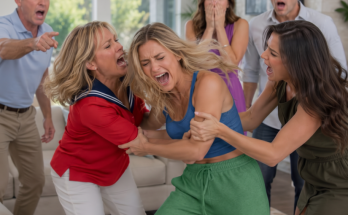
A twelve-year-old guest grabbed frosting off the tablecloth and launched it at his friend. A woman in blue got splattered from the side and instinctively threw the rest of her drink into another cluster of guests. A man in dress pants scooped the remains of the lower tier and swept it across three people in one motion. Within forty seconds the entire field became a formalwear cake war.
Some guests ran for the cars immediately, horrified. Others went all in with astonishing speed, adults in expensive clothes selecting targets with strategic focus. A teenage girl used both hands like twin launchers. Little kids came sprinting in from the inflatable castle and joined with the kind of delighted chaos only children can produce.
The DJ froze for maybe twenty seconds, mouth open, one hand hovering over the mixer.
Then he made the best decision of the day.
He slammed on the loudest, most chaotic track in his library and turned it all the way up.
The field erupted.
What followed lasted twelve minutes by my watch.
Karen stayed near the center for almost all of it. She did not run. She stood there in the ruins of her princess fantasy and screamed at everyone to stop.
By minute four her voice was already fraying.
By minute eight, someone punctured the bouncy castle. I didn’t see who, but I saw it sink while kids tumbled out laughing.
Owen watched with frosting up to his elbows. “Dad, I think she’s really mad.”
“I think you’re right.”
“Are we in trouble?”
“No.”
“You sure?”
“Very.”
By minute twelve there was no cake left at all. Not one intact tier. Just smeared tablecloth, ribbon, broken flowers, and exhausted laughter rippling through survivors on both sides of the frosting line.
Karen stood in the wreckage, pointing and shouting, but something had changed in her face. The rage was still there, but beneath it was something newer and more fragile: the first realization that the story she had been telling all day might not survive contact with reality.
The police arrived eleven minutes later.
Two county units at first, then a third. Karen moved toward the lead officer as fast as a woman in a ruined ball gown could move across grass. She had taken just enough time to straighten the tiara and smooth the front of the dress, though nothing on earth could save the dress.
“Thank God you’re here,” she said, grabbing the officer’s forearms. “These people came onto my private property, assaulted me, ruined my birthday, attacked my guests, and I want every one of them arrested right now.”
The officer looked at her face, the tiara, the frosting, the deflated castle, the demolished table.
“Ma’am,” he said carefully, “take a breath.”
“I will not take a breath. Arrest them.”
“Are you injured?”
“I was assaulted.”
“Are you physically injured?”
“No, but—”
“All right. Stay here.”
Then he walked toward me.
He took in my boys, my clean shirt, my truck parked at the edge of the field, and asked the question that finally mattered.
“Sir, is this her property?”
“No.”
“Whose property is it?”
“Mine.”
He studied me for a second. “Can you prove that?”
“Give me ten minutes.”
“I’m going to need more than your word.”
“I know. But ten minutes would still help.”
The officer nodded once.
“I’ll give you a few minutes.”
Before he got back to Karen, a woman from the party stepped out and quietly told him, “She told every person here she owns this ranch. We didn’t know otherwise.”
Karen heard that and pivoted hard.
“That is irrelevant,” she snapped. Then, changing course in real time, she added, “We rented it. It was a private rental. That still makes this our private event.”
The officer looked at her. “Who did you rent it from?”
“The caretaker.”
“Where is he?”
“He’s not here, but he can confirm the booking.”
I said, “I already called him. He’s on his way.”
For the second time that day I watched certainty crack across Karen’s face.
“It doesn’t matter,” she insisted. “We paid. We have a receipt. Everything was above board.”
“Then we’ll sort it out when he gets here,” the officer said.
Karen dug through her phone and kept talking about the rental, the event, my boys, the cake, the castle, and the injustice of the afternoon.
Then Leon’s truck came up the drive.
He stopped, got out, and looked at the field. The party guests. The police cars. The dead castle. Karen in her destroyed white gown. Then he looked at me and froze.
Karen rushed him. “Finally. Tell them. Tell these officers we had a valid rental agreement. Tell them right now.”
He kept looking at me.
“I can’t do that,” he said.
Karen actually stopped moving. “What?”
“I can’t tell them that.”
“We had a contract. I paid you. You sent me a receipt.”
“I know.”
“Then tell them.”
He stared at the ground. “I’m not authorized to rent this property. I don’t own it.”
Silence.
Karen turned to me very slowly.
“You own this?”
“Have for eighteen years.”
The performance vanished from her all at once.
“But he told me—”
“I know.”
“He said he was selling it.”
“He wasn’t.”
The lead officer shifted his attention to Leon. “Did you represent yourself as the owner or authorized agent of this property?”
Leon did not answer.
Karen pointed at him, hand shaking now for real. “He took my money.”
The officer looked back at me. “What would you like to do here, sir?”
I thought about the day. The spit at my boots. The lies. My sons in the truck. The guests who had been fooled as thoroughly as anyone.
“I want everyone off my property right now,” I said. “I’m not pressing charges against the guests. They were lied to. Same as the rest of us.”
I pointed at Leon.
“Except him.”
The officer nodded as if that was exactly the answer he had expected.
Karen looked from Leon to me to the ruined field and finally understood the shape of the disaster. Not just the embarrassment. Not just the party. The whole structure beneath it. The paperwork. The fake authority. The confidence. All of it resting on rotten boards.
She tried once to speak to me. “I thought—”
“I know,” I said.
She turned and walked back through her guests without looking anyone in the eye. People followed in the slow, silent way a party ends when there is nothing left to celebrate.
The DJ packed up last. As he passed me with a speaker case, he gave me a small nod. I returned it.
Twenty-seven cars had come in.
Twenty-seven cars went out.
By sunset the field was mine again, though it looked like a wedding cake had exploded across twenty yards of pasture. My boys helped me gather plastic cups and candle holders while officers took statements from Leon and a few witnesses. Karen had already gone. The pink-dressed woman with cake on her fascinator apologized on her way to her car. The man in the polo said, very quietly, “I guess I should’ve asked for paperwork.”