
Michael had spent a year believing he was the wronged man.
He had built that belief like a wall, brick by brick, because it was easier to live behind anger than to look too closely at what the anger was covering. Then one summer afternoon on the shoulder of a rural road, the wall cracked.
He was driving Ashley home in the black SUV she loved because it made her feel untouchable. They were coming back from a property visit, though Ashley had spent most of the ride complaining about the heat and the road and the fact that Michael still bothered inspecting projects himself.
“You hire people for that,” she said, tapping one red nail against her phone. “That’s the point of being rich.”
Michael did not answer. Silence had become his usual language around her.
Then Ashley’s voice split the car open.
“Michael, stop the car right now. Pull over.”
He braked hard. The tires screamed, the seat belt locked against his chest, and dust rolled past the windows like smoke.
Ashley was already leaning forward, eyes bright with a kind of pleasure that made his skin tighten.
“Look,” she said. “Over there.”
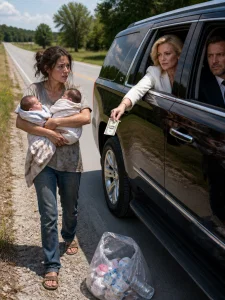
At first he saw only heat shimmer and pale grass and a woman bending near the ditch beside a plastic grocery bag. Then she straightened.
The world narrowed to her face.
Emily.
His Emily had worn soft cardigans and kept grocery receipts in a ceramic bowl by the back door because she never trusted apps to remember what she needed. His Emily had made coffee too strong and cried during old family movies and checked on staff members by name even when Michael had already forgotten their names. His Emily had sat beside him in an emergency room at three in the morning after his father’s heart scare, holding his hand without saying a word because she understood that words would have made him break.
That was the woman he had erased from his house.
The woman beside the road was thinner, sunburned, worn down by too many mornings that started before hope had time to wake up. Her shirt was faded at the collar. Her sandals looked one long walk away from falling apart. Her hair was tied back unevenly, damp strands stuck against her temples.
Still, Michael knew her. He would have known her anywhere.
Then he saw the babies.
Two of them.
Emily held them against her chest, one on each side, wrapped in soft cloth slings washed thin from use. Their tiny faces were tucked beneath knit caps. Their skin was flushed from the heat. One baby’s fist opened and closed against Emily’s shirt. The other slept with the exhausted stillness of a child who had already learned to be quiet.
Michael stared through the windshield, unable to move.
The babies had his coloring. Not just light hair. The shape of the brow, the soft slope of the nose, the small crease near the chin that every baby picture of Michael had carried.
Ashley laughed once under her breath.
It was not a surprised laugh. It was recognition.
That was the first thing Michael would remember later. Not the dust. Not the heat. Ashley’s laugh.
She rolled down the window. “Well, look at you, Emily. Digging through trash. That feels right.”
Emily did not flinch. She only shifted her weight and cupped one hand over the babies’ caps to keep dust from their faces. At her feet, the grocery bag sagged with crushed cans and empty bottles. A milk jug smashed flat at the bottom. Two aluminum cans dented under the heel of her sandal.
A woman who had once signed thank-you cards in his kitchen, now gathering scraps.
Ashley pulled a twenty-dollar bill from her purse and crumpled it and tossed it out the window. It rolled once in the dust and stopped near Emily’s sandals.
“For milk,” Ashley called. “Or whatever.”
Emily looked down at the money. Then she looked at Michael.
There was no begging in her face. There was no rage. That absence hurt worse than anger would have. Her eyes held the terrible calm of someone who had screamed long ago and learned nobody was coming.
She adjusted the cloth around the babies, picked up the bag of cans, and started walking.
Michael reached for the door handle. Ashley’s hand landed on his arm.
“Don’t embarrass yourself,” she whispered.
He looked at her fingers on his sleeve, then at Emily’s back in the rearview mirror. He understood then that if he asked the wrong question at that moment, Ashley would know exactly what to destroy before he found it.
So he did the hardest thing his pride had ever allowed.
He drove.
Ashley talked for the next twelve minutes. She talked about Emily’s clothes, about the babies, about how women like that always found a way to trap men with money. Michael answered none of it. At 2:17 p.m. he stopped in front of an upscale boutique and Ashley stepped out smiling.
“Don’t brood,” she said, leaning back into the open door. “You’re better off. Trust me.”
Trust me. The phrase settled in his stomach like spoiled food.
He watched her disappear behind the glass doors. Then he drove to his office, told his assistant to cancel every meeting for the rest of the day, locked the door, and called David.
David was not a friend exactly. He was the man Michael called when money hid behind signatures, when business partners lied through lawyers, when a deal looked clean because someone had scrubbed it with expensive hands. He had worked the divorce file from the outside and had always been too careful to say what he thought of it.
“Find her how?” David asked.
“Everything,” Michael said. “Where she’s been living. Whether she had children. Hospital records. Shelter records if any. Employment. Phone records. And pull the old divorce evidence again. The transfers, the photos, the necklace. All of it.”
David was quiet for a moment. “Michael,” he said finally, “are you investigating your ex-wife or the people who accused her?”
Related posts