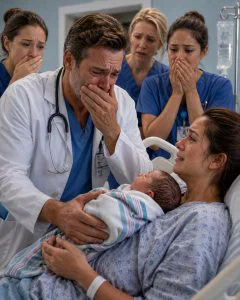
Joanna arrived at Mercy Creek Medical on a cold Tuesday morning with no one beside her. No partner. No family. Just a small suitcase, a worn sweater, and nine months of silence she had learned to carry on her own.
At reception, a nurse offered a gentle smile. “Is your husband on the way?”
Joanna returned a faint one. “Yes… he should be here soon.”
It wasn’t true.
Logan Wright had left seven months earlier, the night she told him she was pregnant. No shouting. No argument. Just a bag packed, a quiet excuse, and a door closing behind him with a softness that hurt more than anger ever could.
She cried for weeks.
Then she stopped.
Not because the pain was gone… but because there was nowhere left to put it.
She rented a small room. Worked double shifts at a diner. Saved every dollar she could. Each night, she rested her hands over her stomach and whispered to the child she hadn’t met yet.
“I’m here. I’m not going anywhere.”
Labor came early and stretched across twelve exhausting hours. Waves of pain left her breathless as she gripped the bed, nurses guiding her through each contraction.
“Please… let him be okay,” she kept whispering.
At 3:17 in the afternoon, the baby was born.
A cry filled the room.
Joanna sank back against the pillow, tears streaming down her face, but this time, they weren’t from heartbreak.
They were from relief.
From love.
“Is he okay?” she asked softly.
The nurse smiled as she carefully wrapped the newborn. “He’s perfect.”
They were about to place him in Joanna’s arms when the doctor entered.
Dr. Robert Wright.
A man known for steady hands and a calm, controlled demeanor.
He glanced at the chart… then at the baby.
And froze.
The color drained from his face.
His hand trembled.
And then, without saying a word, his eyes filled with tears.
The moment he saw the child… something from his past came rushing back.
What happened in the next few minutes would change three lives forever…
PART 2.
The moment Dr. Robert Wright saw the newborn’s tiny birthmark, the color drained from his face.
For thirty-two years, he had delivered babies without trembling, without breaking, without letting the past enter the room.
But this child carried a mark he had seen only once before — on a son who disappeared decades ago.
Joanna clutched her baby closer, sensing that the doctor’s tears were not from joy, but from a secret too heavy to hide.
And when he finally asked for the father’s name, the answer shattered everything she thought she knew…
Dr. Robert Wright had spent thirty-two years teaching himself not to react.
He had stood beside mothers who screamed, fathers who fainted, babies who arrived too early, too quiet, too blue. He had delivered children during storms, during blackouts, during nights when every hallway smelled of antiseptic and fear. People trusted him because he did not tremble. He did not panic. He did not let the emotions in the room become his own.
But now, in Delivery Room Four, with the winter light pressing gray against the windows, Robert Wright stared at Joanna’s newborn son and felt the floor vanish beneath him.
The baby was small, wrinkled, furious at the cold, his tiny fists curled near his cheeks. A nurse had tucked him into a white blanket with blue stripes. His skin was flushed from crying. His dark hair lay damp against his head.
But it was not the hair.
It was not the face.
It was the mark.
Just beneath the baby’s left collarbone, where the blanket had slipped, there was a birthmark shaped like a broken crescent. Pale at the edges, darker at the center, almost like a small moon split by shadow.
Robert’s breath caught.
For a moment, he was no longer in the hospital.
He was standing in another room, decades earlier, holding another newborn with that same mark beneath the left collarbone.
A child who had disappeared.
A child he had believed was gone forever.
“Doctor?” the nurse asked quietly.
Her voice brought him back, but not completely.
Joanna noticed then. She was exhausted, pale, her hair damp at her temples, her body still trembling from labor. But a mother sees everything when it comes to her child.
“Is something wrong?” she whispered.
Robert opened his mouth.
No sound came out.
The nurse drew the baby closer to her chest. “Dr. Wright?”
Robert wiped quickly at his eyes, as though ashamed of them. His hand shook so badly that he tucked it into the pocket of his coat.
“No,” he said at last, but the word sounded too fragile. “No, nothing is wrong with the child.”
Joanna’s expression tightened. “Then why are you crying?”
The room went quiet.
Outside in the hallway, someone laughed. A cart squeaked past the door. Somewhere, another baby began to cry. Ordinary hospital sounds, careless and distant, while Joanna’s entire world balanced on Robert Wright’s answer.
He looked at her chart again.
Joanna Ellis. Twenty-eight. No emergency contact listed. No spouse present. Father of child: not provided.
His eyes moved back to her face.
“May I ask,” he said carefully, “the father’s name?”
Joanna’s fingers curled into the sheets.
The question struck harder than it should have. She had spent seven months learning how not to flinch at his name. She had spoken it to landlords, nurses, government forms, and strangers who assumed there was a man somewhere waiting to arrive. Every time, it left a small cut.
“Why?” she asked.
Robert swallowed. “Because I need to know.”
The nurse shifted uncomfortably. “Doctor, perhaps this can wait.”
“No,” Joanna said, her voice still weak but firm. “If you’re asking because something is wrong with my baby, then you tell me now.”
Robert’s face changed. Not into the calm doctor’s mask everyone knew, but into the face of an old man suddenly carrying a weight too heavy to hide.
“Nothing is wrong with him,” he said again. “But I believe…” He stopped. “I believe I may know his family.”
Joanna stared.
His family.
For months, that word had meant only her. Her hands over her stomach. Her voice in an empty room. Her body standing for hours at the diner until her ankles swelled. Her alone, always alone.
“The father’s name,” Robert repeated gently.
Joanna looked toward the baby, still cradled in the nurse’s arms.
“Logan,” she said.
Robert closed his eyes.
The nurse’s face went still.
“Logan Wright?” Robert asked.
Joanna’s heart slammed once against her ribs.
She had never told the hospital Logan’s last name. She had refused, not out of pride, but because writing it down felt like giving him a place he had abandoned.
“How do you know that?” she whispered.
Robert opened his eyes.
Because he is my son.
The words should have been simple.
Instead, they came from him like a confession.
Joanna did not move.
For a second, she thought the exhaustion had finally broken something inside her. Perhaps she had misheard. Perhaps there was another Logan Wright somewhere, another man with the same careless hands and the same soft way of leaving.
But Robert’s expression confirmed everything.
“My son,” he said. “Logan is my son.”
The nurse inhaled sharply.
Joanna’s lips parted, but no words came.
Robert took one step closer, then stopped, as if afraid she might tell him to leave. “I didn’t know,” he said. “I swear to you, I did not know about the pregnancy.”
Something inside Joanna, something buried deep beneath months of hunger, rent notices, back pain, fear, and loneliness, lifted its head.
“You didn’t know,” she repeated.
“No.”
“He left me,” she said.
Robert looked as though she had struck him.
“He left when I told him. Seven months ago. He said he needed air. He packed a bag. He told me it was complicated. He said he would call.” Her voice broke, but she refused to let the tears take over. “He never did.”
Robert’s jaw tightened. His eyes lowered to the floor.
“I’m sorry,” he said.
The apology was soft, sincere, and useless.
Joanna gave a bitter laugh. “You’re sorry?”
He accepted it. He did not defend Logan. Did not ask if she had misunderstood. Did not search for excuses. That, somehow, made her angrier.
“Where is he?” she demanded. “Since you know him. Since he’s your son. Where is Logan?”
Robert’s face drained again, but this time not from shock.
He looked toward the baby.
Then back at Joanna.
“I don’t know.”
The answer landed between them with a strange, hollow sound.
Joanna stared. “What do you mean you don’t know?”
“I haven’t seen him in seven months.”
The room seemed to shrink.
The nurse finally placed the baby into Joanna’s arms. Instinct overpowered everything else. Joanna pulled him close, inhaling the warm, milky scent of his skin. Her son quieted almost immediately, pressing his tiny mouth against the blanket, his eyelids fluttering.
For one small second, the world became simple.
Then Robert spoke.
“The night he left you,” he said, “he came to me.”
Joanna looked up slowly.
Robert’s eyes remained fixed on the baby’s birthmark.
“He was terrified. I had never seen him like that. He said he’d made a mistake, that he needed to leave town, that people were looking for him.” Robert’s voice roughened. “I thought he was talking nonsense. Logan had always been impulsive. He was charming, reckless, always running from responsibility. I assumed he owed money. I assumed he had gotten into some stupid trouble.”
Joanna’s fingers tightened protectively around the baby.
“He told you about me?”
Robert shook his head.
“No. He didn’t mention you. He didn’t mention a child.” His face twisted with regret. “If he had…”
The unfinished sentence was worse than any promise.
“What happened after he came to you?” Joanna asked.
Robert looked older with every breath.
“I told him to stop running. I told him whatever he’d done, he could face it. He got angry. Said I didn’t understand. Said I had never understood anything about blood.” Robert’s eyes flicked again to the birthmark. “Then he left.”
“And?”
“Three days later, his car was found abandoned near Blackwater Bridge.”
Joanna’s breath vanished.
The baby stirred against her chest.
“No,” she whispered.
“There was no body,” Robert said quickly. “No sign of a crash. No blood. Just the car. His phone was inside. His wallet too.”
Joanna stared at him, unable to decide whether hope or horror was worse.