I threw all of my 22-year-old son’s clothes into black trash bags and kicked him out onto the street. My wife called me a monster, but that night, I realized the real monster had been sitting at our table for months. I came home from work with swollen hands. My wife was serving him dinner as if he were still a little boy. And he, with the remote in one hand, complained to her that his soda wasn’t cold enough. — Part 3
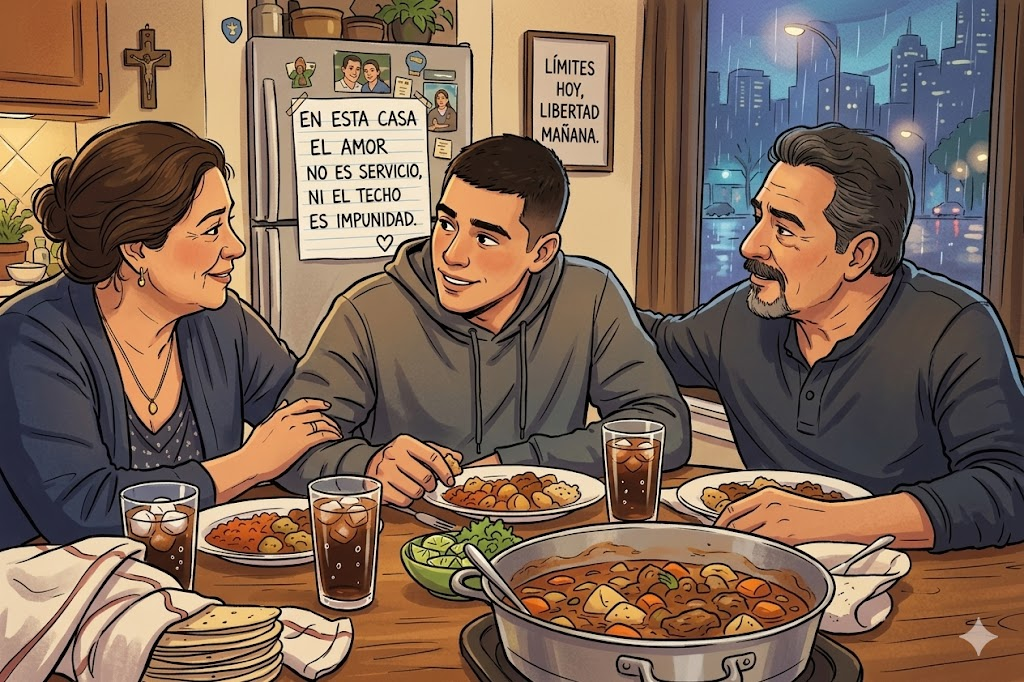
Three months passed. Daniel got a job at a grocery warehouse near the market. He started work before dawn. He made little money. He came home with dirty hands, an aching back, and a silent rage against the world. One Sunday he came to eat. Not to live. To eat. Teresa made beef stew. I put tortillas on the griddle. The table felt tense, as if we were all sitting on glass. Daniel arrived with short hair and a bag in his hand. He put it in front of his mother. “They’re your earrings.” Teresa stood motionless. “What?” “I got them out of pawn. I still owe for other things.” She opened the little box. Her mother’s earrings were shining there, small, old, rescued. Teresa cried. Daniel didn’t move to hug her. He just said: “Sorry.” It wasn’t a pretty apology. It had no music. It didn’t fix anything. But it was the first clean word to come out of his mouth in a long time. Then he pulled out something else. My drill. “This too.” I looked at him. “And my laptop?” He lowered his head. “Mau sold that one. I’m going to pay you back.” “Yes.” He was surprised I didn’t say, “It doesn’t matter.” Because it did matter. It had to matter.
We ate almost in silence. When Teresa got up to serve him more stew, Daniel stopped her. “I’ll do it.” She stayed there with the ladle in her hand, as if she didn’t know what to do with that gesture. Daniel took his plate, went to the kitchen, and served himself. He dropped a little bit on the stove. Before, he would have screamed, “Mom!” This time, he grabbed a rag. He cleaned it. I looked the other way so he wouldn’t see me cry.
He didn’t return home that night. He went to his rented room with two coworkers near the industrial district. It wasn’t pretty. It wasn’t comfortable. But it was his, to the extent that he paid for it. Before he left, he stopped at the door. “Dad.” “Tell me.” “That day… when you kicked me out…” I waited. “I hated you.” “I imagine.” “It still hurts.” “Me too.” He clenched his jaw. “But if you hadn’t done it, I don’t think I would’ve stopped.”
Teresa let out a sob. Daniel looked at her. “Mom, don’t save me again if I start screwing up.” She cried with her hand over her mouth. “Don’t say that.” “You say it.” Teresa took a while. A long while. But in the end, she said: “I won’t save you if you abuse us again.” Daniel closed his eyes. As if that sentence were a door closing and another, harder one, opening at the same time. “Thank you,” he murmured. He left.
The house fell silent. But it wasn’t the sick silence from before. It was a tired silence. With room to breathe.
That night, Teresa and I washed the dishes together. She soaped, I rinsed. Outside, the sweet potato carts whistled their sad tune, and from some apartment, a soccer match played on TV. “Do you think he’ll relapse?” she asked. “Maybe.” “And what do we do?” “The same. Love without kneeling.” Teresa looked at me. Her eyes were swollen, but firm. “I called myself a monster for letting you kick him out.” “I called myself a monster for doing it.” “And are we?” I thought of Daniel carrying tomato crates. Of his bare feet in front of the Oxxo. Of Teresa recovering her earrings. Of my house without loud video games. “I don’t know,” I said. “But sometimes a father has to close the door so the son can find his own.”
A year later, Daniel was still working. It wasn’t a perfect story. He had relapses into gambling. He was late on two rent payments. He asked us for money once, and we said no. He got angry, disappeared for two weeks, and then went back to therapy. He also finished the high school diploma he had abandoned. That day, he sent us a photo of his certificate. Teresa cried all over her phone. I wrote: “Proud of you. Keep going.” I deleted “son” three times before sending it. Then I put it in. Because it was also the truth.
The last time he came to eat, he brought sodas. Cold ones. He put them on the table and smiled, embarrassed. “So nobody sends me to hell again.” Teresa laughed. I did, too. Not like before. Not with innocence. With a scar. Daniel poured the glasses. First his mother’s. Then mine. Finally his own. That order, so small, was worth more than a thousand speeches.
As we ate, I looked at my son. He was no longer on the couch with a crown. He wasn’t a completely new man, either. He was someone learning to carry his own weight. And I understood that the night of the black bags, I hadn’t kicked my son out of the house to lose him. I had kicked him out so that life, finally, could catch up to him.
Teresa placed her hand on mine under the table. Daniel told us he wanted to save money to study mechanics. Outside, the city roared as always: crowded trains, taco stands, trucks, rain threatening from the gray sky. Life didn’t become easy. But it became life again. And when Daniel finished eating, he picked up his plate without anyone asking him to. That simple sound—a plate carried to the sink—was the most beautiful music I had heard in years. Because in my house, finally, no one would ever again confuse love with servitude. Or a roof with impunity. Or a mother with a waitress. And even though it still hurt to remember his black bags in the hallway, I understood something that took me fifty-five years to learn: Sometimes loving a child isn’t opening the door for them. Sometimes, it’s leaving them outside long enough for them to learn how to knock without demanding.