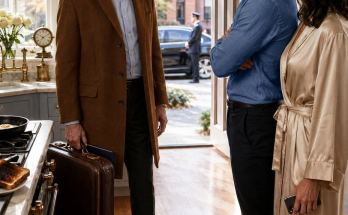
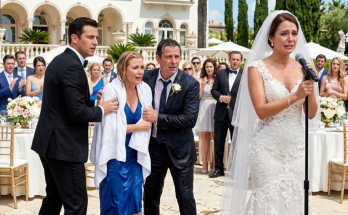
The photo arrived blurry, but I could still see Austin’s face.
Pale. His mouth wide open. Holding my note in one hand and that second folder in the other—the one I had left on the table with bold black letters: “AUSTIN.”
Behind him, Chloe was looking toward the hallway, as if she still expected to find the parakeets, the rabbit, and the cat. She had surely opened every door, checked under the couch, and yelled my name like someone calling for a maid who was taking too long.
She found nothing. No pets. No food. No mother.
My phone started vibrating again. Austin. Chloe. Austin. Chloe.
Then Tyler, my other son, who had been living in Charlotte for years and only called me on Christmas or when he wanted to ask what size shirt his dad used to wear.
I didn’t answer.
In front of me, the cruise ship lit up like a white city ready to lift off from the sea. The Port of Miami smelled of salt, diesel, coffee, and early morning. In the distance, the outline of Fort Jefferson stood dark against the water, like an old witness that had watched ships, wars, promises, and goodbyes come and go.
I was saying goodbye too. But not to my dead. To my chains.
I walked up the gangway with my blue suitcase in one hand and my passport in the other. A young man in uniform smiled at me.
“Welcome on board, Mrs. Theresa.”
The word “welcome” pierced right through me. It had been years since anyone had said that to me without asking for something right after.
When I entered my cabin, I set the suitcase by the bed and pulled back the curtain. Through the window, I could see the pier, the harbor cranes, the lights along Ocean Drive, and a few taxis idling like yellow fireflies. I thought of Ernest, of his white linen shirt, of his thin hands during his final months.
“Forgive me for leaving so soon,” I whispered.
But I didn’t feel any guilt. I felt that he, wherever he was, was smiling.
The phone vibrated again. This time it was a voice note from Austin. I didn’t want to hear it. Then one came from Chloe. No, thank you. Then a text message appeared from my son:
“Mom, what is this? What does this lawsuit mean? Why does it say we have to evict? Where are my animals?”
My animals. He didn’t ask if I was okay. He didn’t ask if I had arrived safely. He only asked about his own comfort.
I sat on the bed, opened my purse, and pulled out a copy of the very folder he was holding in his hands. I had put it together with Claire Montgomery, a white-haired attorney with a calm voice who had been friends with Ernest since high school.
Claire was the one who opened my eyes. Not with advice, but with documents.
Three months before Ernest died, Austin had taken his father to the bank “to help him with some signatures.” Ernest was weak, confused by his medication, but he still understood far more than anyone realized. That night, when he came back, he took my hand and said:
“Theresa, don’t give him the house. Not while you’re still breathing.”
I thought it was just the fever talking. It wasn’t a fever. It was a warning.
After the funeral, when Austin asked about the house with the cemetery dirt still on his shoes, I looked through Ernest’s papers. There, I found copies of promissory notes, an attempted power of attorney, personal loans in my husband’s name, and an application to use our house as collateral for a debt of Austin’s.
My son didn’t want to know what I was going to do with the house. He wanted to know how soon he could strip it away from me.
Claire reviewed everything at her downtown office, near the plazas, where you can still hear live music in the afternoons and servers walk past with Cuban espressos as if they were carrying ceremonial cups.
“Theresa,” she told me, “your husband managed to protect you.”
Ernest had updated his will a year prior. The house was left entirely to me, complete, with no strings attached. He also left a clear clause: as long as I lived, no one could occupy, sell, rent, or use it as collateral without my explicit, written consent.
And Austin had already tried. Not once. Three times.
The first folder, the one I left next to the keys, was the formal notification from Claire: a lawsuit for signature forgery, the cancellation of any power of attorney, and a request for an injunction to prevent Austin from entering my property without authorization.
The second folder was worse. The second one contained copies of bank transfers, receipts, messages, and a log of every single dollar I had given him over the years. Not because I wanted to collect it all back. A mother doesn’t keep a ledger to charge for love.
But when a son calls his mother a “maid” with his hands full of cages, those ledgers become a shield.
Austin called again. This time, I answered. I didn’t say hello. I just listened.
“What did you do?” he screamed. “Where are you?”
Behind him, Chloe was shrieking something about the cat, the rabbit, and the parakeets.
“Good morning, Austin.”
“Don’t you dare talk to me like that! There’s a court server here. She says we can’t stay. She says if we don’t leave, she’s calling the police!”
“Correct.”
“This is my house!”
I looked out the window. The sky over the ocean was beginning to brighten.
“No, son. It’s my house.”
There was a silence. Not of remorse. Of calculation.
“Mom, you’re hysterical. You just became a widow. Chloe and I are worried about you. Tell us where you are, and we’ll come pick you up.”
I almost laughed.
“I am exactly where I should have been many years ago.”
“What does that mean?”
Just then, the ship’s speakers announced our imminent departure. Several people were walking along the deck with coffee in paper cups, sun hats, and that pure excitement of someone who still believes the world can be kind.
I took a deep breath.
“It means I am not going to take care of your pets, or your debt, or your marriage, or your hunger, or your pride.”
“Mom…”
“The animals are safe. Mrs. Mary took them to her nephew, at the shelter that handles responsible adoptions. I left them food, vaccines, and a donation. The cat is finally out of that horrible carrier.”
Chloe snatched the phone. “You crazy old woman! That cat was incredibly expensive!”
Hearing that, something clicked inside me. I didn’t cry because of the insult. I cried because for years, things that had no teeth had made me hurt.