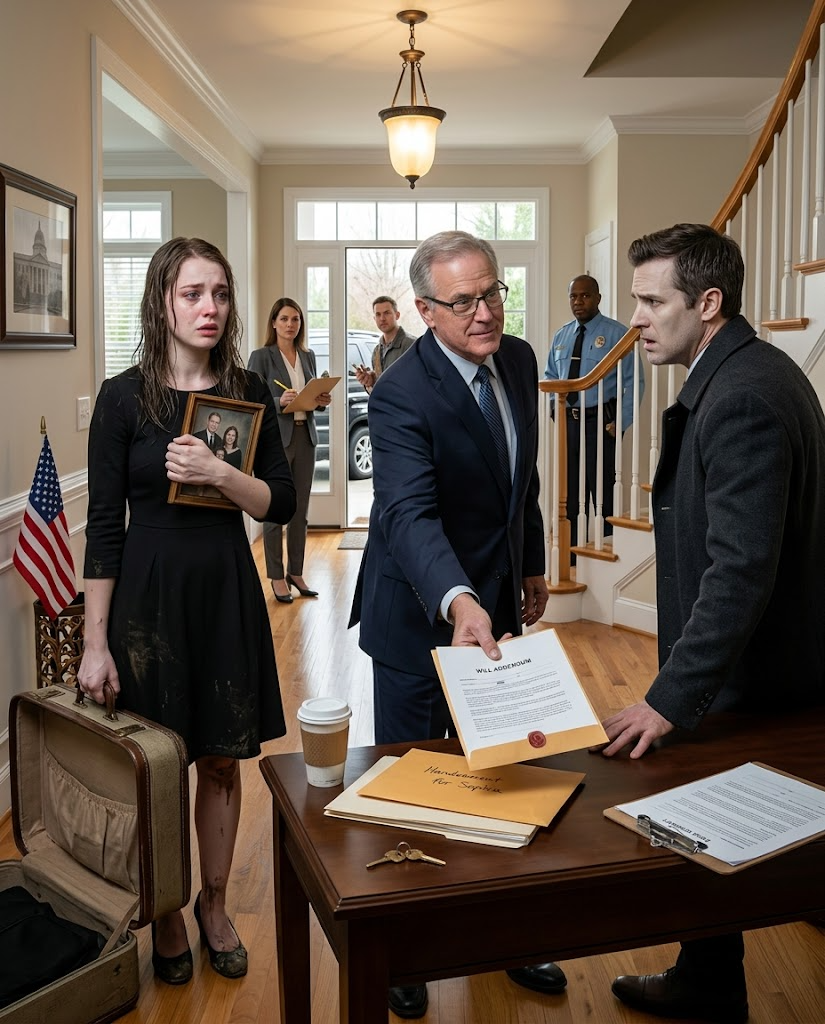
My name was written on it in Grandpa’s crooked black ink.
Sophia — only open this if your father forgets what family means.
For a second, I was back at the kitchen table with Grandpa’s warm hand over mine.
I could hear the rain on the windows.
I could smell his coffee.
I could see him trying not to look tired.
My father saw the envelope too.
All the color drained from his face.
“Harold,” he said. “Don’t.”
The word sounded nothing like the man who had called me useless.
It sounded like fear.
Harold slid the envelope toward me.
“Your grandfather asked me to give this to you if the condition was triggered.”
My fingers trembled as I broke the seal.
Inside was a letter and one notarized page.
The letter began with my name.
My dear Sophia.
I had to stop reading for a moment because the handwriting blurred.
Harold waited.
Nobody else moved.
Even the locksmith seemed to understand he had walked into something larger than a lock job.
I read the first paragraph silently.
Then the second.
Then I looked at my father.
He would not meet my eyes.
Harold took the notarized page and read aloud.
“Upon breach of conditional stewardship by Thomas Stewart, full residential ownership of the Oak Lane property transfers to Sophia Elaine Stewart, along with the William Stewart Family Preservation Trust established for maintenance, taxes, and protection of the residence.”
The real estate agent covered her mouth.
My father gripped the edge of the table.
Harold kept reading.
“Additionally, Thomas Stewart shall be removed from controlling authority over Stewart and Sons Construction pending board review, due to demonstrated conflict of interest and failure to comply with fiduciary conditions.”
Dad looked like he had been slapped by air.
“The company?” he said.
Harold nodded.
“The board received notice this morning.”
At 9:42 a.m., Harold told him, the certification packet had been filed.
At 9:57 a.m., the conditional breach notice had been delivered to the company’s registered office.
At 10:12 a.m., the first board member called Harold back.
Every time Harold named a time, my father flinched.
Not because the times were dramatic.
Because they were documented.
People like my father can dismiss tears.
They struggle with timestamps.
“You can’t do this,” Dad said.
“I am not doing it,” Harold replied. “William did.”
Then he looked at me.
“Sophia, the house is yours.”
I did not smile.
I thought I would.
I thought if the day ever came when my father was forced to face the cost of his cruelty, I would feel triumphant.
Instead, I felt the terrible weight of being loved by a dead man more carefully than I had been loved by a living father.
I picked up the old brass key from the table.
The guard had returned it when Harold demanded it.
The tag still said HOME.
Dad looked at the key like it had betrayed him.
“You think this makes you important?” he said.
I looked at him for a long moment.
“No,” I said. “It means Grandpa knew exactly who you were.”
The real estate agent quietly gathered her clipboard.
“I’m leaving,” she said.
The locksmith packed up his tools without being asked.
The security guard stepped aside.
My father did not move.
For the first time in my life, he was standing in a room where his money, his name, and his tone did not open the door.
Harold handed him a copy of the notice.
“You have until five p.m. to remove yourself from the property,” he said. “Anything belonging to the estate or the residence stays here.”
Dad stared at him.
Then he stared at me.
I remembered the conference room.
I remembered the cemetery mud.
I remembered sleeping under grocery store lights with my mother’s photo beside me.
I remembered his voice saying, “You are useless to me now, Sophia.”
That sentence had felt like an ending when he said it.
It was not.
It was evidence.
By sunset, my father was gone from Oak Lane.
He left in silence.
No apology.
No explanation.
No dramatic final speech.
Just a man carrying a briefcase down the porch steps of a house he had tried to sell before the grief inside it had cooled.
I stood in the doorway and watched him pass the mailbox Grandpa had dented with his old pickup.
The porch light clicked on behind me.
For the first time in twenty-four hours, the house did not feel like something being taken.
It felt like something keeping its promise.
Later that night, I went into Grandpa’s room.
His watch was still on the dresser.
I did not put it on.
I sat beside it and read his letter again.
He wrote that he was sorry he had not protected me sooner.
He wrote that he knew Thomas would mistake inheritance for permission.
He wrote that blood did not make someone family if all they knew how to do was calculate your value.
Then he wrote the line that finally broke me.
You were never useless, Sophia. You were the reason this house stayed warm.
I cried then.
Not loudly.
Not prettily.
I cried the way people cry when their body finally believes it is safe.
The next morning, I made coffee too strong and toast too dark.
I set one cup at Grandpa’s place at the kitchen table, not because he was coming back, but because love sometimes needs a ritual before it can become memory.
Then I took the old brass key, locked the front door from the inside, and stood there listening to the quiet house breathe.
My father had called me useless because he could not use me anymore.
Grandpa had called me home because he knew the difference.
And that difference changed everything.