My daughter-in-law canceled my 60th birthday dinner at my own kitchen table so her parents could use the money for their Maui trip, and my son sat there in silence like my home, my savings, and my dignity already belonged to them—until one phone call from my office exposed the business empire they thought I no longer controlled, the free apartment upstairs suddenly came with a lease, and her own parents revealed the secret plan she had been telling everyone behind my back…
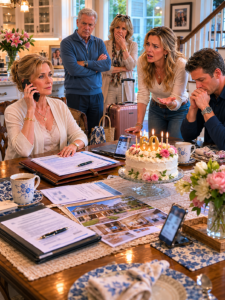
“No birthday dinner,” my daughter-in-law said. “We need that money for my parents’ trip.” She said it while sitting at my own kitchen table, drinking coffee from the mug my husband used to use on Sunday mornings, the blue ceramic one with the little chip near the handle where Edward had dropped it against the sink and then refused to let me throw it away because, according to him, “anything that survives a fall deserves a second life.” Vanessa held that mug like it had always belonged to her. She had one manicured finger looped through the handle, one ankle crossed over the other beneath my table, and a look on her face that told me she had not come downstairs to discuss my birthday dinner. She had come to cancel it. Not ask. Not apologize. Announce. My son Julian sat beside her with his shoulders rounded, his phone in his hand, his thumb sliding up and down the screen even though I knew he wasn’t reading anything. I knew my son’s avoidance the way mothers know weather. I knew the little muscle that jumped near his jaw when he wanted to disappear from a conversation. I knew how he tilted his head toward Vanessa when he was waiting for her to finish saying the thing he was too cowardly to say himself. I had been folding a pale blue cloth napkin in my lap, one of four I had ironed the night before because I still believed small things mattered. A nice table mattered. A cake from the bakery on Maple Street mattered. Candles mattered. A few people who remembered my husband and didn’t mind saying his name out loud mattered. Maybe one evening where I could turn sixty without feeling like an old coat hanging in the back of the closet of a house I had paid taxes on for thirty-one years. Vanessa set the mug down with a hard little thump, glanced at Julian as if daring him to contradict her, then continued. “My parents are flying to Maui next week. The hotel prices are ridiculous because it’s right on the beach, and honestly, this was the only week that worked for them. So we’re going to have to use the money you set aside for Saturday.” The words sat between us like dirty dishes nobody wanted to touch. My birthday money. That was what it had been when I quietly transferred it from my savings account into checking two weeks earlier after calling Mrs. Alvarez at the bakery and asking whether she could still do Edward’s favorite chocolate frosting. Then Vanessa had started calling it “house money,” the way she had started calling everything in my house “ours” the minute she realized I was too tired from grief to correct her. First it was “house money,” then “family money,” and somewhere along the way, without any agreement from me, it became money she could assign to her parents’ beachfront vacation without even looking me in the eye. Julian cleared his throat. For one second, just one, I thought my son might finally sit up, set down that phone, and say, “Vanessa, no. That’s Mom’s birthday. That’s her money. We’re not doing this.” I thought maybe the boy who once brought me dandelions in a paper cup and told me they were “sunflowers for poor people” was still somewhere inside the man at my table. He looked at me. He looked at his wife. Then he looked back down at his phone. That was the moment something inside me went still. Not numb. Still. There is a difference. Numb means you stop feeling. Still means you feel everything so clearly that you finally stop letting it leak out in front of people who would only use it against you. I smoothed the napkin once more, placed it neatly on the table, and said, “I see.” Vanessa smiled in that polished way of hers, all lip gloss and confidence, the kind of smile women use when they believe a room has already agreed with them. “I knew you’d understand. Honestly, Karen, it’s just a birthday. Sixty isn’t exactly some once-in-a-lifetime thing anymore. People live forever now.” I almost laughed. Edward had not lived forever. Edward had gone to bed on a rainy Thursday night two years earlier after reminding me to call the plumber about the slow drain in the upstairs bathroom, and the next morning I had stood barefoot beside our bed with a phone shaking in my hand while a dispatcher asked me to repeat my address. One minute he had been complaining about the furnace and asking if I wanted tea. The next morning he was an absence so complete the house seemed to echo around him. People do not live forever. People leave. And sometimes, after they leave, the people still living walk through your house as if grief has turned every room into something they are entitled to inherit early. Vanessa leaned back in her chair. “Besides,” she added, “you don’t need a party. You don’t even like attention.” That was true enough to sound harmless and cruel enough to cut. I did not like attention because for most of my life I had been the person arranging attention for everyone else. I mailed birthday cards before dates passed. I brought casseroles to church widows. I remembered which neighbor had knee surgery and which one didn’t like onions. I kept extra gift cards in the junk drawer in case Julian forgot Mother’s Day until the last minute. I had spent decades making sure other people felt seen. No, I did not need applause. But I did need to be treated like a person. Julian shifted in his chair. “Mom,” he said softly, “it’s just this one thing.” That stung worse than Vanessa’s words because it was never one thing. It was the electric bill he forgot to help with. The groceries Vanessa added to my list and never paid for. The temporary use of my credit card when their car insurance jumped. The upstairs apartment they had moved into after Edward’s funeral “just until they got back on their feet.” Two years later, their feet had apparently never found the floor. At first, I had wanted them close. Grief makes a woman generous in dangerous ways. The upstairs apartment had a small kitchen, two bedrooms, a sitting room, and its own bathroom. Edward and I had renovated it years ago for my mother, back when she needed a place where someone could hear her if she fell. After she passed, I kept it furnished, dusted, and quiet. Julian moved in after his rent went up. Vanessa came six months later, bringing velvet throw pillows, framed vacation photos, imported candles, and a way of looking at my home like it was badly managed property. I charged them no rent. I asked only that they pay a fair share of utilities. They paid for three months. Then not again. The house became louder after Vanessa moved in, though not in the obvious way. She didn’t scream. Vanessa was smarter than that. She used quiet pressure. Little corrections. Polite insults. Questions that sounded like concern until you heard them twice. “Are you sure you should still be driving at night?” “Karen, nobody uses checks anymore. It makes you look confused.” “Maybe we should simplify the kitchen. Older people get overwhelmed by clutter.” The clutter was my Dutch oven, my recipe box, and the rooster cookie jar Edward bought me at a flea market in Vermont because he said every respectable kitchen needed one ridiculous object. One by one, things shifted. My laundry detergent disappeared upstairs. My good olive oil became “ours.” My grocery runs began including Vanessa’s almond creamer, Julian’s protein bars, and the expensive salmon her parents liked when they visited. Her parents. Richard and Elaine Whitmore lived in a gated community outside Scottsdale and spoke to waiters as if they were malfunctioning appliances. They visited twice a year and left behind half-empty bottles of imported water and the feeling that my house had been inspected and found lacking. Now my birthday dinner was being canceled so Richard and Elaine could sleep in a beachfront room in Maui. I looked at Julian again. He did not look back. That was all the answer I needed. I stood and carried my empty coffee cup to the sink. My hands did not shake. I rinsed the cup, set it in the drying rack, and watched a small stream of water curl down the drain. Vanessa mistook my quiet for defeat. People like Vanessa often do. “Great,” she said brightly. “I’ll call the bakery and cancel the cake. And the deposit for the private dining room should come back on your card, right? I’ll need you to transfer it when it does.” I turned off the faucet. “No,” I said. She blinked. “Excuse me?” “No. I’ll handle my own refund.” Her smile tightened. “Karen, we’re all trying to make this work.” “Are we?” The kitchen went quiet. Julian finally looked up. I dried my hands on a towel and folded it over the oven handle exactly the way Edward used to tease me for doing. Before Vanessa could answer, my phone buzzed in the pocket of my cardigan. I pulled it out and saw Marcus Bell on the screen. Vanessa saw the name and frowned. She recognized Marcus only vaguely as “some old office friend,” because that was what she had decided he was. In her mind, my working life had ended when Edward died. Maybe even before. She thought I lived on Social Security, widow’s benefits, coupons, and whatever dignity I could scrape together from being quiet. I answered. “Good morning, Marcus.” His voice filled my ear, calm and businesslike. “Morning, boss. The closing packet is ready. The attorney wants your signature before three, and the downtown lease is waiting on your approval.” I felt Julian’s eyes lift toward me. Vanessa’s mouth opened a fraction. Boss. It was a simple word, but in that kitchen it landed like glass breaking on tile. “I’ll be there after lunch,” I said. “Have the file on my desk.” “Will do,” Marcus said. “And Karen?” “Yes?” “The Nashville buyers increased their offer overnight. You were right to wait.” I glanced at Vanessa. Her face had gone perfectly still. “Good,” I said. “We’ll talk when I get in.” I ended the call and slipped the phone back into my pocket. For a few seconds, nobody spoke. Julian’s fork slipped from his hand and clattered against the edge of his plate. It was a small sound, but it seemed to wake him. “Mom,” he said slowly, “what was that?” I looked at him. “That was work.” Vanessa gave a short laugh, too sharp to sound amused. “Work? Karen, since when do you have attorneys and buyers calling you?” “Since before you married my son.” Her cheeks flushed. Julian stared at me like he was seeing furniture move by itself.
The truth was not dramatic, not the way Vanessa imagined money had to be dramatic. There were no diamonds in a hidden safe, no mansion somewhere with a gate and a fountain, no private jet sitting at the airport waiting for a widow in comfortable shoes. Just work. Years and years of work. Edward and I had started Mitchell Commercial Realty in a rented office above a dental clinic, back when Julian was still in elementary school and the only thing in our break room was a dented coffee maker, a jar of powdered creamer, and a calendar from the title company with a picture of a golden retriever wearing a Santa hat. Edward had charm. I had memory. I remembered numbers, leases, zoning changes, property lines, names, birthdays, who paid late, who lied easily, who pretended not to see environmental reports, and every foolish thing a buyer said when he thought a woman was only there to take notes. Edward could walk into a room and make a stubborn seller laugh. I could sit quietly through three hours of negotiation and then point out the clause everyone else had missed. We were a good team because neither of us tried to be the other. By the time Edward died, we owned controlling interests in several commercial buildings around the county, two warehouses near the interstate, three small medical office properties, and enough carefully structured partnerships that even our accountant used to say my spreadsheets looked like a hymn to patience. After Edward’s funeral, I stepped back from the public side of the business because grief made me tired of men in golf shirts telling me what Edward “would have wanted.” They always said it with solemn faces, as though Edward had left them secret instructions about my vulnerability. But I never stepped away from ownership. Marcus ran daily operations. I reviewed every contract. I signed every major decision. I approved acquisitions, leases, renovations, financing, and sales. I had let my family believe whatever was most comfortable for them because I thought privacy was strength. That had been my mistake. Silence can be kindness for a while. After a certain point, it becomes an invitation. Vanessa pushed back her chair. “Well,” she said, trying to recover, “I’m sure it’s all very impressive. But the birthday money still needs to go toward my parents’ hotel. We already told them we could help.” “No,” I said again. This time my voice was not loud, but it was final enough that even Julian heard it. Vanessa stared at me. “You’re really going to be selfish about this?” I looked at my son. He swallowed. “Mom,” he said, “maybe we can talk about it later.” “We can,” I said. “But the answer will still be no.” I picked up my purse from the hook by the back door, took my car keys from the blue bowl Edward made in a pottery class one winter, and walked out before Vanessa could find another way to make my birthday sound like an inconvenience. The air outside was cold and bright. Our neighborhood sat on a quiet street just outside Columbus, the kind of place with trimmed hedges, basketball hoops over garage doors, and retired men who rolled their trash bins to the curb before dawn. Edward had loved that house. Not because it was grand. It wasn’t. It was a sturdy brick colonial with a maple tree in front and a back patio he built himself one summer, burning his forearms in the sun and insisting he didn’t need help. I sat in the car for a moment before starting it. Then I laughed once. Not because anything was funny. Because I had spent two years being careful with people who had never once been careful with me. At the office, Marcus was waiting with a stack of folders and the look of a man who had been waiting for me to wake up. He was sixty-eight, tall, silver-haired, and still dressed like every county judge might stop by unexpectedly. Edward trusted him. So did I. “Rough morning?” he asked as I walked into my office. I hung my coat on the rack. “You could say that.” He set the folders on my desk. “Vanessa called here yesterday.” I looked up. “Of course she did.” “She asked whether we had any warehouse furniture we could donate to her parents’ vacation rental business.” I closed my eyes for one second. “She said she was calling on behalf of the Mitchell family.” “That sounds like her.” “She also asked if your office was still ‘mostly ceremonial.’” I opened my eyes. Marcus was trying not to smile. “I hope you told her my throne room was under renovation.” “I told her company assets require approval from ownership.” “And?” “She asked who ownership was.” I sat down slowly behind my desk. For years, this office had been Edward’s. After he died, I changed very little. The shelves still held his old law books, though he was never a lawyer. He liked the look of them. The framed photo of us at the company’s first ribbon cutting still sat on the credenza. In it, I was thirty-two, wearing a navy dress and a smile that had no idea how much work was coming. I ran my finger along the edge of the closing packet. “She’s been treating me like an old woman who should be grateful for a place at her own table.” Marcus’s expression softened. “I’m sorry, Karen.” “So am I,” I said. “Mostly because I allowed it.” He waited. That was one of Marcus’s best qualities. He knew when not to fill silence. I opened the first folder. “Stop the monthly transfer covering Julian’s car lease.” Marcus nodded once. “He’ll notice.” “He should.” “What about the grocery supplement?” “End it.” “The household utilities reimbursement?” “Also ended. From now on, if Julian wants support, he can request it in writing like any other adult asking for money he has no right to.” Marcus’s eyebrows rose slightly. “There she is.” I gave him a look. “Don’t enjoy this too much.” “I am enjoying it an appropriate amount.” For the first time in days, I smiled. Then I signed the downtown lease. That property had been a risk Edward and I took fifteen years earlier when everyone said the area was dead. Now a medical group wanted the entire first floor, a pharmacy wanted the corner space, and the city was putting in new sidewalks. Vanessa had been fighting over a bakery deposit while I was approving a lease that would pay more in one year than she imagined I had in total. Money did not make me better than her. Money never made anyone better. But it made one thing very clear. Vanessa had built her confidence on a lie she invented about me.