
The text came while a man in a gray suit was explaining “future-ready freight solutions” to a room full of people who looked like they would rather be anywhere else.
Flight 2847 to Columbus: Cancelled.
Mechanical issue. Rebooking options available.
I stared at the screen until the words blurred.
For three days, I had sat in a Chicago hotel conference room that smelled like burnt coffee, carpet cleaner, and expensive boredom. I worked logistics for Midwest Transport Solutions, which meant people paid me to solve problems before they became disasters. Missed routes. Broken timelines. Trucks stuck behind storms. Warehouses running out of patience.
I was good at getting things where they needed to be.
Except myself.
Emma’s championship soccer game was Sunday morning. My daughter was nine, all knees and ponytail, with a left foot that could embarrass boys twice her size. I had already missed three games that season. Every time, I had promised, “Next one, peanut. I swear.”
Now the airline wanted me home Sunday afternoon.
I opened the map on my phone.
Four hours and seventeen minutes by car.
I closed my notebook, slid it into my briefcase, and walked out while the speaker was mid-sentence. Outside, Chicago wind hit me in the face like a slap. By the time I reached the rental garage, I had already changed plans in my head: gas once, no stops unless necessary, home by one in the morning.
The highway was nearly empty after midnight. I kept the radio off. The hum of tires gave me space to think, which was exactly what I did not want.
Maureen had been strange lately.
Not angry. Not exactly. Just absent. She moved through our house like a woman listening for footsteps no one else could hear. She checked locks twice, sometimes three times. She said no to sleepovers, birthday parties, Girl Scouts, bike rides around the cul-de-sac. If Emma laughed too loudly in another room, Maureen appeared in the doorway with that tight look around her mouth.
I used to call it anxiety.
That was easier.
We met thirteen years earlier at a backyard barbecue. She was quiet, pretty in a tired kind of way, with dark eyes that seemed to hold secrets. I mistook wounds for depth. I thought love meant waiting until she trusted me enough to explain them.
She never did.
When Emma was born, Maureen became more protective than any new mother I had ever seen. She slept in a chair beside the crib for weeks. She flinched when people asked to hold the baby. She cut off friends who joked that she needed to relax.
“It’ll pass,” everyone said.
It didn’t.
The closer I got to Columbus, the more uneasy I felt. The roads became familiar: the grocery store with the flickering sign, the pharmacy where Emma always begged for cherry lollipops, the line of maple trees leading into our subdivision.
Our house sat at the end of a quiet cul-de-sac, blue shutters, two-car garage, the porch Emma and I had painted last summer while Maureen watched from the kitchen window.
The porch light was off.
Maureen always left it on when I traveled.
I parked in the driveway and sat for one breath too long. The rental car engine ticked softly as it cooled. Somewhere far away, a dog barked, then went silent.
Inside, the house was dark.
I set my bag down in the foyer and climbed the stairs without turning on lights. Family photos lined the wall: Emma missing two front teeth, Emma in cleats, Emma on my shoulders at a Fourth of July parade. At the end of the hallway, her bedroom door stood cracked open.
Her nightlight glowed by the baseboard.
Her bed was empty.
Not messy-empty. Made-empty. Blanket pulled smooth, pillow centered, stuffed rabbit sitting upright like a witness.
Emma never made her bed.
I checked the bathroom. The office. The laundry room. The hall closet where she used to hide during hide-and-seek.
Nothing.
By the time I opened Maureen’s bedroom door, my heart was hammering hard enough to hurt.
She sat up slowly, blinking in the lamp light.
“Keith?” she whispered. “What are you doing home?”
“Where’s Emma?”
Her face did something then. Not panic. Not confusion.
Calculation.
“She’s at my mother’s,” Maureen said.
And in that moment, I knew my cancelled flight had not ruined my weekend.
It had saved my daughter from something I was not supposed to see.
### Part 2
“What do you mean she’s at your mother’s?” I asked.
Maureen rubbed her eyes with the back of her hand, but she was too awake now. Her shoulders had gone stiff beneath the blanket.
“I texted you,” she said. “Thursday morning.”
“No, you didn’t.”
“Yes, I did.”
She reached for her phone on the nightstand. Her hand trembled just enough for me to notice. She tapped, scrolled, then held the screen toward me.
Emma’s staying with Mom this weekend. She wanted to visit.
The message was there.
Thursday, 9:14 a.m.
I looked at my own phone. Nothing. No message. No missed text. No deleted thread.
“Why would Emma want to stay with your parents on a school night?”
“It’s not a school night,” Maureen snapped. “Monday is teacher in-service. You’d know that if you were around more.”
There it was. The old knife. Work. Absence. Guilt.
Normally, I would have defended myself. Explained the conference. Explained the promotion I was trying to keep. Explained that everything I did was for this family.
Not that night.
That night, all I heard was the space between her answers.
“What time did they pick her up?”
“After school.”
“Who picked her up?”
“My mom.”
“Emma went willingly?”
“She’s a child, Keith. Children don’t always know what’s good for them.”
A cold line moved down my spine.
I turned and headed for the stairs.
“Where are you going?” Maureen called.
“To get my daughter.”
“It’s almost two in the morning.”
“Then everyone’s awake now.”
She followed me to the landing, bare feet silent on the carpet. “You’re being paranoid.”
I stopped at the bottom of the stairs and looked back up at her.
That word. Paranoid. She used it whenever I questioned rules that made no sense. Whenever I asked why Emma couldn’t sleep over at a friend’s house. Whenever I asked why she came home quiet after visits with Sue and Willie.
“You should be more worried,” I said.
Her face paled.
I drove fast, but not recklessly. My mind did the thing it did at work when shipments went wrong: build routes, locate weak points, separate emotion from action. Sue and Willie Riggs lived thirty minutes north in Glendale, in a low ranch house hidden behind pine trees. I hated that house. Always had.
Too many doors locked from the outside. Too many family photos turned slightly away from the room. Too many smiles that ended at the teeth.
Willie Riggs had been a retired postal worker when I met him, broad-shouldered, loud, with a laugh that sounded rehearsed. Sue was smaller, sharp as a sewing needle, always watching from corners. Maureen called them “old-fashioned.” I called them unsettling, though never out loud.
The first time Emma cried in their bathroom at Thanksgiving, Maureen said she had eaten too much pie.
The second time, Emma said she did not want to go back.
I told myself kids got nervous around strict grandparents.
The lies we tell ourselves are softer than the truth, but they rot faster.
The Riggs house was dark when I arrived. I parked on the street instead of the driveway. Frost silvered the grass. A security light buzzed over the side gate, attracting tiny moths that threw frantic shadows against the siding.
I knocked on the front door.
No answer.
I rang the bell.
Nothing.
Then I saw it.
A thin line of yellow light beneath the detached garage door at the back of the property.
I moved along the side of the house, keeping under the pines. Needles crunched softly beneath my shoes. The garage had small windows set too high to see through and a side door with a cheap brass knob.
Unlocked.
I opened it.
The smell hit me first: motor oil, old wood, dust, and something sour like fear trapped too long in a closed room.
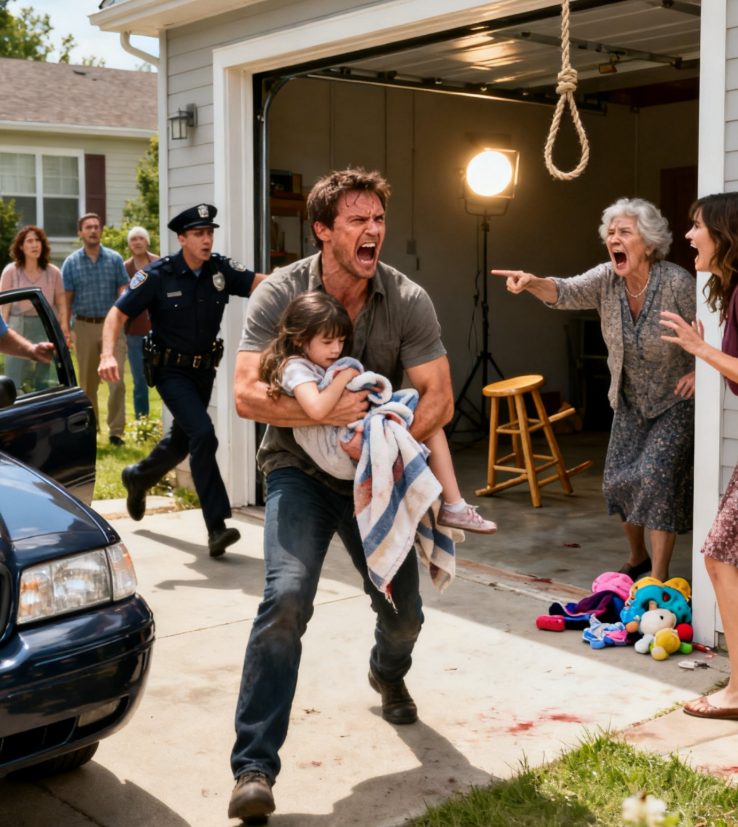
Emma stood on a wooden stool in the center of the garage.
Her wrists were bound above her head, tied to a rope looped over an exposed ceiling beam. Her pink unicorn pajamas hung loose on her trembling little body. Her bare feet gripped the stool like she was afraid the floor would disappear.
For one second, my mind refused to understand what my eyes were seeing.
Then she lifted her head.
“Daddy?” she whispered.
I crossed the garage in three strides, grabbed a utility knife from Willie’s workbench, and cut her down before the rage in me found language.
She collapsed into my arms.
I held her against my chest, feeling every shiver, every broken little breath.
“Who did this?” I asked.
Her lips were cracked. Her voice barely came out.
“Grandma said I lied.”
“About what, baby?”
“I said I wanted to go home.”
I carried her toward the door, but she grabbed my shirt with fingers that could barely close.
“Daddy,” she whispered. “Check her car.”
“What?”
“Grandma’s car. The trunk.”
Her eyes were huge and wet in the garage light.
“She put a metal box in there. I think it has pictures.”
Behind us, inside the dark house, a floorboard creaked.
### Part 3
I got Emma into my rental car first.
That was the only reason I did not tear the house apart with my bare hands.
She was shaking too hard to fasten her seat belt, so I did it for her, wrapping my coat around her shoulders. Her wrists were marked deep red where the plastic ties had bitten into her skin. I did not let myself stare. Staring would turn me into something useless.
“Lock the doors,” I told her. “If anyone comes out, hit the horn and keep hitting it.”
“Don’t go,” she whispered.
“I’m right there, peanut. I promise.”
The garage seemed colder when I stepped back inside.
Sue’s car was parked at an angle near the rear wall, a beige Buick with rosary beads hanging from the mirror. The same car she drove to church every Wednesday. The same car she used to pick Emma up from school when Maureen said she “needed help.”
The trunk button was inside the glove box.
I found it on the second try.
The trunk popped with a dull metallic click that sounded far too loud.
At first, I saw jumper cables, an old blanket, a folded lawn chair. Then I lifted the blanket and found the metal box.
Gray. Heavy. Scratched at the corners. A combination lock hung from the latch.
I did not know the code.
I did not care.
There was a pry bar on Willie’s workbench. I jammed it beneath the latch and put my weight into it until the lock snapped.
Inside were labeled memory cards, old USB drives, envelopes, folded papers, and stacks of photographs tucked inside clear sleeves.
I only looked at one.
One was enough.
It showed Emma younger than she was now, standing in this same garage, looking at the camera with a face I had mistaken for shyness too many times. Nothing in the image needed to be described. The truth of it landed like a hammer.
My daughter had not been visiting her grandparents.
She had been delivered.
Again and again.
The room tilted. My throat closed. Every decent thought left my body, and for a moment there was only a bright, clean image of what I could do to Willie and Sue before sunrise.
Then Emma honked once.
I slammed the lid shut and grabbed the box.
The door connecting the garage to the house flew open.
Willie Riggs stood there in pajama pants and an undershirt, his hair flattened on one side, his face swollen with sleep and rage.
“What the hell are you doing?”
Then he saw the box in my hand.
His expression changed.
Not anger anymore.
Fear.
“Put that down,” he said.
Sue appeared behind him, one hand pressed to her robe. Her eyes moved from me to the broken lock, then toward the driveway where Emma sat in my car.
“You had no right,” she said.
I laughed once. It did not sound like me.
“No right?”
Willie came at me fast for a man in his sixties. I turned sideways and let his momentum carry him past, then drove the metal box into his midsection. He folded, gasping, one knee hitting the concrete.
Sue made a small noise, almost offended.
“She needed discipline,” she said. “Maureen understood that.”
The name hit harder than Willie’s charge.
I looked at her.
“What did you just say?”
Sue’s mouth tightened.
“This is family business.”
I walked toward her, slow enough that she stepped back without realizing it.
“You tied my child to a ceiling beam.”
“She lied.”
“You photographed her.”
Sue glanced at the box, then away.
I knew then. Not everything. Not the whole shape of it. But enough to understand that whatever lived inside that house had been alive long before Emma was born.
Willie tried to stand.
“You don’t understand,” he wheezed. “Maureen was raised this way. She turned out fine.”
Fine.
Maureen flinching at raised voices. Maureen checking locks. Maureen forbidding Emma to have friends. Maureen handing our daughter over anyway.
Fine.
I backed toward the garage door, box under one arm.
“Stay away from my daughter,” I said. “Both of you.”
Willie wiped his mouth. “You go to the police, and we’ll say you planted it. You broke into our property. You attacked me.”
“You want to test that?” I asked.
Sue’s face sharpened. “Keith. Think carefully. Families can survive misunderstandings. They cannot survive public accusations.”
I opened the garage door and stepped into the cold.
“This family ended tonight.”
I drove straight to the emergency room. Emma leaned against the passenger window, wrapped in my coat, eyes half open but watching everything.
At a red light, she whispered, “Is Mommy mad?”
My hands tightened on the wheel.
I wanted to say no.
I wanted to give her one parent she did not have to fear.
But my phone started ringing before I could answer.
Maureen.
And when I saw her name on the screen, I knew the worst part of the night was not behind us.
It was calling me.
### Part 4
I did not answer Maureen until Emma was behind a hospital curtain and a nurse with tired eyes had gone completely still at the sight of her wrists.
The emergency room smelled like disinfectant, vending-machine coffee, and raincoats drying under fluorescent lights. Somewhere down the hall, a baby cried. A television in the waiting area murmured about weather delays at O’Hare.
Weather delays.
My whole life had split open because a plane broke down.
The nurse called a doctor. The doctor called another doctor. They photographed Emma’s injuries. They asked her soft questions in voices trained not to frighten children. Emma answered some and shut down for others, her eyes finding mine every few seconds like she was making sure I had not disappeared.
When they took her for scans and fluids, I stepped into the hallway and called Maureen back.
She answered before the first ring finished.
“What did you do?” she hissed.
Not, Is Emma okay?
Not, Where is my daughter?
What did you do?
I leaned against the cold wall.
“I found her.”
Silence.
“In your parents’ garage,” I said. “Tied to a beam.”
“That’s not—” Maureen stopped. Breathed. Started again. “Mom said Emma was being punished for acting out.”
“She was hanging from a ceiling beam.”
“She wasn’t hanging. They don’t—”
The correction came too fast.
My stomach dropped.
“They don’t what, Maureen?”
She started crying then, but quietly, like she had practice doing it without being heard.
“You don’t understand them.”
“No,” I said. “I understand enough. I found the metal box.”
All sound left the line.
In the space of that silence, I heard twelve years of marriage collapsing. Not with a crash. With a soft, final click.
“What was in it?” she whispered.
“You know.”
“I never looked.”
“But you knew.”
“I knew some things.”
“Some things?”
“My mother said it was controlled. She said if I refused, they would find ways to see Emma anyway. At least if I cooperated, I could make sure it didn’t get worse.”
I closed my eyes.
The hallway seemed to bend around me.
“You gave them access to our child.”
“I was scared.”
“So was Emma.”
“I was their child too.”
That stopped me, but it did not soften me. It explained the wound. It did not excuse the weapon.
Maureen’s voice broke. “They did things to me, Keith. For years. They made me believe it was normal. Then they made me believe no one would ever believe me. When Emma was born, I thought I could keep her safe if I kept everything controlled.”
“You kept her isolated.”
“I was protecting her.”
“You were protecting their secret.”
She sobbed harder. “Please come home. We can handle this privately. Therapy. A plan. No police. If this goes public, Emma will be destroyed.”
That was when I understood Maureen’s fear.
She was not afraid of what happened to Emma.
She was afraid other people would know.
“No,” I said. “The hospital is reporting it. I’m reporting it. CPS is coming. Police too.”
“Keith, please.”
“I’m filing for divorce.”
Her breathing turned sharp. “You can’t take my daughter.”
“You lost the right to call her that when you delivered her to predators.”
I hung up before she could answer.
When I returned to Emma’s room, she was asleep with a hospital blanket tucked under her chin. Her wrists had been cleaned and wrapped. In the plastic chair beside the bed sat a woman in a navy blazer, hair pulled into a tight bun, notebook open on her lap.
“Mr. Rice?” she asked. “I’m Cheryl Dickerson with Child Protective Services.”
I nodded and sat down.
For the next hour, I told her everything except one thing.
I told her about the cancelled flight. The empty bed. Maureen’s lie. The garage. Emma’s condition. Sue’s car. The metal box.
But I did not hand over the box.
Not yet.
Cheryl listened without interrupting, but her pen moved faster and faster.
“Mr. Rice,” she said finally, “given the severity of these allegations, Emma cannot return to your marital home while we determine your wife’s involvement.”
“I know.”
“Do you have safe family?”
“My parents. Cincinnati. Retired. Stable. Emma loves them.”
“We’ll need to verify.”
“Do it.”
She studied me. “Where is the box now?”
“In my car.”
“I strongly recommend you turn it over to law enforcement immediately.”
“I will.”
Her eyes narrowed slightly. “Immediately means immediately.”
I looked through the glass at Emma, sleeping too still.
“Your system moves in steps,” I said. “Whoever made that box has had years of steps.”
Cheryl closed her notebook.
“Mr. Rice, do not make yourself the problem.”
I looked back at her.
“Too late,” I said quietly.
Because inside that metal box were labels, dates, initials, and names I did not recognize.
And one of those initials might have belonged to a child who had not been found yet.
### Part 5
By noon, Emma was discharged into my care with instructions I barely heard and paperwork I signed without reading twice.
CPS approved my parents as a temporary placement faster than I thought possible. My mother, Janet, answered the phone already crying. My father, Phillip, got on the line after her and said only, “Bring her here.”
Related posts


