No place card.
Just a bare table with an empty chair, as if someone had remembered at the last minute that Brooke had a sister and hurriedly made a note: “Stick her somewhere. Anywhere.”
I stood there, absorbing the sight, the hum of wedding prep buzzing around me. It could have been a mistake. An oversight. A temporary glitch.
My instincts told me it wasn’t.
A server passed by, arms full of folded napkins.
“Excuse me,” I said softly. “Is there a delay setting this table?”
She paused, glanced at the chart in her folder, then back at the table. Her brow creased.
“Oh,” she murmured. “Um… I was told this one is self-managed.”
“In a fully catered ballroom?” I asked.
She flushed, shifting the napkins from one arm to the other. “I’m really sorry. I’m just following the instructions we were given.”
I almost felt bad for her. She was the messenger, not the architect.
“It’s okay,” I said. “Thank you.”
She hurried away, leaving me alone with an empty table and the knowledge that this was not an accident.
Back in my hotel room that evening, I sat on the edge of the bed, my navy dress draped across the chair, shoes lined up neatly beneath it. The ocean murmured beyond the window, a constant, soft shushing.
I traced the day back in my mind—Brooke’s brittle laugh, Lucas’s calculating glances, my parents’ distracted indifference. The un-set table. The phrase “self-managed.”
This wasn’t just about saving money on one plate of food. It was a message.
You don’t belong here.
You don’t deserve what everyone else gets.
You are an afterthought at your own family’s celebration.
I lay back on the bed, staring up at the ceiling, and let the familiar numbness wash over me—not the absence of feeling, but the necessary muting of it. The way you shut windows in a house when a storm is coming and you know you can’t stop it.
I did not cry.
I had run out of tears for this family years ago.
Instead, I thought about the numbers I’d seen in my parents’ bills, the quiet transfers I’d made to keep certain due notices from turning red, the late-night emails from clients thanking me for catching things no one else had spotted.
I thought about how my family could so easily hold both truths in their heads at once: that I was convenient when money was tight, and inconvenient when image was at stake.
Somewhere between those thoughts, I fell asleep.
The morning of the wedding, I woke to a sky that looked deceptively soft—blue, streaked with thin clouds, sunlight glittering off the ocean like scattered coins.
Everything smelled like perfume and nerves.
Guests drifted through the hallway outside my room in dresses and suits, laughing, adjusting ties and necklaces, practicing smiles in their phone cameras.
I put on my dress.
It slid over my skin like a second, steadier layer. I zipped it up, smoothed the fabric, stared at myself in the mirror.
Dark hair pulled back neatly. Simple stud earrings. Bare face, save for some mascara and a swipe of tinted balm. Nothing flashy. Nothing that would draw the eye, for better or worse.
For a moment, I tried to imagine the day going differently. Brooke deciding to sit next to me for five minutes. My parents insisting I join their table. A small, quiet acknowledgment of my presence as part of the story, not just a blurry figure in the background.
The image wouldn’t hold.
So I let it go.
I walked to the ballroom alone.
Inside, everything shimmered.
The chandeliers. The mirrored surfaces. The sequins on dresses and subtle sheen of polished shoes. A string quartet played something round and romantic. Voices rose and fell in waves.
I found my table again.
Still bare. Still tucked away. Still pointedly different from every other table.
People were already taking their seats elsewhere. Waiters circulated with trays of champagne and hors d’oeuvres. Water glasses clinked as they were filled. Bread baskets landed with soft thumps.
No one came to my corner.
I sat, folding my hands in my lap, back against the cool wall. The music swelled for the ceremony. Brooke appeared at the far end of the aisle, dress blindingly white, veil floating behind her like a captured cloud.
She looked…happy. Or at least very good at performing happiness.
Lucas stood at the front, jaw clenched just enough to betray tension, shoulders squared like a man about to walk into a board meeting instead of a marriage.
They exchanged vows that sounded more like co-authored social media posts than promises. Words about “adventures” and “building an empire together” and “supporting each other’s dreams.” The guests dabbed at their eyes. My parents held hands.
When they kissed, everyone cheered.
I clapped, too. Not from joy. From some numb, automatic place that had been trained over years of attending events where my role was to show up, behave, and not interfere.
After the ceremony, the guests spilled back into the reception hall. The quartet shifted to something upbeat. Champagne flowed. Plates filled.
I remained seated at my lonely table.
For a while, I watched. The laughter. The toasts. The way people angled their bodies toward Brooke, as if drawn by gravity.
Then she saw me.
Her expression shifted almost imperceptibly—delight sliding into irritation, like she’d spotted a stain on a favorite dress.
She excused herself from a cluster of bridesmaids and glided toward me.
Perfume preceded her again. That same expensive floral scent that made my eyes water if I stood too close.
She leaned down, hands smoothing over the perfect fabric at her hips.
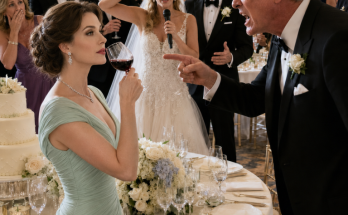
“You do know there’s no meal for you, right?” she said, voice syrupy sweet.
“I’d noticed,” I replied, keeping my tone neutral. “Your staff called it a ‘self-managed’ table. Interesting concept.”
Her smile sharpened. “Honestly, Maddie, what did you expect? You barely participate in this family. You never bring anyone. You sulk in corners. Why waste money on a full dinner for someone who…doesn’t really engage?”
There it was.
The translation of freeloaders into my face.
The people closest to us had gone quiet, tuning in. Conversations at nearby tables dimmed, attention narrowing.
“You think I don’t engage,” I said slowly, “because I don’t perform the way you do.”
“Oh, please,” she scoffed. “This is my wedding. The least you could do is not make things about you.”
My heart pounded. My fingers dug into the edge of my chair.
“I’m not the one who assigned herself a full banquet,” I said, “and her sister an empty table.”
She tilted her head, studying me like an annoyance.
“You can leave the gift and go,” she said, voice dropping. “Really. No one will mind.”
For a split second, something inside me cracked.
Then something else slid into place.
I looked past her—to my parents, standing just within earshot. My mother finding profound interest in the floral arrangement in front of her. My father taking a slow sip of wine.
“Mom?” I called lightly. “Dad?”
They glanced over, already irritated by the interruption.
“Brooke’s telling me to go home,” I said. “Any thoughts on that?”
My mother’s fingers tightened around her clutch. “Don’t start, Madison,” she murmured. “Not today.”
My father shrugged, eyes skittering away. “If you’re going to cause trouble,” he muttered, “maybe you should go.”
There it was.
The final confirmation that, in the hierarchy of this family, I ranked somewhere below fresh flowers and plated salmon.
The hurt sliced through me—but beneath it, underneath the humiliation and heat and tightness in my chest, something else rose.
Clarity.
I stood, my chair scraping back. The sound sliced through the murmured conversations nearby. A fork clinked onto a plate. Someone coughed.
“Okay,” I said. “I’ll go.”
My voice didn’t shake.
Brooke’s smile widened, triumphant. She thought this was the victory. The moment she finally, publicly, pushed me out of the frame.
I smoothed my dress, feeling the fabric anchor me.
“But before I do,” I added, “I want you to understand something.”
The room held its breath.
“You will regret this,” I said quietly, looking at my parents, at Brooke, at the man standing beside her with his hand on the back of her chair.
“Maybe not today. Maybe not tomorrow. But you will.”
The words didn’t come from a place of spite. They came from the same place every one of my warnings did—a cold, clear certainty that patterns have consequences.
For a moment, everything was silent.
Then a chair scraped from somewhere near the front.
I turned.
A tall man in a slate-gray suit had risen from his seat. Dark hair, slightly mussed. Strong jaw. Eyes sharper and calmer than the rest of the room.
“I care,” he said.
His voice cut through the noise like a clean line.
Heads swiveled.
Brooke blinked. “I’m sorry, who are you?”