Freeloaders.
The word sat there, black on white, like a tiny bomb.
I stared at it for a long time, feeling the familiar cold creep over my skin. The list of invitees was attached; every cousin had either a partner or a spouse. Every aunt and uncle was bringing someone.
I was the only one attending alone.
No plus-one to approve. No second name next to mine.
Which meant we all knew exactly who that line was meant for.
I could have replied. Could have sent a carefully worded email reminding them how many times my “freeloading” had paid for things that magically never made it into the family narrative.
Instead, I closed my laptop and went back to work.
Silence disarms people more than arguments do. They expect a reaction. When it doesn’t come, they underestimate the damage they’ve done.
My mother, unsurprisingly, couldn’t leave it entirely alone.
A few nights later, over dinner, she cleared her throat.
“You won’t make a scene at the wedding, right?” she asked, not looking directly at me as she ladled mashed potatoes onto Brooke’s plate.
I set my fork down. “What kind of scene would I make?”
“You know how you get,” she said vaguely, waving her hand in my direction. “With your…feelings. Your moods. I just don’t want any drama.”
“I’m not the one writing about freeloaders in group emails,” I said evenly.
Brooke, seated at the head of the table, smirked. “It wasn’t about you,” she said. “You’re so self-centered sometimes.”
There it was again—that deep, almost comical disconnect between how they saw me and who I actually was. Me, self-centered, when I spent most of my life trying to take up as little emotional space as possible.
I stabbed a piece of broccoli. “I’ll behave,” I said dryly. “Wouldn’t want to ruin your optics.”
Brooke rolled her eyes. My mother sighed. My father reached for the gravy boat and pretended everything was fine.
The ground shifted underneath us.
We all pretended not to feel it.
The wedding preparation became its own ecosystem of tension.
There was the dress fitting, where my role was clearly “supporting character.” Brooke stood on a pedestal in a mermaid gown that hugged her torso before flaring out at the knees. My mother cried actual tears when she stepped out of the dressing room.
“Oh, Brooke,” she whispered. “You’re breathtaking.”
I stood off to the side, a box of pins in my hands, watching Brooke turn in front of the mirror. The seamstress circled her like a planet orbiting a star, poking and adjusting.
When the door opened and Lucas walked in, the first thing he did was reach for the tag inside the dress to check the brand and—more importantly—the price.
My father laughed from his armchair in the corner. “Smart man,” he joked. “You’ll want to know what you’re getting into.”
Everyone chuckled.
I watched Lucas’s face instead of the dress. The flicker of calculation. The way he squeezed Brooke’s waist just a fraction too tight when she asked for his opinion. How his gaze lingered not on her, but on the seam where the fabric pulled slightly—on imperfections, not beauty.
When she asked me, “Well? What do you think?” I answered automatically.
“It’s beautiful.”
She frowned. “You said that too fast.”
“What do you want me to say?” I asked, genuinely confused.
She tossed her hair. “I don’t know. Something more…specific. You never try, Madison. You just sit there. It’s weird.”
That’s when I felt it—the subtle shift that told me I wasn’t just an afterthought in this production. I was a prop. A foil to make her shine brighter by comparison.
The week of the wedding, the house felt like a champagne bottle someone had shaken but not opened yet. My mother snapped at everyone over nothing. My father stalked around with lists and charts he hadn’t actually created, double-checking seating arrangements as if the fate of the world hinged on who sat near the cake.
Brooke floated through the chaos like a glittering storm, leaving fragments of anxiety and demands wherever she went. “Did you confirm the florist? Did you remind Aunt Claire about her dress? Do not let Madison wear anything weird.”
“Define weird,” I muttered once.
She didn’t laugh.
I’d chosen my dress carefully—navy, simple, tailored enough to feel like it belonged in a ballroom but plain enough that no one could accuse me of trying to draw attention. When I put it on the morning we left for Savannah, I felt strangely calm. Like I was armoring up.
In the car, as we drove down the highway toward the coast, I watched Brooke scroll through messages on her phone, thumbs flying. My parents discussed timelines and photo ops. The sky outside was an uninterrupted blue, the trees a blur of green.
Somewhere between Charleston and Savannah, that cold, hollow feeling settled into my chest again. The same one I’d felt at eleven when Victor sat at our table, when the substitute coach patrolled the locker room, when Lucas first shook my hand and talked about “taking over the company soon.”
This time, I didn’t say anything.
Experience had taught me what happened when I did.
They didn’t see the cracks until the whole thing broke.
And this thing…it was already starting to fracture.
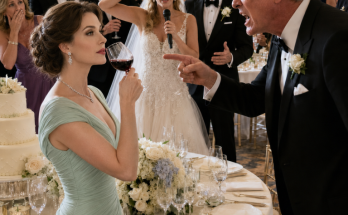
The venue was exactly the kind of place that exists for photo albums and Instagram posts. A coastal hotel property with white stone balconies, floor-to-ceiling windows, and glass railings overlooking the ocean.
Everyone kept saying the weather was perfect.
To me, the air felt too still.
The kind of stillness you get right before a storm hits.
I arrived earlier than my family by choice. I wanted a minute to breathe before stepping into the performance. The lobby buzzed with guests in pastel dresses and sharp suits, voices overlapping in a pleasant hum. I caught snippets of conversation as I moved through the room.
“She’s always been so accomplished, that girl.”
“Lucas’s family is loaded, you know.”
“It’s about time, isn’t it? Brooke’s always been the golden one.”
I slipped past them like a ghost. Visible, technically, but unregistered.
When my parents arrived, they gave me a nod, then hurried off to find Brooke and assist with whatever last-minute crisis needed managing—a crooked flower arrangement, a missing boutonniere, a shade of lipstick deemed insufficiently bridal.
I stayed near a marble pillar, its coolness seeping through the back of my dress. And that’s when they swept through the lobby.
Brooke, veil cascading down her back, hair twisted into some impossibly intricate updo, dress fitted to perfection. Lucas behind her in a suit that probably cost more than my rent, hand in his pocket, expression practiced.
She looked…stunning. Not just beautiful, but fully aware that she was the axis around which this entire weekend spun. Her smile was bright and wide and brittle at the edges.
He glanced at me once. Our eyes met for a fraction of a second.
The look he gave me wasn’t annoyed. It wasn’t smug.
It was wary.
Recognition. Not of who I was, but of what I represented—a mind in the room he couldn’t fully predict or charm.
He broke eye contact almost instantly.
I considered, briefly, warning her again. Pulling her aside, saying, Brooke, something is wrong. Brooke, please. Brooke, listen.
But what could I say that hadn’t already been laughed off?
What do you tell someone who has already decided your perspective is a defect rather than a difference?
I let it go.
Or rather, I held it close and quiet, like a secret I was tired of offering to people who kept dropping it.
During the rehearsal walkthrough, the cracks widened.
Brooke snapped at the coordinator because the candles down the aisle weren’t perfectly symmetrical. “Who put that one half an inch closer to the end? This is my wedding, not a student project.”
Lucas blamed a groomsman for messing up the timing of the processional, even though he was the one who’d missed his cue. “We went over this, man,” he said, jaw tight. “It’s not that complicated.”
My parents hovered nearby, smiling their strained, photo-ready smiles, too invested in the image to acknowledge the sharp edges.
While everyone lined up to practice the entrance again, I wandered toward the reception hall. Curiosity dragged me, but something else did too—the need to know where I fit in their carefully constructed seating chart.
The room was beautiful, I’ll give them that.
Round tables draped in heavy linens, each one crowned with towering arrangements of roses and eucalyptus. Gold-rimmed plates. Crystal glasses glinting in the light. Place cards written in elegant looping script.
I walked the perimeter, scanning for my name. There it was, according to the chart posted near the door: Table 12.
I found it.
Near the back. Tucked against a wall. Partially concealed behind a thick marble pillar. From that spot, it would be nearly impossible to see the head table without craning your neck.
No centerpiece.
No water pitchers.