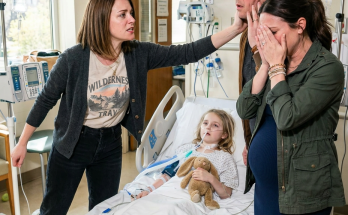
The eruption behind me was louder this time.
My aunt—the one who’d spent the last decade playing Walter’s unofficial PR manager at family gatherings—let out a strangled sound that was half gasp, half sob.
One of my cousins muttered something that sounded suspiciously like, “Holy shit.”
Walter’s mouth opened, then closed. For a second, I thought he might actually pass out. His eyes darted toward Steven, who was now fully pale, his tapping pen stilled at last.
He knew.
He knew this was bad.
He knew that if what I’d presented held up—and he could already see that it did—this wasn’t a messy family squabble.
This was a criminal case.
“But why?” the judge asked, her voice slicing through the chaos as she held up a hand for silence. “If you knew this was happening, Ms. Rati, why didn’t you do something sooner? Why not freeze the account when the first unauthorized transfer occurred? Why let him take almost a million dollars?”
She was no longer just a probate judge in that moment. She was a person who’d seen enough bitterness and revenge in families to know that sometimes the solution caused more damage than the problem.
This was the pivot point.
The moment my entire plan hinged on.
“Because of the law, Your Honor,” I said quietly. “And because of patterns.”
I turned slightly, not for my relatives, not for Walter, but for the invisible people beyond those walls. The ones who might one day sit where I sat and wonder if they were crazy for not reacting the way everyone thought they should.
“If I had stopped him at fifty thousand,” I said, “this would have been a civil matter. A family dispute. He would have hired a different lawyer, spun a different story. Maybe he would have gotten probation. Maybe a fine. But he would have been back in my life in six months, sitting in the same house, at the same desk, figuring out a smarter way to steal.”
Walter flinched, the accuracy hitting something raw.
“I needed him to cross a threshold,” I continued, my voice steady. “I needed to turn a pattern of theft into something… structurally different. So yes. I disabled the security alerts. I left the door unlocked. I watched.”
I leaned forward, placing my hands on the counsel table.
“And I waited until the total amount stolen exceeded five hundred thousand dollars and the transfers crossed state lines, passing through multiple institutions. That pattern creates the groundwork for an interstate wire fraud case that qualifies under RICO.”
I didn’t have to spell out the rest. The judge knew the mandatory minimums. She knew the implications.
“The mandatory minimum sentence,” I added anyway, for Walter’s benefit, “is ten years in federal prison. No parole. No probation.”
Walter slumped back into his chair like the strings holding him up had been cut. The swagger drained out of him. He was just… a man again. A scared one.
He looked, for the first time in my adult life, small.
He understood now.
He hadn’t been robbing a poorly guarded vault.
He’d been robbing a trap.
“I didn’t lose seven hundred and fifty thousand dollars, Dad,” I said, letting the word fall between us like something we both knew had been dead for a long time. “I spent it. That was the price of your prison sentence. And honestly?”
I shrugged.
“It was a bargain.”
Cornered animal, I reminded myself as I watched him.
A rat is most dangerous when it knows there’s nowhere left to run.
He wiped his forehead with a shaking hand, leaving a damp smear across his temple, and reached into his briefcase. His fingers closed around a single sheet of paper, yellowed slightly at the edges, worn from being handled too often.
He straightened.
“She’s lying,” he said, his voice suddenly finding a second wind. “She authorized every transfer. She just forgot.”
He held the paper up with a little flourish.
He handed it to the bailiff, who walked it up to the bench.
I didn’t even need to see the front of the document to know what it was.
“This,” Walter said, turning to face the gallery again, his confidence gathering like a returning tide, “is a power of attorney. Signed and notarized two years ago. It grants me full control over that specific trust account for the purpose of managing family investments. She signed it right after her grandmother died. She was overwhelmed. She couldn’t handle the finances. She asked me to help.”
He looked at me then, triumphant. “She just doesn’t remember.”
Judge Morrison examined the document. Her gaze lingered on the signature.
“The signature does appear authentic,” she said slowly.
“It is authentic,” Walter said quickly, pouncing on the inch and trying to stretch it into a mile. “She admits the account was losing money. She admits she was overwhelmed. She knows she signed it. She just can’t recall the specifics. My daughter is not malicious, Your Honor. She’s confused. She’s dissociating. These paranoid RICO fantasies—”
He gestured toward my blue folder with a disdainful flick of his wrist.
“—are coping mechanisms. She is mentally unwell. That’s why we’re here. To protect her.”
The room shifted again, like the tide pulled in the opposite direction.
My cousins exchanged glances.
Maybe he had a point, their silence said.
Maybe she is confused.
Even Steven looked mildly hopeful, which was impressive given the amount of sweat on his forehead. A valid power of attorney, properly executed, changed the complexion of things. If I’d legally given him control over the account, then technically he hadn’t stolen anything.
He’d just… mismanaged it.
Badly.
But bad management, even criminally bad, wasn’t the same as theft without authorization.
If that document held, my carefully laid RICO case got a lot messier.
“Ms. Rati,” Judge Morrison said. “Is this your signature?”
I looked at it briefly as the judge held it up.
The looping R. The slant of the T.
It was my hand.
I remembered the day I’d signed it as if someone had turned up the brightness on that moment in my mind. The smell of lilies at the funeral. The weight of grief pressing on my chest like a physical thing. My father’s voice, soft, almost gentle for once, as he slid a stack of forms toward me.
“Just sign where the sticky notes are, honey,” he’d said, his tone honeyed. “These are all just formalities. Bank stuff. Estate stuff. You don’t want to deal with all this right now. Let me take that burden off you.”