
- “You made it,” she said, her tone sugared but thin. “Traffic from Lakewood is awful tonight.”
- “Cara?” He sounded surprised. “Everything alright?”
- And that was how Christmas ended.
- Sometimes the worst places become the ones where everything actually begins.
- My chest tightened painfully.
- I swallowed hard. None of it surprised me, but seeing the words still stung.
- “Mom,” she said. “You’re just in time. I’m working on my project.”
- “Did I do something bad?”
- “Easier for everyone.”
- “Grandpa, why am I not good enough?”
- “Reporters,” James said, and the word felt heavy in the air even without his voice carrying it.
- In the middle of it all, my phone buzzed in my pocket. I pulled it out and saw a name that made my throat tighten for a different reason.
- I stared at the name for a second, frozen. My fingers felt numb as the phone buzzed insistently in my hand. James leaned toward me.
- My blood ran cold. I swallowed hard.
- My throat tightened.
- I took a breath that settled deep in my chest.
- “Not yet. There’s something else.”
- “I have never signed anything like that,” I told the agent.
The Christmas Eve when everything finally broke open in my family did not begin with anger. It started the way quiet disasters often do, with soft music, warm lights, and a hope I should have let die a long time ago.
Snow was falling in slow, heavy flakes as I helped my seven-year-old daughter, Lily, out of our truck and onto my parents’ front steps in Evergreen. The mountain air stung my cheeks, sharp enough to wake me from every comforting lie I had told myself on the drive up from Lakewood. I kept telling Lily that family is supposed to be together on Christmas, even if I wasn’t sure I believed it anymore.
We stepped onto the porch, the soft crunch of snow under our boots. Through the windows, I could already hear laughter and the clinking of glasses. My parents knew how to host a gathering. They always had. They were experts at creating the illusion of a loving family, even as they treated me like a shadow they wished would disappear.
Somewhere in the middle of that walk to the front door, I found myself thinking about all of you who listen to stories like mine. If you’re here with me now, I would honestly love to know what you are doing while you listen. It helps me picture the people who share these moments with me, especially on stories as heavy as this one.
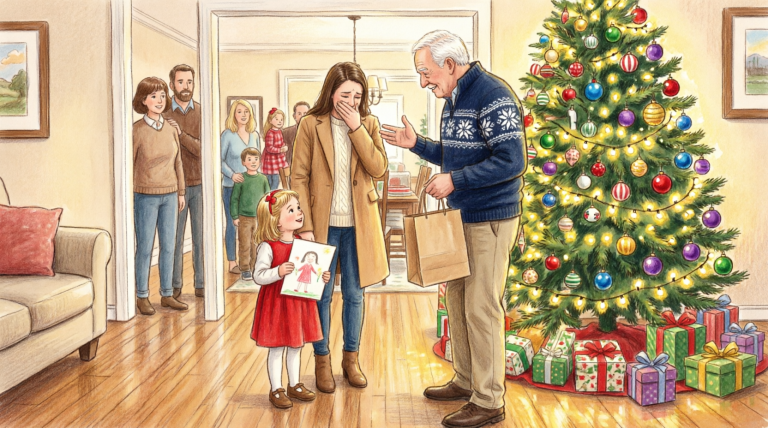
I pushed open the door without knocking. That was the rule for holidays, no matter how strained things were. The warmth hit us instantly, along with the smell of honey-baked ham and pine. Kids ran through the foyer in matching sweaters. Aunts clustered near the kitchen island, topping off glasses of wine. The speakers were playing an old Bing Crosby album, gentle and nostalgic.
My mom appeared from the dining room, smiling in that bright, deliberate way she did when she wanted everyone to think she was gracious. Her blond hair was perfectly curled, sweater pressed, lipstick flawless. She looked at me once, then at Lily a second longer, just long enough for me to see her expression flicker into something tighter, smaller, colder.
“You made it,” she said, her tone sugared but thin. “Traffic from Lakewood is awful tonight.”
“It was fine.”
I helped Lily slip out of her coat. She murmured a soft hello, and my mom responded with a nod, then turned away before the greeting even finished leaving my daughter’s lips. It was so quick and practiced that Lily hardly noticed, but I did. I always did.
We moved into the great room where the main event of the evening was unfolding. My dad stood near the enormous Christmas tree, a drink in one hand and a large black trash bag in the other. He was surrounded by children, at least three dozen of them from various cousins and relatives. The tree lights glowed gold, reflecting off shiny ornaments and the proud grin on his face. That grin said he knew exactly how important he looked right now.
“Alright, kids,” he boomed. “Who’s ready for presents?”
Squeals filled the room.
One by one, he pulled gifts from the bag, each wrapped in bright red or silver paper. He called out names with theatrical delight, tossing jokes over his shoulder to the adults, who drank it in like they always did.
“A brand new doll for sweet Harper. A science kit for little Jack. A big stuffed reindeer for Emma. Look at all my wonderful grandchildren.”
He soaked in their cheers as if they were proof that he was the greatest father and grandfather in all of Colorado.
Lily tightened her grip on my hand. Her eyes were wide, hopeful. She loved Christmas more than anything. She had made a small drawing for my parents—a family portrait with crooked little smiles—tucked safely in my purse. She didn’t care about fancy gifts. She just wanted to belong.
I watched the way my brother, Noah, stood off to the side, shoulders tense, his wife, Maria, looking at the floor. My younger sister, Laura, perched on the edge of the sofa, laughing too loudly at something her husband said, her eyes darting toward me and then away. Everyone pretended this was normal, this performance of a perfect family. But I had spent years learning to read the quiet shame hiding behind their faces.
My dad’s bag was nearly empty before he finally reached in again and pulled out the last gift, a small silver-wrapped box. The room softened into an expectant hush. Kids bounced on their toes. Lily inhaled sharply, her whole small body tightening with anticipation.
My dad turned, his gaze sweeping the room slowly, intentionally. When his eyes finally reached Lily, something inside me braced even before he opened his mouth.
“This one is not for you,” he said.
The words landed with a thud in the otherwise cheerful room. I felt Lily freeze beside me. My dad cleared his throat and spoke louder, making sure every adult in that room heard him clearly.
“Only good kids get presents. Your bastard child can get out.”
I didn’t hear the music anymore. I didn’t hear the laughter that suddenly stopped or the clink of someone setting a glass down too hard. I only heard the soft, wounded sound my daughter made as her face crumpled. She tried to swallow the sob, pressing her lips together the way she did when she was trying to be brave. But she was seven years old. The tears spilled out anyway.
My mom stood near the dining room doorway, arms crossed, watching like this scene was none of her business. Some relatives looked away. Some whispered. A few children stared at Lily with open curiosity. No one spoke up.
Something in me, something that had been stretched thin for years, finally snapped clean.
I crouched down, holding Lily by the shoulders, forcing myself not to look anywhere but at her—not at the man who had just humiliated her, not at the mother who had let it happen, not at the family who always stayed silent.
“We are leaving, sweetheart,” I said softly. “Right now.”
I stood up, lifted my chin, and spoke loud enough for the whole room to hear.
“Alright then. Goodbye.”
I didn’t yell. I didn’t cry. Every word was steady, controlled, like I had been waiting my whole life to finally say them.
No one stopped us as we walked out. A few relatives murmured, “Cara, wait,” or “I’m sure he didn’t mean it,” but none of them stepped forward. They stayed where they were, held in place by the tradition of pretending things were fine.
Outside, the cold air wrapped around us. Lily sobbed into my coat, her little hands clutching the fabric. I kissed her hair, rocking her gently, whispering, “It’s okay,” even though it was not okay at all.
I should have driven away. I should have just taken her home and shut the door on all of it forever. But another thought rose inside me, quiet and sharp. I had spent years building something of my own, something no one in that house had ever believed I could build. A business with crews, contracts, clients, and reputation. And sitting in my Denver office was a blueprint for a full home renovation for my parents, a project worth three point two million dollars, scheduled to begin in just a few weeks.
My gift to the parents who had never believed in me.
No more gifts.
Still holding Lily close, I reached for my phone with my free hand. My project manager answered on the second ring.
“Cara?” He sounded surprised. “Everything alright?”
I kept my eyes on the warm, glowing windows of the house behind me.
“Cancel the Evergreen renovation,” I said. “The full project. And I need someone here in fifteen minutes. Bring the cancellation paperwork.”
A pause. Then he exhaled.
“The entire thing is a three point two million dollar contract.”
“I know exactly what it is. Can you do it?”
“I can. I’ll send a supervisor right now.”
“Thank you.”
I hung up and breathed out slowly, feeling a strange calm settle in my chest. Lily lifted her head.
“Are we going home now, Mom?”
“Soon, sweetheart.” I brushed her hair back gently. “First, I have to give Grandpa his Christmas present.”
She didn’t understand, but she trusted me. She nodded and climbed into the backseat of the car, hugging her stuffed bear while I kept the heater running.
Fifteen minutes later, a white truck pulled into the driveway, headlights cutting through the falling snow. One of my site supervisors stepped out, clipboard tucked under his arm, breath puffing in the cold.
“You ready?” he asked quietly.
“I am.”
We walked back to the front door. I opened it without knocking. Conversations stopped mid-sentence. My mom stiffened. My dad glared like my very presence offended him.
I stepped fully inside and faced him.
“Before I leave, here is your gift tonight, Dad.”
My supervisor stepped beside me, clearing his throat.
“We need to confirm cancellation of the Evergreen renovation contract,” he said, “the full home improvement plan valued at approximately three point two million dollars. Do you, Cara Whitmore, formally cancel this contract?”
Silence fell so hard it felt physical. My dad went pale. My mom swayed where she stood. A few cousins gasped softly.
“Yes,” I said, never taking my eyes off my dad. “I confirm the cancellation.”
My supervisor nodded, had me sign, then closed his clipboard with a crisp snap. The room seemed to shrink around my parents, their faces stunned, their guests whispering behind their hands.
Without another word, I turned and walked out again, back into the cold, back toward my daughter waiting in the car. Behind me, I heard voices rising in confusion, panic, embarrassment. But ahead of me was the first clean breath I had taken in years.