I listened for footsteps outside my door, even though no one ever came back there unless they needed something carried, cleaned, fixed. The servants’ quarters smelled like bleach and old onions, and the walls were thin enough that I could hear laughter from the dining room—my family celebrating a future that didn’t include me.
I didn’t celebrate.
I strategized.
Because celebration is loud. It gets sloppy. It makes people talk. And the last thing I needed was my father’s calm voice turning from dismissive to interested.
I contacted the only person outside my family’s orbit: Noah Bennett, a lawyer in Seville who had once handled a minor inheritance matter for me.
“I need to disappear,” I told him. “Quietly. Without looking like I’m fleeing.”
Noah didn’t ask why. He just said, “Then we do it properly,” in the kind of tone that means the plan will be boring, legal, and devastatingly effective.
Two days later, dressed in a borrowed suit and steady confidence, I signed the contract for a €5 million mansion on the Costa Brava. The purchase wasn’t under my personal name but through a newly formed company structured with strict confidentiality protections Noah carefully arranged.
The real power wasn’t the marble floors or the ocean view. It was anonymity—the fact that money could become a curtain instead of a spotlight, if you knew how to hang it.
Then I left.
No farewell. No confrontation.
I walked out before sunrise with one suitcase and the posture of a man going to work, because people notice panic. They don’t notice routine. I passed the citrus trees, the iron gate, the fountain my mother loved to show guests, and I didn’t look back—not once—because looking back would’ve been permission for them to believe I’d return.
For the first time in years, the road felt open. Not because I was running from them, but because I was finally moving toward myself.
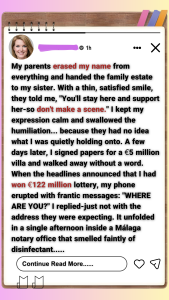
When the story hit the news—“Young Spanish Man Wins €122 Million Lottery”—my phone lit up nonstop. Missed calls. Panicked texts. “WHERE ARE YOU?”
My mother called first, voice suddenly soft, trembling with the kind of affection she only used for audiences. Darling, we need to talk. My father followed with a colder message: This is family business. Answer immediately. Sienna sent nothing at first—then, hours later, a single line: You did this to embarrass us.
I did respond.
But instead of sending my real location, I dropped a map pin to a nursing home in Seville.
It wasn’t cruelty. It was precision.
That nursing home was where my grandfather’s last months had disappeared—where my father promised to visit and never did, where my mother sent flowers twice a year like that was love, where Sienna once took a selfie in the lobby and wrote “Doing my duty” as a caption.
I wanted them to drive to a place that smelled like consequences.
While they rushed there—imagining me cornered, guilt-softened, ready to be collected—I was signing a second set of documents with Noah: instructions for a philanthropic foundation, a trust that locked my winnings behind rules my family couldn’t charm their way through, and a final clause that made me breathe easier than any ocean view ever could.
Because my father’s biggest weapon had always been control through proximity: keeping me close enough to use, far enough to deny. He thought “unauthorized occupant” was the end of my story.
But it was only the last page of theirs.
By the time my parents arrived at the nursing home and demanded to know where I was, the staff had no idea what they were talking about. There was no Ethan Callahan on the visitor logs. No meeting scheduled. No son waiting to be scolded into obedience.
Their rage made them louder than the quiet hallways could tolerate. Their entitlement made them ridiculous. And for the first time, they were the ones being asked to lower their voices.
That afternoon, I watched the sun sink into the Costa Brava from a terrace that belonged to my company—not my family. My phone kept buzzing on the table like a trapped insect. I didn’t pick it up.
Instead, I opened a message I’d drafted carefully, the way you handle anything dangerous: with gloves.
I sent it to all three of them—Graham, Evelyn, Sienna.
A single sentence.
You called me an unauthorized occupant. Consider this your official notice: I’m no longer occupying any space in your life.
Then I did something I’d never done at El Candado.
I turned my phone off.
And the silence that followed wasn’t loneliness.
It was freedom with sharp edges—the kind you earn.