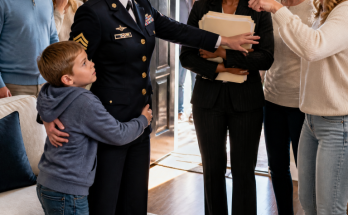
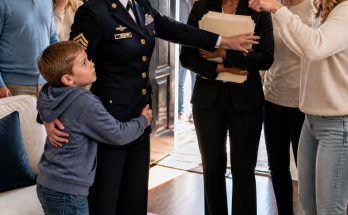
The rain came down in sheets, soaking through my thin coat as I stood at the foot of my son Mark’s driveway. In my trembling hands, I clutched a small, wrapped box—a silver locket with a photo of me and my granddaughter Lily inside. It was her sixth birthday, and I hadn’t seen her in two years.
Not since the day Mark and his wife Sarah decided I was too “toxic” to be around their children.
They didn’t know the truth about me. No one did. I was Margaret “Maggie” Collins, a 68-year-old retired schoolteacher, or so they believed. But I was also a self-made billionaire—the founder of a tech company I’d sold for $5 million decades ago, a fortune I’d quietly grown through careful investments. I’d kept my wealth secret for one reason: to teach my children the value of hard work and humility.
That plan had backfired spectacularly.
I pressed the doorbell, my heart hammering against my ribs. Through the frosted glass, I saw a shadow approach. The front door creaked open six inches, held by a brass chain.
“Mom, what are you doing here?” Mark’s voice was flat, emotionless. He was forty-two now, with gray streaks in his brown hair and lines of stress etched around his eyes. He wore a polo shirt and khakis—the uniform of his comfortable middle-class life, paid for by his job as a mid-level accountant.
“It’s Lily’s birthday,” I said, trying to keep my voice steady. “I just wanted to bring her this gift. Please, Mark. I haven’t seen her since she was four.”
“And whose fault is that?” He unlatched the chain, stepped onto the porch, and closed the door behind him. The rain dripped from the eaves onto his shoulders. “You brought this on yourself, Mom. All those years of picking, prodding, criticizing. Sarah and I agreed—for the sake of the children’s mental health, we needed distance.”
I wanted to scream. Yes, I’d been hard on them. I’d refused to co-sign loans, bail them out of credit card debt, or fund their lavish lifestyle. I’d watched them struggle, offering advice instead of handouts. I’d seen their resentment grow like a vine choking the life out of our relationship.
But I’d done it out of love. I’d wanted them to be strong, independent. Not entitled.
And all the while, I’d been living in a modest two-bedroom house in the suburbs of Cleveland, driving a twelve-year-old sedan, wearing clothes from JCPenney. I could have given them millions. But if they couldn’t appreciate what they had now, would they really be grateful for more?
“Just five minutes,” I pleaded. “Let me give Lily this present. I’ll leave right after.”
“No.” The word hit me like a physical slap. “You need to understand something, Mom. You aren’t welcome here. Not today, not ever. The children don’t ask about you, and that’s for the best.”
I opened my mouth to respond, but before I could, the front door swung open. Sarah stood there, her arms crossed, her face twisted in disgust. She was in her late thirties, blonde hair pulled into a severe ponytail, wearing yoga pants and a designer top. Around her neck hung a diamond pendant that must have cost five thousand dollars—a gift from Mark’s so-called “bonus” last year.
“Mark, I told you to get rid of her,” Sarah snapped. “Our daughter’s party is starting in an hour. I don’t want this negative energy here.”
My fingers tightened around the gift. “Sarah, please. I’m not negative. I’m just a grandmother who wants to see her granddaughter.”
“Oh, please.” Sarah rolled her eyes. “You’ve never been there for us. When we had the twins and nearly lost the house, where were you? Sitting on your pathetic savings account, pretending you’re some martyr.”
The twins. My other grandchildren, Ethan and Emma, Sarah’s children from a previous marriage. I’d always treated them as my own, bought them birthday gifts and Christmas presents. But after the estrangement, even they were cut off.
I took a deep breath. I was tired of being hated for sins I hadn’t committed. Tired of being seen as a villain when all I’d done was love them the best way I knew how.
“Sarah,” I said quietly. “I know about the charity.”
Her face went pale. For a moment, she looked like a deer caught in headlights. Then she laughed a sharp, brittle sound. “What are you talking about?
“The Helen Brooks Foundation,” I said. “The charity for underprivileged children that you’ve been running for the last three years. I’m a donor.”
It was true. After the estrangement, I’d kept tabs on them through a private investigator. I’d discovered that Sarah, using her position as director of a local nonprofit, had been embezzling funds. Over fifty thousand dollars in the past two years. She’d used the money to buy designer handbags, a new car, luxury vacations.
Sarah’s eyes narrowed. “You’re lying. You couldn’t donate to a charity. You barely have two dimes to rub together.”
“I don’t need to lie,” I said. “I have evidence. Bank records, business accounts, the works.”
Mark looked between us, his brow furrowed. “What is she talking about, Sarah?
“Nothing,” Sarah said quickly. “She’s making things up. She’s desperate to cause trouble.”
I reached into my coat pocket and pulled out my phone. I’d brought the digital copies of evidence with me, just in case. I scrolled to the first document and held it up. “I think you need to see this, Mark.
The screen showed a bank statement—Sarah’s personal account. A series of deposits from the foundation, each one labeled “operating expenses.” But I’d highlighted the real destinations: payments to Neiman Marcus, a travel agency, a local car dealership.
Mark took the phone, his hands shaking. He scrolled through the documents silently. When he looked up, his face was thunderous.
“Is this real, Sarah?” he asked, his voice dangerously low.
“Of course not!” Sarah grabbed for the phone, but Mark held it away. “She’s doctored them! I’m a good person, Mark! I’ve done nothing wrong!”
My heart ached for my son. He was caught in a storm not of his making, and I was about to blow his world apart. But Sarah had chosen her path, and she’d hurt people—not just the foundation’s beneficiaries, but our entire family.
“The Helen Brooks Foundation is my charity, Mark,” I said softly. “I know this is hard to hear, but it’s true. I set it up fifteen years ago under a trust, using the money from my business.”
Mark stared at me. “Your… business? You were a schoolteacher.”
“That was a cover. A choice,” I said. “I founded a tech startup in the early eighties. We invented networking software that became essential for small businesses. I sold the company in 1990 for $5 million. I invested wisely. For thirty years, I’ve been quietly building wealth, donating to causes I believed in. The Helen Brooks Foundation is my legacy.”
Sarah let out a bitter laugh. “This is absurd. You expect us to believe you’re some hidden billionaire? Now I know you’re losing your mind.”
I looked her in the eyes. “How do you think I got the evidence? A PI I hired because I wanted to understand why my son had turned against me. The money trail is clear. And I have copies stored with a lawyer.”
Sarah’s bravado cracked. Her hands trembled at her sides. “You… you’re lying. You spent your whole life pretending to be poor, and now you’re pretending to be rich? You’re just a sad old lady.”
“Maybe I am sad,” I said. “But I’m not lying. The fund that supported this house? That was from a trust I set up. The money for your children’s private school? Also from me. I never wanted you to know. I wanted you to succeed on your own. But Sarah, you’ve stolen from the most vulnerable, people I swore to protect.”
Mark’s face was a mask of pain and confusion. He turned to his wife. “Is she telling the truth? About the charity?”
Sarah’s silence was damning. She looked down at her manicured nails, refusing to meet his eyes.
“Answer me!” he shouted.
At that moment, a door inside the house opened. Little Lily appeared, wearing a party hat, her pink dress splattered by rain. “Daddy? Grammy?”
I gasped at the sight of her. She’d grown so much. Her hair was longer, her eyes wiser. She didn’t remember the happy times we’d shared—the baking sessions we had together, her making cookies with me, the day we planted daisies in her garden.
Her gaze fell on me. “Grammy!” she cried, and ran toward me. But she tripped over her own feet, stepping on a puddle, and momentum carried her into my arms. I dropped the gift and caught her, holding her tight.
She was crying now. “I miss you, Grammy. Daddy said you were busy, but I didn’t believe him.”
I couldn’t hold back my sobs. “I’ve missed you too, sweetheart. More than anything.”
But then Sarah screamed, pushing her daughter away from me. “Don’t touch her! You have no right!”
She snatched Lily’s hand, yanking her inside. The girl cried louder. “Mommy, stop! Grammy’s here! I want Grammy!”
“You’ll never have her again,” Sarah shouted, her voice breaking the peace of the neighborhood. A few neighbors emerged from their homes, curious.
Mark looked at the scene—his wife hysterical, his daughter wailing, his mother sobbing—and his face cracked. He grabbed my phone from my hand and held it up. “She’s right, isn’t she? You’ve been stealing.”
Sarah glared at him. “Don’t take her side! She’s alienating us! She’s always been against me!”
But Mark’s patience had run dry. “You turned me against my own mother because you wanted her to be the enemy. You made me believe she was a liar and a burden, but you were the liar all along.”
“You’ll regret this, Mark,” Sarah said, her voice dropping to a whisper that carried a threat. “I’ll take everything. The kids, the house, everything.”
“No, you won’t,” I said, wiping tears from my cheeks. “Because I’ve got the means to protect them. And now that this is out in the open, I’m going to make sure your children are safe. Mark, you’ll have lawyers. The best money can buy.”
Mark met my eyes, the first shred of respect I’d seen in years. “Mom… I’m so sorry. I didn’t know. I should have trusted you.”
Just then, a car pulled up to the curb. A sleek black sedan I recognized as belonging to my private attorney, Jameson, who I’d called earlier to be ready near the area, just in case. He got out with a folder in hand, approaching us.
“Mrs. Collins,” Jameson said, nodding. “Would you like me to serve the documents now?
I nodded. “Yes. Sarah, consider this formal notice that the board of the Helen Brooks Foundation is aware of the financial irregularities. You’re fired, and criminal charges will be pursued.”
Sarah’s face crumpled. She began to plead with Mark. “Honey, it was a mistake! I’ll pay it back! Please, you can’t do this to me!”
But Mark was done. He turned to me. “Mom, I don’t know how to make this right. But I want you to be part of my life again. The children’s lives. If you’ll let us.”
I hesitated. The anger I carried for years still throbbed beneath the surface, mixed with relief and sorrow. But my grandchildren needed me. And maybe, in time, my son and I could find common ground.
“Of course,” I said softly. “But first, we need to talk. Long overdue conversations. And from now on, I’m not hiding anymore.”
As Sarah screamed and neighbors watched, Lily broke free from her mother and ran back to me, hugging my leg. I lifted her up, holding her as if she were the most precious thing in the world—because she was.
Mark joined us, his arm around my shoulder. The rain began to let up, a sliver of sun cracking through the clouds.
I had lost two years with them, but I wouldn’t lose another moment. Sometimes, the most valuable treasure isn’t money—it’s family. And sometimes, the truth can set you free.