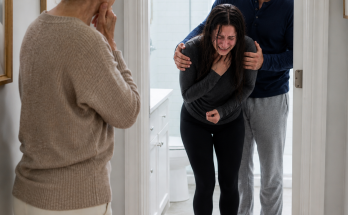
Dad called out my name, but I told him I had copies and so did Bennett.
Seraphina’s voice dropped low as she asked if I would dare, and I told her I already had.
The elevator doors opened and building security stepped closer as Mrs. Montgomery’s door clicked shut. My father looked through the peephole, and for one second, I saw the man who used to carry me through the hotel kitchen so the chefs could sneak me strawberry tarts, but then Seraphina touched his arm, and he looked away.
I told them to leave, and they did, but at 12:38 a.m., Bennett called me with a sharp, awake voice.
“Camille, Seraphina just filed an emergency petition claiming undue influence, financial incapacity, and trust fraud,” he reported.
I looked down the hallway, now empty except for the folder Seraphina had dropped near the elevator, and asked if she could win.
“No,” Bennett said. “But she can make noise.”
I walked to my window and looked across the downtown skyline where the Grand Sovereign sign glowed gold against the black sky.
“Let her,” I said. “Tomorrow morning, we make noise too.”
By 7:00 a.m., Seraphina had already made three mistakes, the first being that she believed loudness was the same thing as power. She sent an email to the entire hotel leadership team describing me as unstable, vindictive, and temporarily in possession of assets I did not understand, ordering the staff to ignore any instructions from me or my attorney.
Her second mistake was copying the hotel’s outside accountant, and her third was copying me. I was sitting in Bennett’s conference room when the email came through, surrounded by trust documents, payroll reports, and a fresh pot of coffee.
Bennett read the email over the top of his glasses and noted that it helped our case. Across from us sat Diane Walters, the interim operations consultant I had hired at 5:40 that morning, who was a practical woman well known in local hospitality circles for saving hotels from family disasters.
“She just gave us cause to bar her from administrative systems,” Diane said.
“Do it,” I replied, and Bennett nodded to his paralegal to freeze Seraphina’s credentials, Fletcher’s credentials, and my father’s discretionary authority pending review.
My phone buzzed with another call from Dad, but I let it ring.
Diane turned a page and said my employees were scared, and that was the first thing to fix, not Seraphina. I knew she was right, as the hotel had two hundred and six employees, including housekeepers who had worked there longer than Seraphina had been married to my father, and kitchen workers who still remembered my mother by her first name.
At 8:15, I joined a video call with the department heads where some faces were tense, some curious, and a few openly afraid.
“My name is Camille Robinson,” I said. “As of last night, ownership control of the Grand Sovereign and its land has transferred to the Laura Vance Trust.”
I told them payroll would be processed on schedule and existing benefits would remain in place, emphasizing that no employee should respond to instructions from Seraphina or Fletcher.
“Are we closing?” a banquet manager named Hector Ruiz asked.
“No,” I said firmly.
“Are people getting fired?” a housekeeping supervisor named Janice Bell leaned closer to her camera to ask.
“Not because of last night,” I said. “There will be a financial review, and if someone has stolen from the hotel, that is different.”
No one spoke until the executive chef, Malcolm Price, cleared his throat and mentioned that my mother used to come into his kitchen every Thanksgiving to check on the staff meal. I smiled despite myself as I confirmed she loved the pumpkin, pecan, and apple pies.
After the call, Bennett handed me a printed copy of Seraphina’s emergency petition, which was dramatic, careless, and filled with claims that my father had been coerced and my mother had been unstable.
“She forgot the part where she ordered security to remove you,” Diane said.
“No,” Bennett replied. “She included it and called it a reasonable safety response.”
I stared at the page, realizing that was Seraphina’s gift, as she could turn cruelty into policy if the font looked official enough. At 10:30, we filed our response, which included my mother’s medical competency records, signed statements from the estate planning team, and the complete trust terms.
By noon, the local business press had the story, not from us, but from Seraphina, who gave an interview outside the courthouse wearing oversized sunglasses and calling me a disturbed young woman weaponizing grief. She said she and my father were fighting to protect a beloved institution from reckless destruction, and the clip spread online quickly.
At 12:19, my father finally left a voicemail asking me to call him because he claimed Seraphina was handling things badly. I listened once, deleted it, and went back to thinking about my mother, which was exactly what had brought us to this point.
At 1:05, Diane and I entered the Grand Sovereign through the employee entrance, the one by the loading dock where the beige walls smelled faintly of citrus cleaner and coffee. Janice Bell was waiting there in her housekeeping uniform, and after studying my face, she pulled me into a brief, fierce hug.
“You look like Laura,” she said, and I almost lost control as I thanked her.
We spent the next four hours inside the hotel, and while Diane reviewed staffing schedules, I walked the property with Hector, Malcolm, Janice, and a maintenance chief named Owen Briggs. Owen showed me leaking valves, delayed elevator inspections, and a roof repair that had been postponed because Fletcher had redirected funds to brand development.
“What brand development?” I asked.
Owen shrugged and told me Fletcher wanted the staff gym turned into a cigar lounge, even though he didn’t even smoke cigars.
By 5:00, the pattern was obvious because Seraphina had not simply been spending; she had been hollowing out the hotel. There were fake vendor accounts, renovation deposits paid to shell companies, luxury floral invoices routed through a cousin’s boutique, and event commissions collected twice. My father’s signature appeared on some of these approvals, and even if not all of them, it was enough.
At 6:20, Dad arrived alone, and he looked smaller in the daylight with his suit wrinkled and his eyes red.
“Mara,” he said, but I corrected him and told him my name was Camille.
The front desk agents pretended not to listen while Diane left us standing beside the marble columns my mother had imported from Italy during the renovation. Dad put both hands in his pockets and said Seraphina hadn’t told him about Silverline.
“But you signed the payments,” I said.
“She said Fletcher was managing modernization,” he defended himself.
“And you didn’t ask what that meant?” I asked, and when he flinched, I didn’t soften my voice.
I reminded him that he had taught me to read every contract twice and never sign under pressure.
“I was lonely after your mother died,” he said, which wasn’t an excuse but the closest thing he had to one.