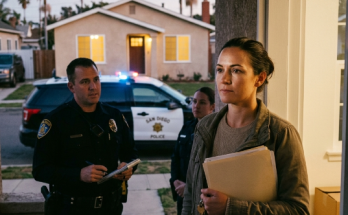
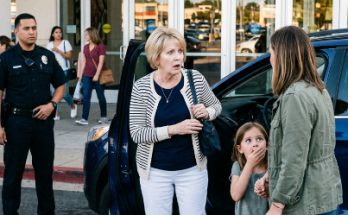
Mr. Hernandez stepped in front of her. “Ma’am, I need you to wait here, please.”
Mark arrived four minutes after that, still in his work shirt, moving fast. Lily slid off the counter and ran to him and that was when she finally cried, the delayed crying children do when the safe person arrives and they can finally stop holding it together. He held her for a long moment, then looked at me over the top of her head. I handed him my phone with the photos.
He turned to face his mother.
“Mom. Why is there a tracker sewn into Lily’s backpack?”
Diane did not answer the question. She crossed her arms and lifted her chin. “Hidden? That’s a bit dramatic. It’s a safety device. Children go missing every single day. I was protecting my granddaughter.”
“You put a tracker in my daughter’s bag without telling me,” I said. I kept my voice level because I wanted every word to land clearly.
“You work long hours,” she said. “You get distracted. I simply did what you should have done yourself.”
That sentence did something to the air in the room. Mark went very still.
I asked Mr. Hernandez to request a police officer. I wanted an official report. Not because I was trying to escalate the situation, but because I understood exactly what would happen if there was no documentation. By Sunday, this story would be a misunderstanding. By Monday, it would be my overreaction. By next week, I would be the daughter-in-law who made a scene at the mall over a grandmother’s love.
I was not going to let the story get rewritten.
While we waited for the officer, Mr. Hernandez reviewed footage from the hallway cameras and confirmed that no one had opened or touched the backpack anywhere in the mall. Lily had walked in with the device already inside it. It had been there when Diane handed her that backpack at dinner the night before.
The officer who responded was thorough and patient. He listened to everything, examined the photos, reviewed the Find My alert, and noted the timestamp on Diane’s message in the group chat. He explained, without editorializing, that secretly placing a tracking device on a person, including a child, without the knowledge of that child’s custodial parents raised serious legal concerns that varied by jurisdiction. He recommended we preserve the device, document all communications, and consult a family law attorney if we wanted to understand our options fully.
Diane tried to speak three times. Each time she began with some variation of “I’m her grandmother,” as if the title itself were an argument.
Then Lily spoke.
Her voice was clear and small, the way children sound when they are reporting a fact rather than telling a story.
“Grandma said not to show Mom the inside pocket because she sewed a surprise charm in there.”
Nobody said anything for a moment.
I watched Diane’s face in that silence. It moved through something complicated: not shame, not quite. Calculation. The recognition that a specific version of events had just become unavailable to her.
Mark looked at his mother for a long time. When he spoke, his voice was quieter than I had heard it in years, and quieter was worse than loud.
“You told my daughter to hide something from her mother.”
Diane looked at him. Then at me. Then she said, “I needed to know where she was. You don’t understand what it is to worry about someone.”
I almost laughed. Not from humor but from the sheer altitude of the absurdity. “You weren’t worried,” I said. “You were tracking us. There’s a difference.”
This was not the first boundary she had pushed in the last year. It was not the fifth. Over the previous six months there had been the afternoon she appeared at Lily’s gymnastics class without telling anyone she was coming, claiming she had simply wanted to watch. There had been the phone calls to Lily’s school inquiring about pickup schedules, which the school had mentioned to me in passing because they thought I knew. There had been the afternoon I was home sick and Diane let herself in with an old spare key to leave soup on the counter, and I had found her in my kitchen, and she had seemed genuinely puzzled by my reaction. Each time it happened, each time I brought it to Mark, we would talk about it and land in the same place: it’s just how she is. She means well. Let it go.
What I understand now, standing in that security office, was that “let it go” had been a policy of appeasement that had convinced Diane the rules did not apply to her. Every ignored boundary had been filed away as permission.
Before we left, I turned to Diane directly and said, simply and clearly, with Mark and Lily and two witnesses present: “You will not have unsupervised access to my daughter until I decide otherwise.”
Diane drew breath to respond.
Mark stood up beside me.
“No, Mom,” he said. “We’re done calling this normal.”
It was the first time in our marriage that I heard him use that particular voice with her. Flat and final, without the softening he usually added, the small verbal cushions that made his objections easy for her to dismiss. I did not cry. But it cost me something to stay composed in that moment, and I think it cost him more.
We drove home almost in silence. Lily fell asleep before we reached the highway, which is what she does when she has been frightened and is too exhausted to stay awake any longer.
That evening, Mark called the school from our kitchen table and had Diane removed from every list: pickup authorization, emergency contacts, approved visitors. I called our pediatrician’s office and asked them to add a password to Lily’s records. Mark found Diane’s old spare key in the junk drawer and left the house to have the locks changed, which took less than an hour, and when he came back he looked like a man who had put something down he had been carrying for a long time.
I stayed up late building a document. Not a diary, not a venting exercise. A clean timeline: dates, locations, descriptions, screenshots of messages, copies of photos, the incident report number from the mall. Every relevant event from the past six months, organized chronologically, with factual language only. No emotional commentary, no interpretation. Just what happened, when it happened, and who was present.
I had watched enough of Diane’s behavior to know that when people like her lose control of a situation, the first thing they reach for is the story. They reframe. They minimize. They redistribute blame. My document existed to make that harder.
She began exactly as I expected.
By Monday morning, Mark had received a text from his mother telling him I was unstable, that I was turning Lily against her family, that she had only used a safety device because I was overwhelmed and not managing things properly. She called Mark’s sister with a version of events in which I had made a humiliating public scene over a misunderstanding. I imagine there were other calls I did not hear about.