Arthur gave me the smile he used before every beating. “Be smart.”
“I was,” I said. “That’s why every word you said for three months is already with the police.”
His face emptied.
Eleanor stumbled backward. “You recorded us?”
Chloe sat up despite the nurse’s protest. “You taught us to be quiet, Mom. You never taught us to be helpless.”
Arthur’s lawyer stopped speaking.
By dawn, investigators had searched our house, his office, and a storage unit rented under Eleanor’s maiden name. They found forged signatures, sedatives, burner phones, and surveillance photographs of our trust attorney. They also found a draft life-insurance policy Arthur had tried to purchase on both of us.
He had not merely intended to steal our inheritance. According to messages recovered from his laptop, he planned to stage a fatal car accident after gaining guardianship.
The detective read the message aloud.
“Two girls, one brake failure, no questions.”
For the first time, Eleanor looked afraid of him.
Arthur turned on her instantly. “You wrote that.”
She screamed, “You promised they would only be declared unstable!”
Their alliance collapsed in less than a minute.
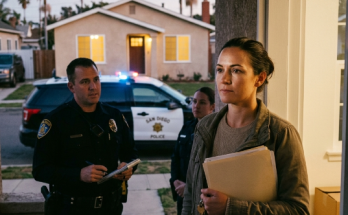
Detective Ross watched them accuse each other, then handcuffed both.
As Arthur was led away, he twisted toward me. “You think you won?”
I held Chloe’s hand.
“No,” I said. “I think you finally lost.”
PART 3
Three weeks later, Arthur entered the county courthouse. Their attorneys argued that the recordings were manipulated and that two traumatized teenagers had invented everything to gain early access to their trust.
They expected Chloe and me to collapse during the preliminary hearing.
Instead, we arrived with Dr. Hayes, Detective Ross, our trust attorney, and Uncle Julian. Julian had recused himself, but helped investigators trace Arthur’s shell companies.
He hugged us in the courthouse corridor. “I should have seen it.”
“You see it now,” I said. “Help us finish it.”
Arthur’s lawyer called me vindictive.
“Miss Finch, you secretly recorded your family for months. That is not normal behavior, is it?”
“No,” I answered. “Neither is needing evidence to survive dinner.”
The courtroom went silent.
A digital-forensics expert verified every file, timestamp, and automatic upload. Then our attorney displayed the forged guardianship petitions beside samples of Eleanor’s signature. Dr. Hayes explained that our injuries showed a repeated pattern, not one fall.
Eleanor began shaking.
Arthur leaned toward her. “Stay quiet.”
His microphone was live.
Everyone heard him.
Chloe testified next. Her voice trembled only once, when she described waking on the floor and believing I was dead. Then she faced our mother.
“You watched him hurt us because keeping him mattered more than keeping us alive.”
Eleanor sobbed. “I was afraid.”
“So were we,” Chloe replied. “We still chose each other.”
Arthur and Eleanor were denied bail.
Eleven months later, the criminal trial began. Prosecutors showed that Arthur had bribed a psychiatrist to prepare the incompetency reports and paid a mechanic to research brake failures. The mechanic had contacted police after seeing our names. Bank records linked Eleanor to the payments.
Arthur’s confidence finally cracked when the prosecutor displayed his message: “Two girls, one brake failure, no questions.”
He stood and shouted, “That money was supposed to be mine!”
The jury convicted him of aggravated assault, conspiracy to commit murder, forgery, financial exploitation, and witness intimidation. He received forty-eight years. Eleanor pleaded guilty to conspiracy, child endangerment, fraud, and obstruction. She received twelve.
At sentencing, she whispered, “I’m still your mother.”
I answered, “You were our first betrayal.”
The civil court seized their proceeds. Part funded a hospital program teaching emergency staff to recognize patterned abuse, with Dr. Hayes as director.
One year later, Chloe and I stood outside that emergency room beneath spring sunlight. We were eighteen, living with Uncle Julian, and attending college. Chloe studied nursing. I studied forensic accounting, like Dad.
“Do you still hear him in your dreams?” Chloe asked.
“Sometimes.”
“What do you do?”
I looked through the glass doors at doctors learning to notice what frightened patients could not say.
“I wake up,” I said. “And remember he can’t reach us.”
Behind prison walls, Arthur had nothing left to control. Eleanor sent letters we never opened.
Chloe and I walked toward campus together, no longer listening for keys in locks.
For the first time in our lives, silence did not mean danger.
It meant peace.