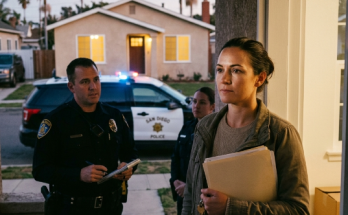
“I didn’t know anything about this.”
Another looked down.
A woman began to cry.
The party was over.
What remained was the truth.
When uniformed officers arrived, Mark tried every mask he had left. First, he spoke calmly, like a worried husband. Then he raised his voice. Then he insulted Emily. Finally, when the handcuffs locked around his wrists, he begged.
“Em, baby, tell them it wasn’t that serious. Tell them you’re confused. I love you.”
Emily walked into the kitchen barefoot, her cheek swollen, her yellow dress glowing in the late afternoon light. Her father tried to stop her, but she shook her head.
She stood in front of Mark.
For the first time in a long time, he did not look powerful.
He looked small.
A man trapped inside his own lies.
“You don’t love me,” Emily said. “You loved what you could take from me. My house. My money. My voice. My fear. But it’s over now.”
Mark cried.
Not because he was sorry.
Because he had lost control.
Diane was handcuffed next. She screamed that Emily was ungrateful, that she had destroyed the family, that a good wife endured things, that private matters should stay private.
Emily looked at her from the patio door.
“That was what helped you most, Diane. Keeping everything private. But my bruises were not private. My fake debts were not private. My fear was not private either.”
The neighbors were already outside. Some were recording. Others only watched in silence. The house Mark loved pretending he owned ended the evening surrounded by police cars and yellow tape.
The cake was never cut.
The candles slowly melted into the frosting.
That night, Emily did not sleep in her own bed.
She went home with her father to Columbus, back to the house where she had grown up. When she walked in, she saw a photo of her mother still hanging in the living room.
That was where she finally broke.
Right in front of the portrait.
In a way she had not allowed herself to break for months.
Robert held her without telling her to be strong.
He only said:
“I’m sorry I didn’t see it sooner.”
Emily cried against his chest.
“I didn’t want to see it either, Dad.”
The legal process was not fast.
Justice rarely arrives like it does in movies.
It came through files, hearings, expert evaluations, statements, and nights when Emily doubted herself.
But every time she wanted to give up, Claire reminded her of one simple thing:
“You don’t have to convince them you suffered. The evidence already speaks.”
And it did.
The recordings of Mark humiliating her.
The medical photos.
The bank records.
The forged signatures.
The neighbor’s security video.
The confession in the kitchen.
The insurance policy.
The envelope Diane tried to throw away.
Mark was placed in pretrial detention while the case moved forward. His company fired him after prosecutors requested financial records and discovered he had used fake accounts to hide gambling debts.
Diane lost her position at a savings cooperative. Her friends stopped visiting after the case became public in the neighborhood. The woman who always said, “There are no scandals in my family,” ended up walking into court with her face covered.
Eight months later, Emily finalized the divorce. She legally reclaimed her maiden name. She kept the house. She received compensation for the fraud. The protection order became permanent.
But the most important thing was not written in any document.
The most important thing was the first morning she woke up without being afraid of footsteps in the hallway.
On her next birthday, she did not throw a big party.
She invited her father, Claire, two friends, and the neighbor who had handed over the security footage without asking for anything.
She bought a lemon cake from a bakery in Brookside and played soft music while sunlight filled the kitchen.
There were no balloons.
No fake guests.
No nervous laughter.
Only peace.
When it was time to blow out the candle, Robert handed her a small box.
It was wrapped in the same blue paper from the year before, carefully saved.
Emily opened it.
Inside was her father’s watch.
“That day, I took it off because I needed it to record the truth,” Robert said. “Today, I’m giving it to you because you no longer need anyone else to measure the moment you leave.”
Emily fastened it around her wrist.
She felt its weight against her pulse.
Steady.
Real.
Hers.
She looked around her kitchen.
The same kitchen where they had humiliated her.
The same kitchen where they had tried to destroy her.
The same kitchen that now smelled like coffee, lemon, and freedom.
Then she smiled.
Not because she had forgotten.
But because she finally understood that surviving was not the same as staying silent.
Surviving could also mean collecting evidence with shaking hands, asking for help even when shame tried to stop you, stepping into the garden when everything seemed lost, and letting the truth walk straight through the front door.
That night, before bed, Emily turned off the lights without checking the locks three times.
And for the first time in years, her hands did not shake.